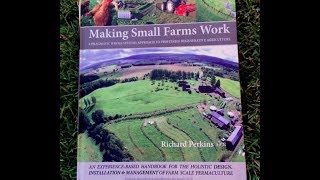
This content was created by Richard Perkins. This content was uploaded by Richard Perkins. This is a YouTube video titled "S4 ● E106 Making Small Farms Work" created on September 11, 2017, featuring Richard Perkins discussing his book on regenerative agriculture. The video includes a conversation between Richard Perkins and another speaker, along with Chef Ben, about the book's content, its practical approach to farming, and the personal process of self-publishing and distributing it. The book is aimed at individuals dedicated to small-scale regenerative agriculture.
Chapters
A lot of people have been writing about books now we have thousands of them.
Chef Ben, what have you made?
We got fruits of the forest soup, Asian style pig. Forest raised pigs? Yeah. Wonton. Homemade wontons with forest raised pigs.
It's homemade pasta.
Homemade pasta or everything. Everything's from here. The stock is made with the little, with the pig's bones. We've got shiitake grown on the logs here. We've got namiko grown from the logs here. Gerolls that is chanterelles, winter chanterelles and golden chanterelles from leeks from the garden. Leeks from the garden. Onion top from the garden. Garlic from the garden.
This everything is real ease.
Making small farms work is, as it.
Says on the COVID a pragmatic whole.
Systems approach to profitable regenerative agriculture. It's an experience based handbook and that's really what I wanted to put across. I've read a lot of books in this field and often there's a lot of theoretical things put forth by people that are inspiring a new generation of people to think differently. But what I wanted to do was write an experience based handbook of what we're actually doing, how we use holistic design, using keyline design, holistic management, permaculture design, to plan what we're actually up.
To before installing and then managing those.
Systems on the ground in a profitable, scalable, replicable way. And that's why I've dedicated my life's work to helping others getting started on the right foot. So I've got a lot of tons of books that have turned up to the farmstead. So I want to show you what's in the book.
So the book was co published by a lot of people whose names are in the front there from the Kickstarter campaign we ran. And it's divided into chapters. It's a very pragmatic book. My intention and aim is to write.
A book for people who are dedicating.
Their lives to going into farming, small holding, producing, you know, a business from their landscape. It starts with the context and introduction. You know, what is regenerative agriculture and thinking about climate and talking about our site specifics, etc. And then it starts talking about holistic management. One of our traits is integrating holistic management with keyline design as well as permaculture. So chapter two is all about clarifying your context and holistic management. What is holistic management in terms of decision making, creating your holistic context and then how to use that to test decisions as well as looking at site data Collection and finding an ideal property to start with. Then we go into maps and landform as well as looking at principles and attitudes for making it all work. Then chapter four is all about keyline design and gives some really good examples of how we're using that practically in the sort of typical landscapes we have. It's a big confusion with keyline design as most people have come across it either explained badly, poorly, inaccurately, or applied to landscapes that they can't relate to. So this really brings it home for a lot of people. Then chapter five, we look at water systems at the farm. Water's the first layer of design. So I've used this on a scale of permanence from keyline design to order the chapters of this book. But it's all based around what we actually do and our experience. It's not a book about theory and wild ideas. It's about tangible, doable, practical solutions to profitable farming. So chapter on water, everything from using levels to the right way to reticulate water around the landscape and how to use keyline design, how to build ponds and clean water, etc. And then we jump into chapter six, it's about trees and woody crops, a really big chapter looking at all the different elements of trees and woody crops. And then chapter seven, we're looking at infrastructure and using waste streams to build up spaces for people and animals and basically a lot of mobile infrastructure and things at the farm. And we've got fencing. Chapter nine is about starting to get into our specific enterprises. So this is about pastured boilers. Chapter 10 about pastured hens and egg mobiles. There's a lot of detailed info in here and as I said, it's a book for people that really want to do this stuff. It's not really a book for getting inspired and reading about stuff. It's about how to actually do it. How to build your own slaughtery, how to think about all the hygie wash down procedures, how to run pastured eggmobiles. Then there's chapter 11 on grass and grazing. And then chapter 12 is about no Dig market gardening, how to plan a market garden, how we do all those things. Chapter 13 about the soil, food web. And then chapter 14 is about financial planning. So it's quite a comprehensive book. So what do other people say about this? Well, Ben Fork, who's an awesome guy who was founder of Whole Systems Design and wrote the Resilient Farm and Homestead a lot of people have read, says this might be one of the broadest overviews of designing regenerative farm systems, aside from Mollison's original black book. And he thinks that there's a lot people can gain from this book, whether they're a seasoned farmer or coming to this from scratch. Alan Savory, who's the author of Holistic Management and the Savory Institute president, believes that this is a good book for.
Socially conscious new and old farmers.
And then Jorgen Anderson, who is an amazing man up in the north of Sweden running the Nordic Savory hub, says Richard and Johanna are an invasive species in Sweden, threatening to destroy our traditional culture of hopelessness. And yes, he's talking about how with walking the talk of holistic management, it's enabled us to maneuver through complexity without losing sight of what we're trying to achieve. So if you're up for giving up your right as victims of circumstance, then read the book.
Nice.
Stefan, who's behind the permaculture orchard, left some nice words there. And Mark shepherd, author of Restoration Agriculture, left some beautiful words, too. And it's really nice.
You know, these are people I admire.
And value their thoughts very much. So what's in the book? I'm just going to flick through the book a little because what I aim to do with it is fill it with a lot of different images, tables and things that you can really see.
For yourself how we've done.
Because I'm very visually orientated myself and so I like to see things, you know, so we've done a lot to put out video and things, but it's nice to capture that in the book. And so I've loaded it with, you know, a lot of information and I've put together a lot of photos showing how we've done things step by step. And yeah, I think the feedback's been fantastic so far. There's a lot of visual benefit to the elements we've added. It's not a perfectly polished book. It hasn't had a team of expert graphics people on it, but I like that it's raw and ready. If you like our YouTube channel, then you'll probably appreciate the style of the book. I'm interested in the quality of the information and not so much the, you know, the beauty of the book. It's not worth the economics to me in my mind, you know, to have a team of five experts on salary for half a year to polish it. It's good enough and I'm up for that Pareto principle, get it out and then improve it over time. And probably not this winter. Next winter I'll do a revised edition because so much is changing all the time at the Farm.
This book is totally dedicated to people who are really wanting to dedicate their lives to this and go out and set out for themselves. Whether it's a small hold where you want to earn some money through the enterprises you run there, or whether you want to farm professionally, this is who the book's for. It's not a book just for random readers. It's not a book that I want to be in libraries around the country or in bookstores. It's for people who are seeking out very direct, tangible download of knowledge from someone further down the line than they are. And so that's been my approach with self publishing and keeping a direct connection with the people that buy the book. Many people have asked why the book is not available on Amazon or in bookstores, etc. And we've decided we'll only publish the book by ourselves from the Farm. We've had offers from publishers and they just don't live up to what we're trying to achieve. And we want to have a direct relationship. I actually personally hand pack and ship every single book that we sell. And I like that. I like reading the names of the people that we sell books to. It's been really interesting. Sold books in over 60 countries now and it's a real pleasure for me. I really enjoy it. It's a lot more work to do it ourselves. And we don't charge for handling, we charge just the shipping cost as it's presented to us by the Swedish postal service and the price of the book. But it's something I love to do. I'd like to know who's buying this book too, and how many people are buying this book because it's very specialist knowledge. It's, as I said, it's not a book to be out in bookstores to catch people's interest. It's a book for people really dedicating their lives to small scale regenerative agriculture. And that's a very niche market. So we're happy keeping it small. I've looked at other options that people have presented for helping distribute the book further afield, etc. But it doesn't work out much cheaper. And it doesn't seem to make sense to me the size of the print runs we do. So I'm keeping it this way for the foreseeable future. Last year we did put an online version as a PDF for people that want instant access or don't want to pay shipping fees. And that's there for people that want it. But for me, I wanted a hardcover book.
I really appreciate that, a good, solid.
Book that will last a lifetime. Because personally, my library gets used by thousands of people and it gets trashed. So I like having a solid book that's printed in good quality. So the book is 350 crowns, that's about 35 Euros. And shipping outside of Sweden anywhere in the world is 200 crowns, that's €20. Now, some people find that expensive and write to us to express that. And all I can say is that's the price of shipping. This book from Sweden. Sweden is an incredibly expensive country. And if you find that expensive, just be grateful you're not setting up a small farm here because it's tough. It's really tough. And it makes me feel really confident that what I'm sharing here is so valuable. Because if we can make this work here in one of the most expensive, most highly restricted and regulated countries in the world in the very short growing season that we have, then there's good chance that you can make it work most places. And so, yes, the shipping is €20. And it's, you know, it's kind of crazy because it's €20 if you live just across the border in denmark and it's €20 if you live in Australia. But either way, you know, for me, it's a small investment for the amount of knowledge packed into this book. And I say that in the context of, you know, when people come on short trainings or go for lecture days, they spend a lot more money for a lot less information. So this is really a straight to the point, no nonsense book. There's not a lot of superfluous philosophy or ramblings. It's straight to the point as I like to teach as well. So I think people have read it, have feedback that it's a very good book in their minds. And I've had a lot of great reviews from the book too. You can see some online and maybe some people watching this have already read the book, can share your thoughts and opinions. You know, it's always nice to hear a lot of people write to me personally by email or by YouTube messages or whatever. And a lot of people have been changing their farm design or approach to business through reading this book, which is amazing to hear and I'm really touched and really grateful that you send them on. I can't always respond to those because I get such a high volume of email, but I really value it and I really, you know, it moves me a lot. It touches my heart that so many people benefit from this work. So please keep sharing that and maybe share it on this video if you've read the book already. Because I think a lot of people follow our work now that haven't read it. And you know, many people have asked how they can support me. You know, people have mentioned doing like Patreon to support the YouTube videos or whatever, but I really want to do YouTube for free. I'm not interested in making money through it. I'm not interested in playing a YouTube game and doing loads of clickbaiting titles. And I just don't care for that. You know, it's not. I just don't need to do that and I'm not going to do that. I'm up for just raw and ready sharing of information. I'm not up for fancy cameras and spending loads of time on it. I don't have the time. I'm busy and I'm doing what I'm passionate about and I'm committed to that. And I'd rather spend time, you know, on the ground here with the people around me than, you know, in some digital world. So I like to be able to put stuff out, but I'm not going to spend much more time on that. But yeah, I think if everyone that wanted to support us read this book, it would support me a bit financially and it would give you a lot of information too. And the money that's received through selling this book goes straight back into bringing you resources and sharing the information that it seems so many people benefit from. So that's an awesome way to have a mutually beneficial exchange. So one thing I decided, it's just a very quick video today to update people, let them know the books available. And the books are now online again for sale from our webshop. So you can see the link below. For the next week, until the 18th of this month, I'll be sending out signed copies for every copy bought. Now when you buy a copy, I will sign it and write something to the person who's bought the book. The name that you put on the purchasing slip, there is a note section if you want me to address it to someone else. But for this next week only, I'll be doing signed copies of the book to celebrate having several tons of them now filling up my office. So thanks so much for watching our videos, thanks for sharing, thanks for supporting us by buying the book and I hope you get a lot of benefit from from it and look forward to seeing you in the next video.
More from Richard


A review of short and intensive season on a mixed farm and restaurant/event space in Sweden






Alskade Kyckling Exploring complexities of poultry production in Sweden and what we stand for


