S4 ● E111 A quick update and a look forward to the new season, new enterprises and new trainings
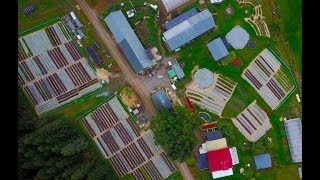
Richard Perkins updates the farm's late-season work: new nest boxes, tunnel doors, a €1,500 leanto greenhouse. He's launching two regenerative-design training courses starting mid-January, considering a €10,000 smoker, and planning to keep 1,200 layers next season.
Questions this video answers
€1,500
13 weeks; content released weekly (aim to start mid-January and run until April)
€10,000
Over €4,000
Seven pigs taken today; five taken the other day
Chapters
So two more new nest boxes have been built to put into the tunnel. They'll also be in the future eggman builds. So the season's beginning to changed dramatically and with that everything's sort of closing down. Since we've taken both the yurts down, it changes the landscape and the landscape behind us is changing very fast. Now we're just wrapping up the season with a few other projects. We're building new nests here that will be going into the polytunnel. Nicholas is back for the end of the season and he's been helping along with the team. So really giving me a bit of rest time. I've been working on five, six hours all summer and so I've just got to a point where I need a bit of rest. The tunnel is pretty much done. Got the doors in and next step with this is just protecting it. Ready for chickens coming in. It's really nice. They've improved the door design since the last tunnel we bought and so we're ready to keep going in here. We're going to put some really tight meshed kind of chicken netting, plastic netting. It's going to be battened on to these two rails just to stop bedding and the chickens from getting into the edges. And the new nest boxes, we're going to put them about a meter up in the air and have steps coming up to them to both allow bedding to build up over the winter. And the steps will allow them to get some of the muck off their feet. It's much easier to have clean eggs in the summer when the birds are on pasture. But we're going to be growing a lot of tomatoes in here next year and we're on compacted subsoil. So we're going to start by inoculating this with compost and composted bedding, and then start a new layer with some peat moss and other organic matter and do an experiment to see what the optimal bedding is going to be for this year. The gardens are getting covered slowly now as they come out of use and we've only got a few. There's still a lot of food in the ground, but it's just the last few boxes now and we're starting to do more microgreens that we're selling at Rico and people are really appreciating that. So it's something we might do to keep the customers with something fresh vegetable wise over the winter. And that's been. Yeah, it proves to be really worthwhile. You can generate a lot of revenue Just from that small lean to greenhouse, you see where the chickens have been.
Through the tree lanes.
Now we've been concentrating the efforts there to flatten everything so we can inspect again for any vole holes. Because we did some. We lost a lot of trees last winter, as I've said before. So we're looking to destroy all tunnel networks and eliminate those. And I think we've done a pretty good job at that. But now's a chance to sort of see the ground flat as the grass stops growing. You see that the broilers are now moving quite erratically. We're down to the last slaughter which is happening on Monday and the new models proves quite well. I'll do a video update on the different feed trials we've been doing and it's too early to say exactly how that went yet until we've done this last group of birds. You can see up here in the top of Nutfield, the impact just one time moving broilers through has made.
I mean this was land that we.
Never really took animals to because you.
Can'T get the eggmobiles up there.
And yeah, it's really improving the grass dramatically and that's why we run these birds.
It just really radically improves grass on a small scale.
I plan on doing some videos soon, just reviewing the season, how things went, what went to plan, what went better than planned and what didn't go to plan. And there'll be a few other updates like that. I'll probably take some time out soon because of the online training I'm putting so much time into. Currently it's looking like it's going to be two options, a full course and a self led course that has exactly the same content. It's hundreds of hours looking in detail around the farm, at the different enterprises and how it works and all the details. Then it's hours and hours of lectures about all aspects of regenerative design and it's. Yeah, there's a lot of resources on there. I think. There's nothing really out there like it. It's full of all the business spreadsheets and tasks that you do step by step. And I can monitor the participants progress through that process and give feedback. So the structure will be. If you want a self LED training, you basically have all the same material. You get instant access to all of it when you join the course and then you don't really get any time to ask questions or any peer support. It's just, hey, if you're motivated and you want to take the information and use it as you wish then that's a lot of information in one place. It's all based on our direct experience as farmers and as educators and designers.
So I think it's a unique package.
That we can offer from here. And then the full course will have a lot of my time as well as peer support. So it will have a weekly seminar. The content will be released weekly over 13 weeks. In that case, I think it's going to be aimed to start mid January and run until April time. And that one's going to require a lot of input from the participants. I see it as like a kind of consulting process and it'll be much cheaper than consulting me. And the reason I want to do it like that is because when I designed properties for people in the past, it doesn't often work out so well if the person that's in charge of decision making is not really totally clued.
In to why they would prioritize this over that, etc. So I want people to grab the.
Reins and do their work and put the bones of the business together and they're property design. But I'll mentor them and follow them along every step and prod and push them and make them ask the right.
Questions and dig deeper at times. And I think that's, you know, that's.
Really where some of my strengths are with the intern programs we've been running here. And it's going to be so released weekly with the section following basically following the chapters of the book Making Small Firms Work. And at the end of each week everyone will have hopefully had time to look through hours of video and associated notes and spreadsheets and whatever resources are in that section. And then there will be a webinar scheduled at the most sensible time to meet the participants needs. And what I'll do is take questions for anyone that shows up in the webinar that will automatically be recorded and put into the course that other people can view it. But you'll only get to ask questions if you show up for the webinar. And then the other bit of feedback I'll give is each section has tasks.
That you should complete.
And basically it's a very guided process. It's guiding you as to what to do and in what format to do it, and centralized point where everyone will upload those resources so you can work with your peers and give feedback and.
Advice to each other.
But I'll be responding directly to every person's completed outputs, as it were. So that's the way the interactions will work. It Won't be sitting around asking questions.
Randomly at any point.
I'll be giving direct feedback to completed tasks. So it requires you to be motivated, self motivated to some degree and, you know, timely. I'd say it's going to be a full time training for 13 weeks. It's an incredible amount of information and.
A lot of work to do if.
You'Re designing your own sort of enterprise. But I think there's nothing really comparable out there for someone who's just about to invest tens or hundreds of thousands of euros or dollars into creating a business and property. There's nothing really so detailed coming from full time farmers who also, you know, able to share their design and educational.
Skills as well. So I'm really looking forward to it.
I think it's the best training we will have ever done and the best way we could do consultancy actually it'll be cycle. And so it's the way we're going to put all of our consultancy in the future and most of our education. So I'm really looking forward to that. I think it's actually going to be completed in the next few weeks. I'm getting through the material quite rapidly now. It's a lot of editing but I'm just going quite hard at that at the moment. And yeah, I'm super excited for it. I know a lot of people are interested and we're finalizing details with prices and availability and limitations on the number of participants, etc. And I'll release all that info as I know it because right now I'm not totally sure. Happy forest pigs. Hey Big Mama. Big Mama has a litter too. So we're keeping three original sows that we have in the bore over the winter and we'll keep them over in the paddock by the road over there. It's feeding time so they're hungry. But we're going to keep them over by the road so we can access them during the icy winter when it's too deep snow to get down here easily. So we're taking seven pigs today and we did five the other day. So we've got a lot of sausage to make. This is under the power lines and they've pretty much cleared it. So we're clearing out the animals. Most animals are going to be off farm very soon. Just keeping the layers that are going in the tunnel you can see in the distance there pretty soon. And we're going to explore a different way of doing the bedding this year.
Better open this carefully then.
This is caution.
Open carefully. Contains powdered mushroom. Ah, Parasol mushroom.
Aha. This is a pasta mycelium mushroom. Aha.
So, yeah, it's just a part. It's just the dried powdered mushroom. I'm seeing a ridiculous amount of parasol.
Mushrooms.
Dehydrating and whizzing them in a food processor until powdered. I usually use them in soups, sauces. Yeah, very nice. Might try some of that in the gravy tonight.
Gravy.
Thank you, Donna.
Cooking. Thanks, Donna. We've got lamb sausage.
Lamb sausage.
And you're making toad in the hole again. Toad in the hole again. Pop by, popping. The blonde. Very nice. Stock is bubbling away. Chutney's bubbling away. Green tomatoes everywhere. So there's been a lot of awesome preparation of preserves. And these are different things. There's pickled cucumbers, there's different marmalades. Lingonberry jam, aronia jam, blueberry jam and red currant jam. A lot more pickles. Pickled tomatoes, pickled cucumbers. And there's different chutney sauerkrauts there. And these are all for going in the boxes and for winter food supply and spring food supply. So we're eating these things late into the spring when new things come around. So Leanto Greenhouse has performed beautifully this year and we're going to keep rocking microgreens. We've got a bunch on at the moment for our RICO customers and it's performed really well. I'm very happy with it. I mean, it's, you know, super low cost. It cost us €1500 to build this and I think we'll be growing micros all through the winter and really happy to do so. People really enjoy them. Might try out a few different varieties. Currently we're just focused on pea, sunflower and mustard. But we might try out a few other things as it grows in popularity over the winter when there's less other fresh things available. Carla's busy taking the last of the herbs. We're going to expand the herb gardens next year possibly and fill the empty spaces. And we've been using a lot in the amazing cooking here as well as having a tea supply throughout the rest of the year. So tomato crops all cleared and we've got salads in the row cover just to extend the season in here and get more salad crops. Some can overwinter if we want to.
Now Nicholas is back. Nicholas been my right hand man for the last few years. He's been here every year actually and knows the farm better than anyone except myself.
We're talking a lot because him and Matt are staying on now till probably.
December time or late November time before we go on holiday. And we're looking to create a whole structure for the new business and we're not entirely sure how that's going to look, but we're making decisions already because, for example, the hens next year, we cycle our hens every year and they're slaughtered in the spring as the new flock arrives. So essentially, once the hens go in the tunnel for the winter, they won't come back out of there. And we do that, we get point of lay birds four months old, so they're 16 months old. And really that decision is based on production, but also on the pastured model of having new birds out when the season starts in the spring and keeping them out as long as we can. But we sell the birds for the price. We acquire them as edible, you know, as meat chickens. They're much smaller than the broilers and a bit harder to process because they still have egg yolk and, you know, a lot of production going on in there. So it's a bit messier, it takes a bit longer to process them, but they're much tastier. And, yeah, I'm really hoping the turkey side of things picks up. If we decide to build a smokery, it's a big investment. It's a €10,000 investment for the smoker we want and we would have to build a smokery. We're going to get in contact with Per Nielsen, who's an amazing. He's a food health advisor, but he helped us a lot when we made our kitchen a commercial kitchen, which you see is essentially like a normal house kitchen, but because we serve food outdoors in the yurts, we're technically a kind of outdoor kitchen. We still have to go through a lot of regulations. We've put over €4,000 into water testing to be able to serve cups of tea in the morning and things like this, which we also need for the slaughtery, you know, but that's worked out really well. It's really nice having that kitchen. We can make jams and chutneys and things. We couldn't do, say, sausage for sale in there. But that's something we're looking into. We're thinking if we could make a cool bot chiller and in the smoking facility, because we'll need to chill the birds in brine before they go in the smokery. So we're thinking if we could double the function of that room and turn it into a meat processing room, because you need a different license for meat processing. The slaughtery allows us to take poultry and process them for whole birds, but you need a whole other license for meat processing. So we're thinking we'd like to do it in the new facility so we can make sausage and things because really larger animals like sheep and the pigs, it's much better economy if you take the time to process them and add value through making sausage. And it's something we really enjoy doing actually. I love making sausages and I like. I don't eat so much meat actually and I like to eat high density. You know, a small bit of dried sausage or something is really good. It feels really good. So I think we might go down that route. We need to discuss this. We're also talking about setting up potentially a tree nursery, selling trees that you can't really buy easily in other places. We're also discussing whether we should become a tool hub selling like paper pot transplanters and things like root trainers, mycorrhizal fungi and occupants and board forks and market garden tools that, you know, many people want and more and more people are wanting but it's hard to get them over here. So we're thinking we could be a really good hub for that in Europe. But it's also a lot of work and Swedish Post is, you know, I haven't found it that reliable. Sending books all over the world. It's been quite disappointing and very expensive. So it comes down to whether it's worth the time in putted. And next year we want to focus in on really mastering the enterprises we run. You know, trying to double production whilst taking the workload down massively. We want to take a thousand hours off the market garden, which I think we can do with the paper pot transplant for example. And growing on bigger transplants should allow us to double the revenue there without growing the garden at all. And I hope Ricoh really develops. I imagine it will. It's a cool model and it's been working really well for us. But I think we will move away from csa. Boxing is more and more towards the kind of RICO style market setup. But everything is pre sold with the broilers. We're still planning to add value to the birds by smoking them. And if we had the sort of processing facility we could then halve them things like turkeys. A lot of people sadly today don't know how to break down a chicken or turkey themselves or are lazy to do that and they want to buy fillet and it's, you know, taking the breast Meat off a chicken makes those breasts the same value as the chicken. And it takes seconds. We've got our evisceration down. Ben likes to challenge me. He's got processing down to 35 seconds of bird, and I managed 25 seconds of bird last slaughter. So we're getting really good at these things. You know, you can't get faster than that.
And so being able to just break.
A turkey down into breasts, like smoked breast fillets, sliced, you know, it's worth more than the turkey and it doesn't take very long to do that. So it's something we're considering. It's a whole nother load of work. But our goal has been how do we double the enterprise revenues? And it doesn't necessarily look like doubling anything. It might just be adding value to things and having more diverse jobs in.
Our day, which we all like.
It still looks like it all revolves around most of us doing an animal chore and then coming back and working in the gardens, which I'm really looking forward to. I'm really excited to work in the gardens. So we're just deciding now how many layers we're doing.
We're definitely going to have 1200 and.
We'Re deciding whether we have 1600 or not. We know we can sell the eggs from 1200 birds without trying, and we're not sure if we can sell all of them from 1600. And eggs, you got to be careful because they pile up pretty quick. So we're moving the egg packery to the wagon that this €200 wagon that we've been kidding out as an intern wagon and now it's going to turn into the smokery and egg packing facility. So a lot of decisions to happen. We're going to basically spend a couple of months with a whiteboard and computers and just hash out different plans and open up creativity and then prioritize it all and nail it down to, you know, a game plan, which I'll try and document as much as I can of because I think it will be, you know, insightful for some people. So the aim is similar to what we were thinking earlier in the year. It's like we'd all like to draw an annual salary and I think we're going to say it's a nine month year, so everyone gets three months paid off farm and we work for seven months as a season. Now, most people have always come here for six months because that's when the main production is going on. But I'm always super busy for a month before everyone Gets here, getting things ready, doing all the starts for the market garden. So we're going to say it's a seven month season and a month for planning and then a month farm sitting over the winter. So everyone knows all the systems and can run the farm on their own. Basically. In winter it's much easier. There's just eggs and looking after bigger animals, but there's no big moves to do every day. And there's some customer relationship stuff and selling and a bit of basic accounting, but it's something that anyone can do. And so that's going to be a life changer. You know, to be able to take three months paid off and travel and disappear is. It's really beautiful for anyone. And everyone that I've invited in the business is not Swedish, they're not local. So we're going to see. You know, that makes it really attractive, I think. And a lot of discussions to happen still to work out the best format for that. But it's looking good. And our intern program next year is going to be quite different too. It's going to be very selective. We're going to have a few interns and it's going to be six months. And it's going to be specially targeted for people just about to go off and start their own thing because that's who we've been able to serve best in the past. And so what we'll do is you pay for three months to pay for training on the ground. We're not sitting around in class like our interns have in the past, where they're sitting with me all day and doing very targeted field work. We're going to be out farming every day. And I'm mostly excited about that because that's, you know, why I'm doing this in the first place. And then the last three months you'll get paid. So it encourages people to, you know, live up to their commitment and take responsibility for committing to a season, working hard and then getting the equivalent of being paid all season. We don't know the details of that yet. We're going to play with the numbers and really work through the plan for next year because a lot's changing. So we can't just. We need to sit down and plan all that. But it's going to be really cool. But it's not going to be many interns and please don't apply yet because I won't read them. We're going to have a very tight window for applications and set some basic boundary conditions and ground rules for those applications because it's a bit of a messy process. We get a lot of requests and a lot of applications for our core team, and. And so we just want to make that a lot clearer and simple. It's probably not going to be till December that we release news about that. I would guess.
More from Richard


A review of short and intensive season on a mixed farm and restaurant/event space in Sweden






Alskade Kyckling Exploring complexities of poultry production in Sweden and what we stand for


