S4 ● E116 Eating my words, delivering pigs and nut trees in the park
This is a transcript of a Richard Perkins farm vlog (YouTube S4 E116) documenting a day of on-farm activity and deliveries. The video covers practical farm tasks (inoculating a soaked book with oyster mushrooms, preparing a deboned rabbit stuffed with pork), collection and distribution logistics (picking up 12 butchered pigs, using shared freezer space, Rico drop-off points), livestock strategy (keeping nine cows, plans for pastured poultry, reasons for not choosing sheep), and reflections on team size, work-life balance, and future plans. The episode closes with concrete sales figures for a 75 kg gutted pig and notes on expanding local pickup networks.
Questions this video answers
October 10, 2017
12 pigs
75 kilos (gutted, with head)
€10,500 (the transcript states this as the retail price for the pig)
About €12,000 of pig delivered to customers that day
Chapters
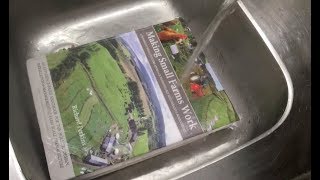
So raggy, what are we doing? We're taking some pearl oyster that we grew out from the bottom of our mushroom plug spawns that we've grown out on cardboard. We're going to take this little book, pour boiling water over it to soak it, and we're going to inoculate it with mushrooms and then eat the book. What do you think about that? Sound good? It says information is only beneficial if it leads people to carefully considered action. I sincerely hope this book contributes in a small way. If when you've read it, you decide it does not, I suggest you soak it in good clean water. Inoculate it with choice oyster mushrooms, sorda spawn and post meat dried mushrooms that I might eat my own words. Okay, sawdust form is in on page 146. Close that up. We'll put on the seller eggs then. What do you think? So it's all wrapped up and it's going on the shelf. Maybe next year. Get to eat my own words, Chef Ben, what have you got there?
We've got a lovely little Ridgedale farm.
Rabbit, New Zealand red rabbit. What are you going to do with it?
I think that I'm going to completely debone it and keep it whole. And then I'm gonna stuff it with pork mince and wrap it with bacon.
Very nice. Roast it off the end of the rabbit enterprise. That's it. Celebrate them. Hey, gardeners, what's going on? What's going on? You're going new Rico today.
Going to two different. Three different places today. Selling virtually every farm product we have.
Sweet. We're picking up 12 pigs from the butchers and then we're meeting. We're going to get her, aren't we? And then we're going to meet Carla. She's taking stuff to Karlskoga.
She's going to go this way an hour to 45 minutes to Arvika, where we have customers and restaurant customer business. We're going up this way to get pigs. Then we're going to meet at our freezer spot where everyone's picking up pigs and some turkeys liver and some veg boxes. And then you and Nicholas are going to come back to the farm with some pig and some other to meet some other customers. And Carla and I move on to the new Rico with 22 chickens and turkeys and more veg and more eggs.
Nice. Yeah. And we're really excited to push the Ricoh thing now. And what would you say is the sales advantage on the vegetables? Like what sort of percentage increase in revenue do we get by selling loose veg.
Well, it's about a tenth of the work, a tenth the space, and 10 times, I mean, you know, it's obviously just an easy way to generalize the same 10 times. But it's. At first glance, it's. It's much better. And the customers have the option actually to purchase the box with a loose veg. And they're purchasing loose veg. So they're, they're picking what they want. They have the choice, and it's more value per square foot. It's good.
Boiler pans are all away. And main thing you want to do with these in winter is to make sure you support the middle of the fridge. You see the piece of wood we've put in just from the snow load, you know, especially wet snow in the spring, it just adds a huge amount of weight to them. So that's where we stack them up for the wintertime. Gorgeous color on these red oaks. One of two very healthy hives from splits earlier in the year. And one of the hives is not doing too well. Reuben is curious. Hey, Reuben. Piglets in the woods. So we just got three sows left now and 16 piglets. They should be ready for slaughter end of next year. We're picking up 12 from the butchers today, and we'll just keep these pigs over the winter. Someone was asking about why we decided cows over sheep. Well, the thing is, we like eating beef and sheep are just, you know, they could be more economic than cows, but we prefer eating beef to sheep. And so we have nine cows now. And we decided that we need herbivores and we'd like to branch into more truly pastured poultry like geese and things longer term. But the economy on a small farm for sheep or cows is just not very good. Someone asked why we're not taking the ram lambs from the north of Sweden. Well, the economy looks really bad for that because we'd be buying animals each year essentially for some years before getting to the point of being able to actually get breeding flock. So it's, you know, it's, it's just a decision. It's not set in stone yet. But we like eating beef and we like cows more than sheep. And these cows are particularly lovely. They're not the best meat cows perhaps, but their meat is highly valued and prized by chefs and they're very well adapted to the climate. So I'm happy keeping these for now and we'll see how that goes over the winter. So we're here picking up pigs. And it's Hudson and wife and grandma team. And we can't look in because he's concerned. There's a bit of a mess in there, as you would expect. You know, bones and bits around. But actually it's very simple setup. It's basically the animals are backed into this barn here when I delivered them last week. And then there's a kill station out there. And then they are gutted and lifted up on a hoist and put in a chiller. And from the chiller they go into the evisceration room here, which basically has a meat sauce and tables and a vacuum packing machine. And it's very simple.
Are you gonna pop, Nicholas?
You can if you want to. You just might want to put some.
Of the man stuff.
Livers, chickens, Turkeys. Let's see, number one now, fish.
Which.
Is beautifully down at the bottom.
And you got those gray grates.
How's your collapse for that?
They're doing short term. 12, 13, 14.
So we want to. This freezer space worked out really good for us. It's part of Coop Vermlands has really big freezer. And we just went square meterage. But it's one way that allows us to sell products year round because we only produce pastured boilers in the summer. And so this allows us to spread the selling throughout the year when we also have eggs to sell anyway as well as microgreens. So works really well for us. And we've got over a thousand chickens here right now, as well as a bunch of turkeys and lamb and pork. So we'll be selling that as mixed meat boxes and single cuts etc all through the winter. We actually nearly lost Matt last week. You got stuck in the freezer?
No, I got stuck in the freezer. Had an icy mustache and everything.
He's got an icy mustache now, you can see. But he got stuck in this door with no way to get out. And there's no one here working that day.
You can see here the emergency release explains how to get out if the outside door won't open.
Anyhow, I managed to get out the.
Other freezer, the other side of the freezer, but I was just in a closed section surrounded by barbed wire.
So that's.
At that point you phoned me.
At that point I phoned rather calm. I've watched a lot of movies, so I figured, you know, better. Better use my fingers while I can. I said it's not an emergency, but I'd really appreciate it if someone comes and lets me out of the freezer.
So Carlo's Here. What's going on? I'm just back from Avica. How did it go? It went really well. Cool. So now we're just swapping over some goods to you off? No, to Karlskoga. Yeah. First Rico in Karlskoga we need to.
Give you a small veg box.
Logistics. So what time are you lot going to get home tonight? 9ish. Probably 9ish. What happened to this 40 hour work week plan? Later we're just waiting for customers and we see walnuts that we've got on the farm planted in the middle of town. And some interesting. This is a wingnut farm from the Caucasians. Need to get out and about more and find nut trees that are bearing to take seed stock from. There's no nuts on this one. Quite interesting. This is heart nut which we've also got planted and there's nuts on this tree. So this would be a good tree for us to come back to and take some nuts off for germinating some good clusters in this one. It's going to be some years till nutfield bears trees of this size. But just goes to show they do grow here. This is Gingko biloba. Now I planted some of these and they all died. This one's doing really well. Ginkgo is an unusual plant because it doesn't actually have any living relatives. It's really good for blood flow to the brain. Making teas with this and tinctures to increase memory. Beautiful tree. Prehistoric tree. So great to see. It's grown here and it looks perfectly healthy. It's very nice in this park. All these old oaks. You don't really get to see so many old trees in this part of Sweden because it's all just forestry. It's very nice. Here's beach which you tend to see further south in Sweden. I love beech very much but these are grand old trees and I planted a few beech that didn't survive but it makes me want to try them again because beech is a wonderful master tree for raising pigs under. So this is how a large part of our sales go. We basically turn up in random car parks and people turn up in their car park and get their goods. Today we're just doing the pig. But this is kind of how we've been set up since the beginning. It's kind of how Rico works. Except with Rico you would have 20 other producers and people are coming in a half hour or 45 minute window picking up all their goods. So Nicholas, what's your feelings coming back to the farm knowing that we're changing everything that you've known over the last few years. How are you feeling about that?
It's been changing every time I came here basically from the first season, season onwards. It's always been kind of like a new chapter coming in. And I think the next change will be quite significant in how we structure the whole business. And for me it's exciting to get even more insights. Last year I was doing some of the accountant stuff, but I think this year we will dive even more into that and do the next step of taking out the numbers and see what the whole business looks like and how, how we can lever some of the costs we have and lever the outcomes of it. So that's pretty cool. And it also gives more flexibility on what we want to do and how we want to set up. And I think it's cool to have a full new start in a way where we can just decide on how do we want our work weeks to look like and what's the outcome.
We want to work. It feels like we're really starting again though. It feels, it feels like pretty clear to me that we can all get an annual salary out of seven, eight months work. But what do you think about the 40 hour work week target?
It would be great, but I don't think it's realistic. It changes a lot when you live on the farm.
Right.
Because it's so hard to tell which part is actually part of the work week and which part is just happening because you're around anyways most of the time.
So yeah, often our days off, we like to start big projects just because it sounds fun. Keeping the lines defined is difficult.
I think it would work if we remind ourselves more often of really taking time off and taking care of each other, of doing so so that we can make space, especially on the weekends, I think is something that we should aim for next year. So I think that would be really make a difference if we.
Yeah.
To the weekly flow. And you've been building up a circus wagon this year in Germany now and you're gonna bring that to the farm. I'll see.
Yeah. If it, if it works out well and I get. Get it all done this winter, then it would be great to have it because, you know, private space on the farm is very, very short. Like there's not so much space where you actually just can have your stuff and be by yourself. And if there's a lot of people around, that's. I think that's part of the quality of life to just sometimes get off and do your own, be for yourself and do your own stuff. So.
And you've been, I mean, you've been here every season as kind of like my right hand man. And what do you think about this new chapter with like potentially only six of us on the farm? Like, how do you feel about that, having seen, you know, from groups of 10 to 50?
Yeah, it feels like a double edged sword. I mean, there is a dynamic on the farm that I really like. If there's a lot of people around, especially if they stay like for the internship, if they stay long term, there's a lot of possible friendships evolving that are more than just working relationships.
Right. We've seen a lot of people go off and do stuff having been here or even had babies here or whatever.
On the other hand, it's nice to have a small team where you can really be focused and you don't have to take care of so many different roles that all need managing. So if everyone has an overview about what's going on, then that really helps to make the workflow efficient. And that's something that I really enjoy too, if things just have a good flow. So yeah, it's going to be interesting to see how the farm feels with less people around. Sure.
Okay, drop off's done. Last customer. How long was he vegetarian last?
Couple of years.
Couple of years vegetarian. We've turned another vegetarian to a meat eater starting on a whole pig. But we have a good record of converting vegetarians to omnivores at Ridgesdale. Very nice. So invest them to be on our way to sunny. Just done our drop off here and we've got several customers in Sune and then we're going back home to put the rest of it in the fridges at the farm for people picking up at the farm and evening done. So we're in Sune, our local town. It's about 20 kilometers away and we got 1, 2, 3, 4 customers here to give pigs to. And then we're off home, end of a long day and the guys will be back from Karlskoga. Not for another hour and a half, I guess. Just for reference of what things cost in Sweden. These three boxes here represent a pig that weighed 75 kilos at slaughter. Weight so gutted, but still with a head. And that retails to the customer for €10,500. That's about €1,000 in these boxes. So it's a lot of value. It's about, I think, €12,000 of pig that we've delivered to customers today. So it seemed like the Karlskoga Ricoh went well. That's the Rico ring that's organized on Facebook where customers sign up for products in advance and then pick them up like a drop off point like we've been doing. So that opens up bridges. There's many Ricos along the belt from Stockholm towards our direction, so it's something we're exploring. Anyway, thanks for watching our videos. Excited to share as always and we'll see you in the next video.
More from Richard


A review of short and intensive season on a mixed farm and restaurant/event space in Sweden






Alskade Kyckling Exploring complexities of poultry production in Sweden and what we stand for


