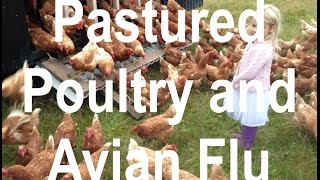
Richard Perkins (video) discusses how ongoing avian (bird) flu restrictions in Europe—particularly a nationwide ban in Sweden on keeping birds outdoors—threaten small pastured-poultry producers. He outlines immediate operational dilemmas: 800 laying hens and ~1,000 broilers are due soon; regulations require covered tops and netting dug 20 cm for category-2 areas, preventing use of mobile field pens; indoor rearing would conflict with their pasture-based values though pasture poultry contributes roughly €150,000 revenue to their farm. He describes possible timelines (hopes for lifting of ban in May–June), contingency planning (temporary indoor housing or cancelling further batches), and broader concerns about increased frequency of such outbreaks and economic impacts on small producers.
Chapters
Avian flu is still a really big issue in Europe and we have a ban in Sweden on keeping birds outdoors. But as the spring approaches, it's now time to order the first boiler chicks as well as the laying hens. So what are we going to do about that? This video is about some of the thoughts and concerns that have arisen that affect our business right now. So bird flu is largely influenced by the actions of big industry, but it's not big industry that's going to suffer from these outbreaks. It's really going to be small producers like ourselves. Pastured poultry is very vulnerable. So it really brings up that saying of not putting all your eggs in the same basket. I think we need to start really exploring more truly pasture based models like rabbits, etc. But in the immediate situation we're in, we have to do something because we have 800 layers arriving in a month's time and we also have our first order of broilers to make a thousand birds. So really what we've got to ask ourselves in our circumstances, are we prepared to raise them indoors? It's a really sensitive issue and it's a big issue for people all over Europe. The ban has been lifted somewhat in parts of the UK and it's also being lifted for hobby flocks now in Denmark, I believe. And it's typical with this kind of virus that the spring season sort of helps it dissipate. But here in Sweden, it's the full ban on birds outdoors. But also it looks like there's been outbreaks up to six weeks ago. But we have this complexity of the migratory bird patterns here too. It seems that most cases have been happening out on the coast where there's migratory birds. But the ban affects the whole country and Sweden has quite strict rules about these kind of things. Here we have structures such as this tunnel. Under organic certification standards, we could raise broilers in here and we can raise them in our barn too. Question is, do we actually want to do that now? We can't get around these regulations with things like mobile field pension, because the regulations as they are right now in a category 2 situation mean that the birds have to have a covered top and they can have netted sides which our pens can fulfill, but that netting has to be dug 20 centimeters in the ground. So you can't use a mobile setup to do that. Would I want to raise boilers in here? Not really. And I mean, you know, you would have to change the skin on here or put a different skin, similar sort of structure up. That's more suited to livestock rearing in the hotter months. But what I'm anticipating is the ban is likely to lift at some point. It's just whether it lifts in time for our first big batch of broilers. We're doing a large custom batch at the start of this season. We do have the physical space to do it. It really doesn't sit well with how we value raising passive poultry. In fact, it runs totally opposite would essentially be conventional organic producers. And are we willing to do that? I think in our context, pasture poultry makes up about €150,000 of revenue in our business. So we can't just say no to it. We've already got orders in place because we plan the season well in advance, so it's not as simple as saying we can't do it. So right now we're looking at an emergency plan of what we would do to get the spaces in order to deal with that if it comes to it, but hope that the ban lifts. Seeing it lift in Denmark and hoping that there's no further outbreaks in Sweden means there's a good chance that by the time the birds go out the ban will be lifted. But you can never be sure. So it really comes down to what we're prepared to do and it's a difficult one and I suspect a lot of people are really wondering what's going to happen with their businesses. It would be a massive shame to have to convert this space because we've got lovely crops that have overwintered spinaches and there's some herbs and salads coming up that we would like to crop fully before we put in the tomatoes and cucumbers. It would be affecting mainly the first batch of production, I would guess, because the ban would likely lift later in the summer, so we would still be able to use this production space for our cucumbers and tomato crops because they don't go in the ground till June. But the bird orders begin now. Birds have to arrive. We have a very short window of production, so we would need. We can run six batches of boilers in our summer months. So the first bird orders come right now and the birds arrive in a few weeks time and then it's a few more weeks till they go out. So we've got about six, seven weeks to see if that ban is lifted before we'd have to implement an emergency plan plan. And, yeah, it freaks me out, to be honest. I don't know what other people are thinking they're going to do if poultry is making up A large part of their business. This is obviously an issue that's only going to increase in frequency. It's a very interesting one and it's hard to say how it's going to play out this year and how that will affect us. We're dedicated to finding solutions to things, so we'll find out a contingency plan. And you know, in our context, we don't believe in raising birds indoors anytime they don't need to be because of the benefits they have both on the landscape in terms of the scarification, scratching action they have and the obvious nutrient deposit they leave on the ground. But also to have fresh air and fresh pasture every day naturally keeps them hygienic and that's what makes them such a high quality product. So I think it's going to be a major blow to many people if this ban continues. I think for us, the risk that it will go on well into the summer is fairly low. I think I would imagine it lifting in May, June, that I'm willing to take the risk this year and try it out. And whilst I don't think I'll feel very proud of the production of birds indoors, I think we need to be realistic about the revenue income and we certainly wouldn't be interested in raising them indoors all season. So if it didn't lift after the first batch of boilers, then I think we would cease production there. That's a bit trickier with laying hens, but we have to order our laying hens so far in advance. We're already contracted into the replacement flock that's coming and I don't know what we would do about that. We might collaborate with some schools. Schools tend to like to buy the spent birds nowadays as a sort of eco awareness part of many school programs. So if it came to it, it might mean a lot of culling later in the year. It really goes to show how, you know, you're. You're vulnerable when you're working with some of these things. Like obviously the market gardens are going to be fine this year and our pastured livestock will be fine, but they don't contribute such a high amount of revenue to the business. So, yeah, I'd love to hear what other people are thinking if you're raising pastured poultry, what you're going to do about it here in Europe. It'd be great to talk with other people. I think this is going to affect a lot of people in a lot of ways, but check out what's going on in other countries around you because it seems to be lifting in other areas, and it might well be that Sweden implements the same kind of lifting as other countries where high risk areas are kept under the ban for much longer and hopefully we would fall into a low risk category because of the distance from the coast, etc. But yeah, I'd love to hear other people's thoughts. I mean, it's, it's a really serious thing and it's, you know, it's really shaking us up a bit at the moment because of the obligations we have. Yeah, thanks for watching the video. It's going to be interesting to see how this plays out. I'll keep you updated with it. I'm very excited about spring coming regardless and getting on with planning out the market gardens and getting the pastures pumping again. Click subscribe below if you want to keep up to date with the farm and you can check out more about our work on our website, on our Facebook page, or in our book Making Small Farms Work. It's available on our website as a PDF and hardcover book. See you next time.