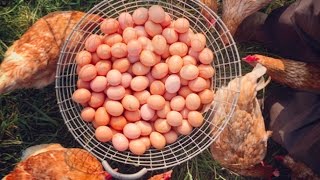
Richard Perkins (farm vlogger) announces that Sweden's bird-flu ban has been lifted and describes how this allows his small farm to resume pastured poultry production. He details immediate stocking plans (2,000 birds arriving in ~3 weeks: ~1,000 broiler chicks in the first batch, ~800 layers for egg-mobiles), and seasonal scale (about 4,000 birds planned for the year). He explains farm practices—time-controlled grazing with daily-moving eggmobiles (not free-range), use of pit-trap invertebrate studies to confirm insect intake, and rapid turnout of broilers (~3 weeks). He states economic and production figures (≈1.7 million Swedish crowns revenue ≈€170,000; >8 tonnes pastured broilers; ~13–15 tonnes of eggs per season) and operational details (use of sawdust bedding ~30 cm, three-week timelines, need for new pens and ATV wheel upgrade). The video also highlights poultry's soil-building value for small farms and points viewers to the book Making Small Farms Work.
Questions this video answers
2,000 birds arriving in just under three weeks.
About 1,000 broiler chicks in the first batch and about 800 layers.
About 4,000 birds this year.
About 1.7 million Swedish crowns (about €170,000).
Over 8 tonnes of pastured broilers and about 13–15 tonnes of eggs each season.
Chapters
Great news. This morning I woke up and I checked the agricultural website and the bird flu ban has been lifted, which is great news for us. We've got 2,000 birds arriving in just under three weeks. We've got a thousand boiler chicks in our first batch of six, and we've got 800 layers coming to fill the egg mobiles here. And for us, it's a major part of our economy. There's about 1.7 million crowns of revenue generated by our pastured poultry, which is about €170,000 or so. So it's not as simple as saying, oh, we're not going to raise any birds this year. So we had gone through this whole process mentally preparing for what we would actually do. But I can say I'm mightily relieved to hear this ban is lifting. It's really important for us. I mean, we're producing over 8 tons of pastured boilers and about 13, 15 tons of eggs each season. And it's really what sets our products apart, the ability to move livestock every single day. We don't believe in free ranging. We believe in time controlled grazing. If you've ever been to a free range shed production unit, typically if they have a static housing unit, you'll find that they don't actually range so far. And so the area right outside the housing is just denuded of vegetation and there's no insect life. And that's the beauty of being able to move poultry every single day, is that we give them access to fresh forage which stimulates the ingestion of greens and forbs that give them vitamins and minerals that make our products stand out from anything else that's available on the market here. But critically, it also means they get a lot of insects. And when we did our pasture surveys, we did. Kate, who was here in the first year, did a lot of invertebrate studies. And chickens are omnivores, they need meat protein. We live in a clumsy, topsy turvy world where some organic chicken foods have got soya protein, usually imported soya, but this isn't really what a chicken needs. A chicken's an omnivore, it needs meat protein. And so by moving freshly onto daily ground, we stimulate the ingestion of a lot of insects. And our insects and invertebrate studies here showed that they were taking. You can find out about this in our book. All the initial studies we did are in there. And the way we did those invertebrate studies is we put pit traps in the ground and you can measure the species and number of insects before birds come through and then you can measure again afterwards and you can gather a picture of what insects the birds are taking and in what quantities. So it's a really, really important part of our enterprise to be able to move livestock every day. And it's really where a small farm like ours can out compete with even big industry. That care and quality that we can put because we're doing things in a small scale and very much human centered, we don't do things with big machines, etc. So that level of care and quality is really, you know, the benchmark that sets the quality of our product apart. I'm so excited to get the eggmobiles back on the move actually. It's such a joy to move animals around daily. They really enjoy it. You can see, you'll see this summer as we follow the farm. But ah, super nice. We got new wheels on the Rhino with better mud grips because it had road tyres before. We don't have a tractor here and we don't really need one. But sometimes when the ground is wet, the ATV we have, it's a Yamaha Rhino, it's quite powerful machine but it doesn't have enough weight to give it traction in wet ground. So there's occasions where it's quite hard to pull the eggmobiles. Something we always do actually is we always come in the tops of fields in our grazing plants and that's because we can allow gravity to help us move the eggmobiles down each day. And yeah, we'll make a video soon about the plans for the grazing this year because we're going to do things quite differently. We've got all of our neighbors, extra ground, these beautiful paddocks you can't really see here, but we have a few hectares, two beautiful sheltered paddocks in the back there that haven't had animals for many years. So we're really excited to get over there with the cows and the sheep. We'll probably have a couple of extra calves this year. So we'll probably have seven cows and about 50 sheep grazing over there mixed in with grazing here. But we can't take the egg mobiles over there, it's too challenging in the terrain there. In many cases, you know, industrial poultry is raised indoors. It doesn't have access to sunlight, to fresh air, etc. And we don't really ever believe that poultry should be raised like that. It's not necessary. And it's really where small local farms can do such better job than big industrial productions. Obviously but it's, you know, the way we're raising our birds here. What excites us about these enterprises is the soil building capacity for small farms from poultry. I mean, there's nothing like it to really have an impact on the ground. With ruminants, you need a lot of ruminants and you need a lot of space. So for small farms, cows, sheep, etc. It's not going to build soil so fast as having large flocks of poultry because we can keep large amounts in small space. So for us it's been vital. And you've probably seen old videos we've put up. It's amazing what the poultry have done. You know, you couldn't do that with any other species. On a small scale like we're working on. It's time to build more poultry pens. We're going to need a whole bunch of new pens that we tend to build out of scrap wood that we get from local meals and just simple roofing and chicken netting. So we've got a few to build before the birds arrive, but we've got three weeks till the chicks arrive and then another three weeks till they'll go out on the pasture. We tend to get the boilers out at about three weeks and we find that they do much better the quicker you get them out. And especially if you give them turfs of grass, etc. To get used to being on the ground when they're young in the broodery, then they do better is our experience. So we try and get them out as soon as we can. We have to be careful at the start of the season because they are very fragile and the temperatures are often very cold. You don't really want wet, windy conditions when young birds go out. I mean they are still literally little kids at three weeks of age. We have got the rest of the bedding to dig out in here and then we're going to pressure wash this place and do a little painting with lime and then put down, we're going to use wood dust like sawdust and we'll put down about 12 inches, 30 centimeters of sawdust and then that will be added to every day or two as the birds get bigger. We're going to need this whole space for the first batch of birds, about 1,000 birds and then we'll be going down to probably 750 at a time. We're doing about 4,000 birds this year. So big clean up to happen. We've got three weeks till the chicks arrive, so I'm going to put the camera down and dig. It's a huge weight off our minds and it's really relieving and it really allows us to concentrate on doing what we do best, which is raising superior quality pastured poultry like you can't really buy in the shops here. So thanks for watching our videos. I hope you find it useful and we're going to be starting to put out a lot of content to allow you to follow the farm throughout the production season here. And yeah, we appreciate your views, shares and likes, etc. And you can subscribe to keep up to date with the farm and you can find out more about our way of farming in our book Making Small Farms Work. It's available on the website as a PDF or hardcover book. Thanks for watching. See you next time.