S4 ● E19 OVERVIEW OF OUR GRAZING PLAN FOR 2017
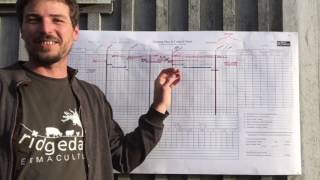
A YouTube video (by Richard Perkins) describing the farm's 2017 grazing plan: why an annual grazing plan matters, how timing of moves controls pasture recovery and hygiene, and how different stock (cows, sheep, laying hens, broilers) and mobile housing (eggmobiles, Salatin-style broiler pens) will be rotated between the home farm and neighboring paddocks. The plan specifies seasonal benchmarks (growth ~May 1, dormancy ~Oct 1), movement rules (move faster when grass grows fast; target recovery windows), stocking targets, and a goal to reduce winter feeding from five to three months by increasing forage output through managed grazing and poultry fertilization.
Questions this video answers
May 1
October 1 (can vary by up to three weeks)
About 96 hours
Typically 20 to 45 days
About August 1
Chapters
Animals are really a double edged sword because whilst they can cause so much damage in our landscapes if they're mismanaged, they're also the quickest way to regenerate landscapes and produce a valuable product. And this year our grazing planning is quite different as we have access to a lot more land and we have a lot more animals. The management of livestock is all about time, really. Animals are generally moving to find fresh forage and keep hygienic. And we've had a wonderful system here of the cows and sheep moving ahead of the eggmobiles, both to keep the ground short, to stop the electric fence that protects the laying hens from shorting out in longer grass, but also the cow pats get full after about 96 hours. In our specific circumstance, the fly larvae reach their peak and the dung beetles have gone out of the cow pats and done their work. And so it's the perfect time to bring this scarifying flock of chickens in who will scratch through the manure patties and eat all of the omega oil rich fly larvae. That's worked really well for us in the past and it's worked well for the broilers to follow up behind them too, because the grass is nice and short for the young birds as they come out. But things are changing. We've been given a few hectares of grazing. It's beautiful paddocks for my neighbours that follow on from our fields and have access to the stream. And they've got wonderful protection from alder and birch in the riparian zones. Really beautiful little sheltered paddocks. But we can't take the eggmobiles over there, it's too lumpy in terrain. And I don't think we want to take boilers over there because of the hassle of moving the boiler pens, the salatin style field pens we use over into those paddocks. So here's a little look at what we're planning to do this year. The reason we spend a lot of time making a grazing plan each year and then monitoring that plan and adapting it when things change, is that managing grasses through animals is all about time. The time that animals stay in one place and, and the time until they come back to the same place. The recovery period, which is constantly changing throughout our short growing season. So it's involved a lot of observation and pasture research in the past and each year we just keep refining our level of detail in our planning, etc. What we're going to do this year is take the animals we're bale grazing currently in our land. And when growth starts, which we typically write as the first of May, we write dormancy as the first of October, but that can vary up to three weeks in our climate. What we will do is take the cows and sheep shown in blue to our neighbour's land and we will let our grass grow up for the month of May before bringing the animals back in. Now our laying hens and our broilers will all be on our land, and in a couple of weeks, all of the laying hens come to the farm and they'll be straight into top field, which is our driest field. So this spring, in the spring, it's usually quite wet, so it's good for us to bring them into the driest field first so they don't mess the ground up before the grass has really started growing. Part of what you're doing with a grazing plan is working out how much forage you'll expect to have, how much you have, and refining your plan so you could know how many animals you can feed off a certain area in a given time of the year. In our farm, we buy in hay for winter feed. We did make some hay last year, but we bought the majority in. And that's a strategy we appreciate as a small farm, because we don't have to look after expensive haymaking equipment, which wouldn't be much economic sense on a small farm like ours. And it's basically an imported nutrient. All of that manure is then put back onto our land, so it's just constantly building fertility. What we want to do then is quickly move around the land with the birds in the beginning, and we'll be grazing quite quickly through the neighbour's land because the grass will be growing fast at that point. And it's good when the grass is growing fast. It's good to move animals fast. And as a rule of thumb, when the grass is growing slow, you move the animals slower. And the reason you do that is it increases the recovery time throughout all of the different paddocks. Come June and July is when our interns are here and we'll have all the animals on our farm. We're actually going to go twice over our land. A long pass and a short pass. And that's primarily to keep everything centered when people are here, so we can keep an eye on things. But more importantly, it's to make sure we keep the grasses to down at a sensible level, that the eggmobiles and the boilers still can work for us. If the grass gets too out of control, then we'll have Problems. I've even seen people having to cut the grass to put up the electric fence around eggmobiles. And to do that every day is crazy business in my mind. We're then going to leave our farm with the cows and sheep in about the 1st of August and stockpile the whole farm. We'll obviously still be running batch four and batch five and six of our broilers. And the eggmobiles will be out until mid October or so. So we'll be using the Landsdale. It's hard to factor the chickens in because they do take the layers, take maybe 30, 40% of their diet from the pasture, both from insects and greens and forbs. But the boilers take some, but not a lot, but they do leave a lot of manure. And the ground needs to recover before we can graze it. So we have to work all these different factors in together. And it's a little bit complex, but we're building up more and more experience each year with how to do that. This year we're raising 4,000 pastured boilers, 800 laying hens, and we'll probably have about 50 sheep and five cows and a couple of calves this year. So it's quite a lot on a very small space. It's quite intensive, but we're just trying to rotate everything through without ever overgrazing any of the grasses, allowing long recovery times. So this period in June, July, for example, we always come into the fields at the top of the field. And that's because the eggmobiles need gravity to help them move down. They're kind of on the edge of what an ATV can pull. And so we always come in at the top and leave at the bottom for every single field. And we know how big to make the nets. Because our fields are divided up by tree lanes, we have a pattern of how the fences go in each of the fields. And they're ranging from 9 to 12 meters wide. Times however long fits in the multiples of nets that we're using. So we know how long the layers can take in each field at a maximum time. And we know how much space it takes to raise each batch of boilers. So we plan the different boiler batches in to make sure they're not crossing over on the same land again. And that's to do with the nitrogen loading and making sure we comply to regulations, etc. And so you see, when we first come into our, what we call top field here, we'll come back into it in July, but the recovery period will be from the beginning to the beginning. So we have nearly 45 days recovery, and that's at the quickest time of year. Recovery here takes typically 20 to 45 days. Depends on the time of year, obviously, and the weather conditions. It's a lot more complexities to this, like the grass is growing exponentially at the start of the season, and the nutrition levels change throughout the year, too. So it's not just about the volume of forage, it's about the quality of the forage. It's. In the past, we've always tried to prolong vegetative growth on the sort of sigmoid curve of a grass's growth. There's an ideal point there to graze in terms of the maximum amount of forage. But also, as the grass grows, it gets woody and leggy. It's not so palatable for animals, so the palatability goes down and gives you this crossover point that's an optimal grazing point. And we've done really well managing our grasses to not ever overgraze them and to keep them vegetative late into the year, into sort of October time, when dormancy kicks in. But what we want to try now, we have more land, is to allow our grasses to express themselves, express their physiology, and do a lot more trampling of grasses, trampling the ground in front of our egg mobiles and laying hens, and as a way to capture even more carbon, which is all feeding the microbiology. So it's a new thing for us, and we'll have to see how it works. I would imagine by the end of the season, we'll have done several rewrites of this plan. And the plan is, you know, set to give you a clear, organized way of how you're going to approach something. But then it's the monitoring and the adapting of the plan that's really critical. So this is something what I would expect to change multiple times throughout the year. So we've put in everything that we can think of that we need to consider, and we planned the timings to ensure we don't overgraze grasses and also can fit them in with the laying hens and the broilers, and we'll see how it goes. It's going to be a really interesting year for us, but hopefully we will massively increase our forage output again each year now, because mainly the activity of the laying hens and the boilers fertilizing the pasture, it's amazing. The areas of this farm that were just moss and they've totally been obliterated now, and we've got thick, dense forage pretty much everywhere and, you know, a lot more forage than we had when we first came here because of that increase in the nutrient and water cycling from having a lot of livestock here and managing them well. Because it's been a couple of decades without animals here. So it's been a very quick turnaround for us. You know, a big cost of keeping animals in this climate is the winter feed costs and for us we buy that in. But if you made it yourself, it's still a big cost with all the machinery required, etc. So our aim is to see if we can reduce that. We're not sure how long term the agreement is with the neighbour. We're very good friends with our neighbour, so we're not needing to pay rent or anything like that. We're on very good terms with them and they actually get more subsidies if we graze them. So. So it's a mutually beneficial situation, which I imagine if it all goes well, we'll be able to continue to do for many years. But rather than try and eliminate winter feed costs, what we're going to try and do is go from five months winter feeding down to three months winter feeding and just see how much we can get out of our stockpile at the end of the year and just minimize the amount of time that we need to buy him food for. For us, it's not a problem economically, it's not huge amounts of animals that we have anyway, but it's something to work towards, which we're excited about. Thanks for watching our videos. I'm really excited to have the grass start growing again and be able to show you some greenery in the landscape. Really, this olive drabby color wears thin on me at this time of year, but soon the growth here is explosive, like almost in the tropics, when the heat comes back and the sun comes, everything explodes into life here. A miraculous thing. I'm really excited to keep sharing with you as we start the season up. So don't forget to click subscribe below and keep up to date with the farm. We'll be posting very regularly throughout the season now, and if you'd like to find out more about how we farm, you can check out our book, Making Small Farms Work. It's available in the links below on our farm website. Thanks for watching. See you next time. It.
More from Richard


A review of short and intensive season on a mixed farm and restaurant/event space in Sweden






Alskade Kyckling Exploring complexities of poultry production in Sweden and what we stand for


