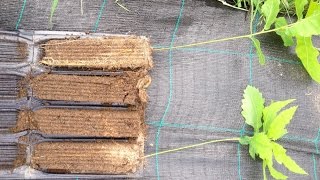
Richard Perkins shows how root trainers work: plastic modules with grooves that guide roots down and let them prune themselves in air, preventing the root-binding damage that regular pots cause. He uses a 3-year-old Siberian pea tree as an example and explains why they're especially useful for growing trees and perennial crops.
Questions this video answers
Nine
About 3 years old
About 250 Swedish crowns
About 15 times less (buys in batches of ~1000)
Slow-release MPK fertiliser (non-organic)
Chapters
Propagating perennial crops is something we're really passionate about here. And each year we seed hundreds and sometimes thousands of different tree seeds and cuttings etc to spread around our tree lanes. Today I wanted to talk to you about root trainers. What they are, how they work and why we think they're awesome. Root train is simple plastic plant cells in what's called a book. And they fold up like so. And nine of these will fit in this tray. And what you'll notice is that they have grooves inside them. And what that makes the plants do is send their roots straight down. You can open up the books anytime you like and inspect the root development without disturbing the plant at all. And that's really nice, for example, with cuttings, when you want to see how well the roots are established before planting out, etc. What's interesting about a root trainer is that as the roots come out the bottom here, they're held off the ground in these racks. They air prune because roots don't like to grow in air, which means your plant can't outgrow the pot. That's really important when we're thinking about propagating things that might live for centuries, even a thousand years in some cases, like some of the nut trees we planted up in nutfield. When you buy a tree that's planted into a pot, often the aerial part of the plant far exceeds what's possible to be mirrored in the size of the pot. And you'll find that the plant has become root bound when the roots go round around the pot. And I liken that to the Chinese practice of foot binding, where they would break the bones in the foot and bind the foot to create a different shape of foot that they found to be aesthetically pleasing. But the reason I'm likening it to that is that you've caused permanent damage that can never be repaired. And in the case of a thousand year tree or couple of hundred year tree, that's not something you want to deal with. For a vegetable seed, that's fine because vegetables are going into organic compost and then in a few weeks they're out into the garden and you know, generally they're not root bound by that point anyway. If you've used the correct size cells, however, with a tree, that's not something we would advocate. So we like to use root trains. I'm going to show you some of the roots. This is the Siberian pea tree. This is the pioneer nitrogen fixing shrub, very hardy at this climate and potentially possible to be bred to create an edible Bean seed, although to be honest, I can think of better things to eat. But it has scope as a perennial protein source in these cold climates. So this is about 3 years old and I want to show you what a 3 year old Siberian Petrie from the root trainer looks like. And here's a three year old Siberian Petri out the root trainer. Now this one hasn't been cared for very well at all. And that's primarily because it had little value to me. Every winter it's sat out and just frozen solid. But you see here how the roots have been guided down and they've air pruned themselves at the bottom here. So this tree can't outgrow its pot, which means I can keep it at a sensible size, it won't go root bound. And as long as it gets sufficient feed, I can keep this in this sort of dormant growing state until I actually want it. And that's why we use these root trainers. We're often planting it unideal times because we do a lot of work with education. So we choose to do planting when there are people around often. And so this creates a really nice healthy root system that can't go root bound, but still has this benefit of a potted plant, of allowing me to plant whenever I like as long as I manage the watering and moisture of the plant. Now this is one case where you might not want to be organic when you're growing vegetables. The vegetables in a very small cell, typically for two to four weeks or whatever. Organic vegetable, organic potting mix is plenty of nutrition for those young vegetables before they go out on the ground. But a young tree that might stay in the pot for up to a couple of years, this one is three, three and a half years old. Now you need to mimic how it gets its nutrition in the wild. And you can't do that with organic compost for trees. So this is one case where I would use slow release MPK fertiliser. It's not organic, but it's very different from, you know, water soluble MPK that you spray on fields. It's not leaching off into the groundwater and causing problems there. It's very slow release and you're using a very small amount just to ensure that tree has a healthy start. You're putting all that cairns and getting a good root system. You need to put that care into making sure that young tree gets adequate nutrition just like you would your child. Making sure that they get correct nutrition in the early years affects the rest of their life. It's quite Amazing to think that these two trees are the same age and yet this one remains in perfect health. And if I plant that up in the ground, it will shoot off. You know, it's got a very established root mass, but the roots are in very healthy condition. And it's those grooves in the root trainer that train those roots straight down. Every plant wants to root as deep and as wide as it can because it needs to secure its future in terms of its nutrient and water resources. We have a lot of misunderstandings of roots from studying plants growing in already damaged soils due to agricultural practices in the past. But I really like these root trainers. There's a couple of different varieties you can get, and you can also get them for vegetables. You get them in different sizes. It's one of these products that's worth buying wholesale. I've seen one tray, which is nine of the books that hold a plant like this in Sweden. They retail for about 250 crowns. I've seen them. I mean, I pay 15 times less than that because I buy them a thousand at a time wholesale. So it's something to go in with your friends and buy a bunch. If you're interested in, you know, growing trees from seed, particularly if you wanted to use them for vegetables, you use a much smaller one. And you can even transplant vegetables that really don't do well with traditional transplanting. We don't use them so much now because we have spaces of premium in our greenhouse and so we use the smallest modules possible to be able to ensure we can get enough starts in there. But a really interesting product, I highly recommend them. We've used them to propagate all of our nut trees, which we do some of each year, as well as cuttings and things like that too. Here's an old rejected nut tree that we didn't plant just to illustrate those straight vertical roots that air pruned at the bottom there. Life is like a mirror. Whatever is above ground should have an equal mirror underground. Often people will buy large fruit trees in tiny pots, sort of fooling themselves into thinking that that tree will do better, but that tree will have much bigger transplant shocks. And also, you know, like a young tree in perfect condition with its taproot still intact and all its roots in good condition will really quickly overtake that several year old tree with tiny amount of root mass that's been pruned to keep it in a pot. I really wouldn't recommend buying anything pot grown unless you really have to. And I would always check the roots to check if they are root bound. And I would never buy a perennial plant that's root bound. It's just not worth it for something that's got such a long life expectancy. Hope you found that useful. Thanks for watching our videos. Don't forget to click subscribe if you want to keep up to date with the season as it unfolds. I've got to get on with some building work so it's the end of the video. You can find out a lot more in our book Making Small Farms Work. Thanks for watching. See you next time.