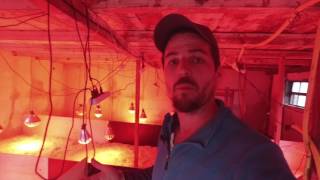
Richard Perkins sets up a brooder for 1,000 day-old chicks across four pens with deep litter bedding, heat lamps, and waterers. The birds move to pasture after three weeks at 350-400g, reach 3.5kg by eight weeks, and typically see 3-5% mortality using this system.
Questions this video answers
1,000 broiler chicks
Each pen is 10 square meters; target 250 birds per pen
Four heat lamps per pen; 150 watts each
Over 10 tons
About 15–20 centimeters
Chapters
In 10 days time, there's a thousand broiler chicks turning up at the farm for the first batch of six in the season. I just want to show you the preparations for the broodery. So things aren't finished in here. We've got to tighten up all the electric lines and make it a bit neat and ordered. We're just testing out the lights today. Making embroidery involves a few things. You need good ventilation, but you also need heat. We have four lamps per pen and we got four of these pens. Each is 10 square meters, which is enough for 250 birds to comply with regulations. And it's much better to have four small groups of 250 birds and one big group of a thousand birds. Day old chicks that arrive at the farm need to have access to ultra clean water and we give them free access to starve the food in the first four days. And then we go on to a restricted feed program, which for meat birds keeps them in optimum health. Just last week we finished digging out over 10 tons of deep litter bedding from the cows that were in here over the winter. And we've changed the configuration of the barn. We've taken out some of the walls and we've put up these little sidings about 70 centimeters tall. And that's because for each batch of boilers that come in here over the season, the litter will stay in place. We start with about 15, 20 centimeters of wood shavings. And this is added to every time is necessary. Like when the birds first arrive, they are very small, like almost like a yellow golf ball with legs zooming around the place. But they quickly start growing. These birds grow extremely fast. In eight weeks they weigh three and a half kilos. And we keep them in a brooder for three weeks, at which point they'll weigh between 350, 400 grams or so. The regulations here mean that you can't keep more than 20 kilos of birds per square meter. That's obviously far greater than the amount that will be in the brooder. And no more than 25 animals per square meter is a good rule of thumb. Those regulations are more for the sort of older birds, which complies with the field pens, Saltin style pens that we use here. And it's important to have sides that can carry the deep litter. What we do with the birds is we add litter daily and they're obviously compressing it down. But then when a batch comes out, we don't clean the bedding out, we'll sprinkle it with a bit of water. With the hose pipe and we'll dig over the surface and then we'll add more bedding before the next batch come in. And we found our motility rate goes down to 3, 4, 5% when we use a deep litter system like that, which is really neat. We're using 150 watt heat lamps and we have four per pen. And you can get more powerful lamps. But I feel like it's better to have multiple smaller lamps to spread the heat more evenly across the the room. To clean up the stable. We've done a lime wash over the walls and just made it nice and ready for the birds coming in. We've also cleaned the windows after the long winter just to get a bit more natural light in here. And we've still got to put in all the feeders and the waterers. There's regulations that apply to how much space per feeder and waterer there are per bed. And so it's important to follow those rules for the well being of the animals. We're going to be doing batches of 750 birds generally throughout the season. So we'll have one spare pen after the first batch because we're doing a thousand in the first batch. Just for general hygiene. It's good to have a separate pair of boots that you use between pens and that don't go outside into the farm where they could be cross contaminated with manure from wild birds or from other animals here at the farm. And we've maintained a little walkway through to the back of the barn because we need access through there throughout the year. We have good venting in the barn naturally and we've also got the ability to open doors to monitor the temperature. We use a laser thermometer to measure the temperature on the backs of the birds. And you can find out more in our book about the temperature charts we use. Because we actually aim to keep the birds in here only for three weeks because we found that the quicker you get the birds out onto pasture, the better really. In typical free range setting it might be four or five weeks until they get them out on pasture. But we found that three weeks is better. And we'll actually cut sods of turf and put them in. We supply food and water and grit and we also put turfs of grass in here to get them used to stack standing on it and pecking at it and investigating it. And we found that does a better job once they get on. They do better when they go out on the grass. In some ways it could be better to have more circular Sided broodery spaces where there's no corners for the birds to get piled up in because if they get cold they will huddle together. You can really tell a lot from the birds just from their body language and their noises. You know, often if they're chirping really loudly, they're either hungry or cold. If they're really huddled up, then they're too cold and you can read it. You know, you obviously need to know what you're doing, but it's common sense really. By the end of the season, the bedding will be right up here, I would have thought, and still be able to be accessed by ourselves and still hopefully enough freeboard on the top of the boards that they aren't getting into the other pens. So still a bit of tidying up to do. But we've got 10 days or so till the birds arrive, so plenty of time to get it all organized and ready for the birds to arrive. I think they're going to be very happy in here. We typically put the lights on the day before the birds arrive so that the bedding is warmed up and then I'll show you the process when the birds arrive. But we typically introduce 1 in 20 of the birds to the waterers and as long as some of them learn where the water is, obviously a day old chick has just hatched, it hasn't eaten or drunk anything when it arrives at the farm. So we teach maybe 5% of them where the drinkers are and they all soon learn very quickly and they don't eat so much in the first days, but then it's exponential in the next week or two. And I'll tell you all about that when we get there and show you skills. Quite amazing to watch these birds grow and in three weeks they're still feathering out, but they're ready to go out in the field pens. And the quicker we get them out, the better in my mind, as long as the weather is good. It's wet and windy weather that's really bad for young birds, so we always make decisions based on the weather at the time. But we're having a really nice spring so far, so I'm hoping it's going to be a nice early start for the season for us. Thanks for watching our videos. Hope you enjoy the updates from the farm. Click subscribe below to stay updated. You can find out a lot more technical details in our book Making Small Farms Work. It's a pragmatic approach to the design of regenerative agricultures for small farmers and relevant to people all over the world, despite the fact that we're in a very northerly cold climate. Thanks for watching. See you next time.