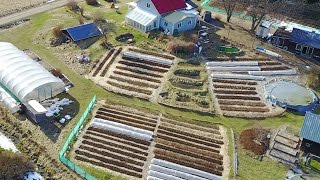
Richard Perkins documents spring farm work: transplanting kohlrabi, peas, kales, and garlic into no-dig beds, managing 1000 chicks in the brooder, and upgrading the electrical system to handle overloaded circuits from freezer and oven demands.
Questions this video answers
400 liters
16.8 kilowatts
40 meters (shallow well)
Up to 50 amps and 25 amps to the house
Chapters
Been a nice sunny day today and we've been getting a lot done and chicks are doing fine, pigs are doing fine, people are doing fine. It's an amazing team. We've got again, and we've got laying hens coming tomorrow. It's busy times as the season starts to go now, so it's a quick update from the farm today. Just melting away from the landscape and it's really nice. I mean, we live outdoors here, so it's really the temperature and the weather really affects the group and the people here. So it's been glorious. Sunshine during the days, cold at night, still minus 4, minus 5, but seems like good weather's on the way. We've been hearing a bit last night. We've been doing little sharings each night between dinner and sauna, and hearing a bit about Astrid, who's a master mathematician. She's giving up her life as a teacher to transition towards agriculture and she knows she wants to have a life in agriculture, probably in Denmark, and so she's coming here to give her a final boost before she starts off her own. And we heard about Marielle and Natalie's journey here. They've been living without money for several years and hitchhiking around the world, having amazing experiences at David Holmgren's place and many other amazing places. So they were sharing some of that experience. Transplants are going in today. What have you got going on, Matt?
We're transplanting some kohlrabi. It's a freshly made bed.
It's never been used before in the new north beds.
New north beds. This is the wrong way to use a knife when you can't find the proper tools. Sometimes you have to make sacrifices in order to grow food.
They're a bit bigger than normal transplants. We potted these on due to lack of space. They've suffered a bit of cold damage, but I think they're going to pull through, no problem.
This is 400 liters of the compost.
On top of.
Cow manure, essentially, which is from the farm, and we put it on and I guess it was September of last year.
Really nice to have the first crops in the ground, mostly kohlrabi. Some direct seeded peas now and kales going in. Plenty more to go in in the coming days. It's going to be busy now as we ramp up and the hens coming tomorrow, it's going to be getting more active on the farm. Nice garlic crop coming up here. We're here with the chicks and they're doing really great, actually. This gas, heater's just been a lifesaver and we've not lost any chicks to low heat, so it's turned out to be perfect in the end. They've almost doubled in size now. Might be hard to tell from the film. They're eating well, they're very lively and so it's turned out to be really successful and it's very relieving actually. And they're doing really good in here and it was nice. I was watching them yesterday evening sitting in the corner where the sun was coming in through the window in addition to the heat lamps. They know where the heat is. So very happy about progress in here.
But it's just because I was sticking.
The unicorn community immediately you were dividing. Lots of building going on at the moment. Putting in a new staircase here at the back of the barn. And Astrid and Lukas are making a covered washing line which is a bit of an upgrade for us to be able to dry our clothes even when it's raining. Had the electrician around today because we're really maxing out the power here. It's all domestic hook up and it's quite old. But we have a lot of freezers over here in the freezer room. And the domestic oven, we've got a commercial oven now that runs at 16.8 kilowatts. Then we have the slaughtery that's got commercial refrigeration and scalders that's using a lot of power right now the chicken brood is on. That's several thousand watts of bulbs as well as our lean to greenhouse which consumes a lot of power. So we've been finding a lot of the time when multiple things are switched on at the same time. It's just maxing out the system. And what we found out is that the previous electrician has been instructing us incorrectly on the sizes of the fuses. It's quite an old system we have in here, but basically we're putting this whole system up to 50amps and 25amps up to the house. And that should mean we have the correct amount of power to run all the tools, machinery that we need here this time of year. There's a lot of heaters which we can't have fire in some of the buildings, so we're needing to use electrics. And so it's. It's been interesting. Last year we were maxing out the water use at the farm. Sweden's got a very big lack of groundwater. We only have a shallow 40 meter well, so we were pumping onto the gardens and it's just too much. But now we have the lake and irrigation system. It's no problem. But it just, you know, it's a part of the reality of setting up commercial enterprises in the domestic setup. Gracie's here with her new bike. How you doing, Gracie?
Good.
Yeah, you're pretty good on that bike already. You were zooming down the hill. What did you do with it? Chandler, please. I pierced it with garlic pieces, then wrapped it with olive oil, put salt and pepper on top and time, and then left it in the oven for three. Your horse looks beautifully done. Look at that.
It's a different ingredient. It's for Lucas to eat. So there is no flour.