S4 ● E34 Super lightweight Pastured Broiler Pen
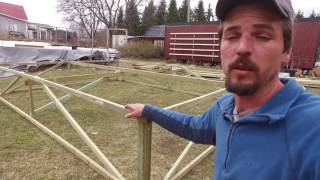
Richard Perkins gives a farm update: end of week two with a new team (interns and farm managers) and progress preparing for the season. Broodery update: Day 12 chicks growing well (~53 grams per day), feeding schedule reduced to 4 → 3 times/day, birds due out to pasture in ~1 week. Construction update: building 10 new lightweight, fully-bolted "Mark V" broiler pens (3 m × 4 m footprint; heights 60–75 cm), using treated 28×45 mm timber, angled supports and crossover beams for roof support, and a jig/production-line approach to speed assembly. Site prep: concrete pad (approx. 22 cm depth) being prepared for silos; 10 m^3 of gravel recently delivered. Other notes: yurts to be rehoused, gardens planted (peas, kales, kohlrabi), emphasis on hands-on regenerative-agriculture training and team culture, and calls-to-action for the book "Making Small Farms Work" and Olivia's Kickstarter.
Chapters
So it's the end of our second week with the team here now and we've been building a really nice team, working a lot together outside, even though the weather's been bad. And today we've been starting the process of constructing 10 new boiler pans of a new design. So I want to just tell you a bit about that. Day 12 in the broodery and the birds are doing really good. They're up to 53 grams a day now, so it's almost double the amount per bird in the last week or so. And they're doing great, they're really active and it's nice and warm in here now. So the birds are spaced out evenly. These boxes are big enough for them for three weeks to fit within regulations. And that's the point. We get them out and then we turn the litter over with the addition of maybe half to a whole watering can of water in this area to start a microbiological process to really reduce the mortality of the subsequent batches of boilers. And as I've said before, the litter will be going up throughout the season. We'll dig it out at the end of the year. But birds are doing great. We haven't lost many, so that's been fantastic. They're developing really strongly and they're jumping a lot now, getting really active with their practicing with their wings, etc. So it's really nice to see the girls doing a great job in here. It's gone down to four feedings a day a couple of days ago, and that will slowly go down to three feedings a day as the birds get larger and they're out in the fields. But soon, in a week, it's time for them to go out. The weather's improving. It looks like we're going to have a nice sunny week ahead of us now. So we're going to get all the new boiler pens built. And it's a slightly new pen that we're building this time. We're working with interns and farm managers who are coming here to get very hands on, as well as theoretical learning about all areas of regenerative design and regenerative agriculture. So a big part of that learning is giving people responsibilities to do things for themselves so that they really learn practical skills in their experience. Part of that, you know, it has its ups and downs. There's pros and cons to this kind of approach. We've actually got four different types of pens. Some of them are coming into their fourth season and actually we're going to replace one that's just seen better days. You see the roof of this one is just totally bowed out. The supports aren't strong enough anymore and we've had very robustly built ones. The one below this is like a tank, but it's very hard to move for some people. We have people of all different strengths and sizes here, so it's got to be practical now. It also has to be heavy enough that it's not blown away. It gets very windy here, but it's more the roof panels. There's always two opening panels which is how they come out. It's how we give the birds feed and water. We'll have a waterer sat up on the strong point here. But what we've done in the past is always build with free timber. We're actually going on our first two timber hall next week to collect a lot of free timber because we can build stuff for free and it doesn't last forever because it's not treated. And what happens is people often put in screws without pre drilling properly and things start to wear down. This one's in fine shape and it's a medium weight one that was built two years ago. And what we've done this year is decided to make a much lighter model with bolts instead of screws. And so I'll show you what we've been doing today. So I got a lot of hardware done today for putting in a concrete pad for the silo here. And our neighbour had a large building firm all his life, wanted to help out with getting better prices on concrete and gravel, etc. And he was like, I'm going to make some calculations and I'll get back to you. And then 10 minutes later 10 cubic meters of gravel got dumped here, which would caught us out by surprise a bit. But we're bringing this up level. It had a dish in here before and we've calculated we need about 22cm of concrete to meet the pressure demands of the silos which sit on four legs. They're going to get dropped off here over the weekend and the farmer who's dropping them off is leaving his trailer here for a week so we can measure up the holes in the feet and prepare for the foundation. And then we'll get the digger driver to come and help lift the silos up. But here we've been getting ready for next week's project which is assembling all these boiler pens. We need 10 new ones and we're going to also patch up a couple of old ones. Lucas has been making this incredible jig for the chop saw. And I've always wanted one of these. It's just we don't have a space indoors big enough to have most timber here comes in 5.2 meters or something like that. So we've got a nice long bench with a tape on the back so we can clamp wood and do very quick, repetitive cuts without measuring anything. So it's a very simple thing that lots of people have. We just never had one because we didn't have space. So we decided to build an outdoor one. And he's built it so that the saw just sits nicely in here and you can just set it up instantaneously. We're often doing building projects all over the farm, so it's really nice to have gear like that. This is the Mark V pan and it's totally bolted. There's no screws and it's very lightweight. This is 28 x 45 millimeter diameter timber and it's treated timber. Because this is sitting on the ground all year in the wet pasture, you definitely want the bottom rails treated. Ideally, you don't need the top parts treated. But we just decided because the timber is such small dimension, it's not very expensive. We just bought a load for the new pens and what we've done is made up some jigs today and we've also made up this one pen so that we can make a little production line and cut all the pieces and assemble them all really quickly. Because in the past, when we've given someone a task to build one and they've had a bit of freedom to create their own design, etc. It's led to all different weights, different strengths and weaknesses, and it's taken people a long time to build them. We want to build 10 very quickly and just be ready for the birds going out. So this design has a crossover in the middle to support the roof. And we made sure that we've put the angled rods in the middle there to support the roof. They're going across the shorter distance. So it's 3 meters across the 4 meters long. And you're always pulling on the longer edge. So you're pulling it either this end or the other end. Now it's important therefore to put the angles across this direction. Because when you come to collect the broilers on their one bad day, as Joel Salatin would like to say, it's much easier to access the pen when you've only got a beam in a way there. If you have them going across long ways, it's a little bit of a pain to access the pen. These are only 60 high. We have pens ranging from 60 to 75 high. You only ever need to get in there on that one day that you take the birds for slaughter. It's not really a big issue. You're kind of on your hands and knees anyway. So for wind and just the fact that the timber and the chicken mesh that we use comes in multiples of 60 cm meant that we went for the lower option this time. And it's been really nice to get everything bolted this time instead of any screws anywhere. So everything's drilled properly, everything's spaced correctly, and it's just, you know, a bit of a nicer job, which I think we deserve, really, in the end. It's very strong. Don't know if the camera can tilt this far, but you can see I'm standing in the middle here. It has some flex, but that's really great because our pastures are not flat fields like some people have. We have lumpy terrain and when you have a little bit of flex in the frame, it sits back down on the ground nicely, which is really beneficial. We always carry a few strips of wood just to plug up any holes. So this will have three areas of covered roof. We're using just a roofing material like you put on any structures, and that's held down with roofing screws. But we have to have 3/4 cut covered with roofing. And then we always have one end and one side with a plastic film because it's so windy here. And we always face the pens so that the greatest protection is to the south, where the predominant winds come from. We're always very mindful of the weather when the birds go out, particularly that first couple of weeks when they're still really young and fragile. But I'm really happy with this pen. Whilst the timber is very low dimension, it's super, super light. I mean, anybody could move this very easily. So tomorrow we're going to just fix up. We're having a weekend, actually, but we're going to fix up the diagonals and make a template for the roof panels. And then we have a whole cutting list and we'll just start cutting and drilling with the jigs and get all the pieces assembled so we can pop these together really quickly. And then hopefully about this time next week, those birds will be out on pasture. It will be really nice to get the first batch of boilers out on the ground. There's many ways to build these pens, you know, slight adaptations, but you definitely need these support bars on the ends and you definitely want them to the middle. We've actually placed one beam on top of the other because it's stronger than any jointing you could do. But really happy to have chosen to use bolts for this pen design because it's just so much more rigid. It doesn't cost much more because whilst bolts are more expensive than screws, you typically use five or six screws to hold this solid. And we've just used 1, 2, 3 to hold the whole corner assembly. So I'm very happy with the design, actually. It feels like the best pens we've made yet and the lightest even. But I have, you know, I don't doubt of their stability. They're not going to blow away. I'm not concerned about that. And so, yeah, we'll just be getting these together in the next week and then we've also got to get the yurts up. The yurts have sat under these covers all winter, so we're going to sand the floors here now and then get the yurts up ready for the season. But the gardens are doing great. They've been sowing a lot more peas and there's a lot more can. Kales and Kohlrabi has gone out now, so it feels really productive. It's really nice to have everyone out in fairly nice weather today. Just getting the spaces ready for really starting production now. People have asked to see more from the team and we will be including people here and there in the videos. One thing is, when we're actually working on the ground, we work really hard here and I don't stop and take little films while we're working because we're really in the flow of things and we love doing what we're doing. So it's, you know, for me, it's not a priority to sit and make little films while we're actually doing stuff. It just takes too much of our time and that's not really what I'm interested in doing. But also, the team have just got here and we're getting to know each other and everyone comes with their different cultures and experiences and backgrounds and, you know, it takes time to get to know each other well, and I don't want to be walking around sticking cameras in people's faces and making them uncomfortable. Carl was a good sport when he got stuck in the forest, but, you know, you'll see plenty of the team throughout the year and I think you'll see the characters evolve in their time here and I think it's going to be great. But yeah, I just wanted to mention that because it's a sensitive thing. I want to make a safe space for people where everyone feels comfortable as well. That's it for today. Just a quick update just to show you about the new pens. I'm going to show you more around the gardens as things start to grow. I think with the warm weather coming this week, things will really start to grow. So I'm excited to show you as the gardens develop. Now we're planning to move out the house at the end of the weekend, so it's going to be a bit of a change around in the way we use spaces here and I'll post some updates as that goes. Thanks for watching our videos. Click subscribe if you haven't already and share the videos with your friends. If you want to stay up to date with the farm, you can find out more in our book, Making Small Farms Work. It's available in the links below. And check out Olivia's Kickstarter campaign. It's running right now. It's the third funded already and you'll get a really beautiful, candid look at how we run this place in the summer. It was filmed last summer at the farm. So thanks for your time. Thanks for watching. See you next time.
More from Richard


A review of short and intensive season on a mixed farm and restaurant/event space in Sweden






Alskade Kyckling Exploring complexities of poultry production in Sweden and what we stand for


