S4 ● E36 Heavy metal, New Broiler Pens and the most awesome core team
Richard Perkins and Matt update on multiple farm projects: pouring concrete for two 20 ft silos, managing 1,000 broiler chicks at day 16, building new broiler pen frameworks, maintaining irrigation and filtration systems, and hardening off greenhouse seedlings in 3-6°C nights.
Chapters
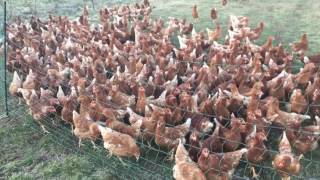
It's been a super long day. We've got deadlines with a big concrete truck coming tomorrow to put a slab in for the silos. And all the boiler pens need doing before the weekend as well as a load of other jobs that need doing around the farm. So we can't always bash out projects as quickly as we like. So quick update from today. So we have 7 cubic meters of concrete arriving tomorrow and we've just put the geotextile down to prevent moisture coming up into concrete. We're putting the silos here so there's many tons of pressure on very small feet. So we've wired all these. This is 13 mil steel and we've wired them all together. Now we've bent C shapes that these will be 5cm off the ground with little feet you see there. And we'll be wiring on some C shapes that are 12cm height difference and building another mesh on top. So we've got to get that all done today. Just getting some fresh air to the chicks. So it's day 16 in the brooder and yesterday the birds went on to 50% grain. We get wheat and barley from a local organic farmer. And so the birds have got until Monday before they come out and a new batch of 750 birds will replace this batch of a thousand. It's a lot cooler in here now. We've had the doors and windows wide open today because it's been so hot today and the birds have got, you know, they're stronger now and they don't need so much heat. We still kept the lights fairly low just because of the nighttime temperatures at the moment. It's close to zero light frosts at the moment, but they're doing really great. And as I said before, the girls done a fantastic job seeing this first batch through the brooder. The girls have had an epic production line today. Now there's eight complete frameworks and they feel really good. They're super strong. You can just hop up on these and walk across, which seems sufficient. So we've got the nets to put on still and all of the windproofing on the sides and on the roof too, but pretty cool. Very happy with the pen design. There's Tim. So finally there with the concrete pad, it's some heavy metal going on here. We've got 7 cubic meters of concrete coming tomorrow. And this is the pad for the silos. We've got two 20 foot tall silos being dropped off that will be put on here. So it's a lot of weight concentrated on Four small feet. And so working with our neighbour, who's had an industrial building firm all his Life, he's recommended 13 miles rebar, which we've wired together. And we had issues. We were separating them with these bent clamps from our original schematic that neighbour helped us put together. But when we measured it up it was too high and there's a risk of metal sticking out the top of the concrete. So quick fix solution, because the truck's coming tomorrow, we bought some 80 mil feet and turned them upside down. That seems to have done the job. So it's been a bunch of work. Luke and I have been putting a lot of aching finger time into getting all the wires twisted in and lifting up the bars. So tomorrow this will be full of concrete and then we need to vibrate it. Our neighbours lent us this cold vibration device and it'll be a case of keeping the concrete moist for a week or so until it's hard enough. And there's been a delay on the silos. They're not going to come till the weekend. And we should get our first big grain delivery for the homemade cider, which is in the barn over here. Now, Picking up bargains today, there's a guy that works with a trailer company who's selling these off cheap. Couple hundred euros. We can turn one of these into a gobbledygo for turkeys. It's not allowed on the road anymore, but turkeys are going off road. So we're going to extend the roof, stick a load of roofs in, take some of the front end cladding off, make a little gobbledygo for the turkeys. That will come later in the year. We're aiming to have turkeys in the freezer for the Christmas market. They sold last year, but we didn't do. So many people really liked them. They were the best turkeys I've ever had, to be totally fair. But there's a couple more trailers like this and they've got very heavy duty top plating which is quite handy for mobile firewood storage. Could even be used to move animals in a situation that's necessary. Always like bargains. We're after some telegraph poles now for the hops. We've got hops all the way down the riparian. The riparian is a strip of perennial vegetation along streams. We have two streams flowing through the farm and where the field adjoins the riparian, we've planted hops of three varieties from the local brewer who gives us his spent grain. This year we're lifting the Plants splitting them and putting up the hot poles. So we're after some telegraph poles and one of the teams out right now looking to pick some up and investigating with the neighbors. So that's a nice project Coming up in the next couple of weeks. The hens are really gathering a little bit more courage and they're really enjoying the full size of their paddock. Someone commented, I saw about leaving the chickens to denude the ground turning into mud. I think you might be mistaken. We're up at 59 degrees north, so very high lat. Our grass has only literally just started growing. I'll show you down on the ground here and it's exactly the same in the pen. They do scratch the surface. That scarification is a really beneficial process in the start of the season. Removes any thatch or any moths. We don't really have any moss left in our fields. And then they leave their calling card, as it were. So yeah, it's hard to compare it to. You mentioned Joel Salatin's farm but they're in a very different climate zone. We're in a very northern extreme climate here. So grass has only just begun to grow. The warm weather's just begun. Soil is only just warming up. You know, it's too early to the grain farmers to sow spring grain. So it's still very cold, it's freezing at night time. But they're not taking it to bare ground, just the grass hasn't grown. But in three seasons we, you know, we now have the best grass in the village. So I would say stay, stay tuned to the videos and come back here in a couple of months and you'll see some of the beneficial impact of these birds. So I'm cleaning the disc filter from the market garden irrigation supply and this is a very nice filter for dirty water because we're using a stream. It's going to be hard to see this on the film but it really is designed to work in dirty water for very clean water, for drip irrigation etc. We don't need it that clean. I need two hands to do this job properly actually. But we get a lot of detritus from the run out of the forest. Even though the water is very clear, there's a lot of particulate from the micro level and the ducks kick up the edges of the pond. They're happy to be down there now at this time of year. But this is basically lots of micro grooves and you just rinse it out regularly to keep this working. So to good and keep the pressure up in the pond in the irrigation head above here at the farm. So the inflow you saw here, that's feeding from a pipe in the stream that comes down through the forest here used to be a much bigger stream. And this little amphitheater shape actually used to be a sawmill once upon a time. It was sat on the road here, now the lowest point on the farm. And it was a very natural dish with this south facing bank that we decided to put these aisles, these alder with grapevines growing up them. We trimmed their leaves last summer. They've put on about a meter and a half of growth in a year and a half of growing. Yeah, it was a natural sight for a pond. And we're using gravity to bring water into the pond here and then it overflows here through a 25 centimeter pipe. So it's calculated that there's no way that the. The banks can flood because the water coming to the stream. There's also water coming from a couple of springs that we've tapped into the pond. But the outflow is big enough that it can handle any storm event, as it were. And then there's a simple siphon. We've got a weight and a sink, sorry, a weight and a float here, keeping the pre filter off the bottom of the water. And that goes down to the pump and then along up to the farm. That's just checking the configuration for the east and west beds. It needs a little tweaking each time. You put the risers in the different spaces, you can set them to rotate from 90 to 360 degrees. So you just got to set them up. Once they're in the flow of the season, it will be in their minds automatically. But it seems to be running well. We've had no problems with the pump system this year. Misa just loves chasing water. She's going to nuts for this when it comes over. So while stuff's going out in the garden, it's still only the hardiest things. There's still a lot of young seedlings in the greenhouse here. Someone asked about hardening off this year. We're just harding off by transferring to the greenhouse or putting straight under row.
Cover when it was chilly and winter and snowing a couple weeks ago. And last week it was going down to about 9, 10 degrees in here at night. That's with the fire going in the house, blowing hot air into the greenhouse. And then things would be hardened off into the tunnel over there. In those same nights, the temperature was going, staying above zero. But it was definitely between say 3 and 6 degrees on average and things have been hardening off in there going down to about 5 to 10 degrees at night time. Now the weather is getting warmer and it's into the beds under row cover and it's above 10 degrees during the day. It's really nice, actually. I think, I think it's about 15 degrees today.
You caught the sun a bit. Matt.
I did catch the sun a bit and luckily someone left their sunscreen here last year so I'm using it and Robin got me a a nice hat to protect my.
So that's it for today folks. Just taking a moment down at the lake here, waiting to turn the irrigation off. Hope you enjoy the videos. Click subscribe below if you want to hear more from us throughout the season. Now you can find out more in our book Making Small Farms Work. And check out Olivia's Kickstarter for the film Grace's Backyard about Ridgedale having a candid look inside the farm, how it runs in the summer. Super excited to share as always. Thanks for watching. See you next time. Sam.
More from Richard


A review of short and intensive season on a mixed farm and restaurant/event space in Sweden






Alskade Kyckling Exploring complexities of poultry production in Sweden and what we stand for


