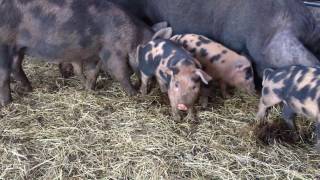
Richard Perkins walks through spring farm operations: pigs composting winter bedding, mobile broiler pens being refined for easier towing, garden plantings, and a new German plucker being tested before the next hen slaughter.
Questions this video answers
May 3, 2017
12 pens present and 8 more being built
Approximately 3–4 cm per week
Beautiful day today in the sun. We've laid the concrete pads and we've been busy on the boiler pans as well as in the gardens. Lots of progress on the ground. Feels great in the warm weather and everyone's happy. We had a lovely birthday fiko up in the neighbour's land with the cows and sheep to celebrate one of the team's birthdays. So a quick update from the farm today.
Perfect song for pouring sama. That's how it. So the pad's in and screeded and we've moistened it down a couple of times today because it's been quite sunny and hot. It's got a slight fall out so it drains here. It seems to drain naturally out of here too, which is perfect. And just leaves 2cm from the barn door. So it all went to plan very nicely. And cider should be here at the weekend. Piggies have moved into sheep barn. Sheep are up with the cows at Kent's land and there's about 80cm on the left hand side of the silage and hay from the sheep over the winter. And I imagine it won't look like this tomorrow morning. We're just putting some old fencing along to protect the stones that support the barn. And we just want them to turn this over and introduce oxygen. It's just silage from the winter and mostly hay. Used silage when we run out of hay. But they've packed that down. It's pretty deep here and hopefully as they turn it over they will like to eat that. They like to eat old rotting bedding. Hopefully that will introduce some oxygen to start this composting. This will all go out later to the tree lanes to mulch trees. So we'll leave the pigs in here for some days and then they'll join the others up in the forest. Today we uncovered the yurt platforms. We're getting a floor sander in tomorrow because we never actually treated this wood and it's quite important to protect this wood. Now this is the dining yurt in the middle of the gardens. So we'll be sanding this down and soaping the floor in the traditional way here while the weather is nice. Looks like more rain at the weekend and then we should have the yurts up pretty soon now. So it's really good progress on the pens today. We've been putting the mesh on and some extra supports in the roof here that will take the angles that support the roof and door flaps on here. And we've been putting on the handles to tow them along. One Thing to be aware of when you, when you want to pull these along is that if you use something like a fence wire, it'll eat into the wood. So we're using a bit of fencing tubing, insulating tubing to just protect the framework as well as the chicken wire. And then we just use a thick rubber hose that's comfortable and ergonomic to grip. Something to consider with the height of these wires is the position you're going to be in when you're actually pulling these along to make it ergonomic. Now you want to set it up obviously for your own height, but we're working with all different height people. And so the pen doesn't want to be high off the ground when you're moving because young birds will go underneath that or they risk getting a leg trapped, etc. So you want it to be at the right length and not stooping as you pull that along. A lot more transplants going in there. Most of the leeks and onions are in. There's some beautiful pak chois and lettuces that have gone in. Biggest problem we have here in Sweden is flea beetle, but we haven't had any issue with these. Right now we use diatomaceous earth at certain points and we're using different kinds of biological pest controls. Sometimes we use Bt bacillus, thuringiensis, but insect netting over the beds or fleece as soon as they go on, that's the dinner bell. Covering the beds immediately after sowing or transplanting is the key. I'll do a little garden update soon, talk more about some of the methods we use for that. But it's looking good. Lots of progress in the gardens and I haven't been spending much time in them myself because I've been busy with the other things going on. But I'll give you a nice update soon. The oaks just outside our house are just forming their buds. I expect they'll shoot forth the first leaf growth in the next week or so. It's interesting. Microclimates about 15 meters elevation below us in the village. They've already got 2 centimeter long leaves. So it's, it's very, you know, we're on the edge of a microclimate here. It really makes a difference. The grass down by the lake, about 6, 700 meters away, is already about 10, 15 centimeters tall. We're just seeing the tips of growth now. Different kales in here, different red and green kales. We grow quite a lot of kale. Some of our customers don't like kale their husbands don't seem to eat it. We love it. Super nutritious, super flavorful. There's beds of spinach here. These are the new north beds and we've got garlic coming up on the right there as well as Kales, Broccolis, etc. Lots to be planted out soon. We've got the irrigation coming on again tonight over here. We're trying to put 3, 4 cm down a week so we keep an eye on the weather and then we water as needed. So boiler pen is doing good, but we've got to fix up some of the old ones here and we've got just a few days now to the first birds go out and we'll be using all of these pens. We'll fix up the plastic on these as side wind protection. There's 12 here and we're building eight more. So it's going to be a lot of pens on the field and we're working out the best way to. To run them this year. I'm just in the storage room now testing the chiller. We've had a technician out, but it's not clear what the problem is. This dial has always been strange. You see the chiller's just gone now. That's a Spanish unit and it's. The temperature's always gone up as the temperatures decreased in size. It's always been a bit funny, but it became a bit unreliable during slaughter sessions and we've got to butcher all the old hens pretty soon as soon as we can get this figured out. It's working right now, but it feels unreliable when you're putting hundreds of kilos of meat in there. So we're going to test it now because it's working. It didn't turn on at all when it was colder outside, but because it actually works now, we think it's something pressure related in the electronics sensors, so it might be easier to fix. So hopefully the technician will be out this week and then we can get on and slaughter the old hens, which will go off to a local organic focused school. As well as giving us meat to eat ourselves. For doing the hens, we'll be getting a chance to test out the new platform plucker. It's a German plucker, same brand that we had before, but the model we had before was technically a turkey plucker with a central rotating drum with fingers on it and smooth sides. This version has no lid, but it has a lot more fingers on the sides as well as the bottom and it rotates a little bit slower it seems and I imagine it's going to do a very nice job for us so we can to test that out and get everyone used to the slaughtery and how this it all works in here through the different stations before it's time for the boiler season to really begin.
That's it for today folks. Thanks for watching our videos. Don't forget to click subscribe to Follow the Season. Share the video with your friends. It helps grow the channel. We appreciate that. Thanks for your time.