S4 ● E39 800 more broiler chicks arrive tomorrow....
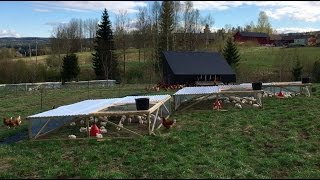
A narrated farm-update video by Richard Perkins covering windbreak planting (alder, willow, spruce), broiler chick care and brooder preparation for 800 arriving chicks, yurt/ger construction and use as teaching/social space, and preparation of the slaughter/processing area. The video mixes practical management choices (restrictive feeding, bedding, brooder heating), animal-welfare notes, and upcoming tasks (fencing, slaughtering older hens, planting strawberries).
Questions this video answers
800 birds.
200 per brooder pen.
0 degrees (freezing).
About 60 square meters; fits up to 40 people comfortably.
Chapters
So the windbreak's just coming into leaf behind me. And this is alder. We planted 80 centimeter whips about two, about two summers ago. And the willow here is growing up nicely 7, 8 meters tall in places. Now it's just coming into leaf. We've got spruce down here every three meters to form a winter windbreak. And I'm making a video today because I'm off camera collecting day old chicks tomorrow. So a quick update from the weekend. It's already neem four. We haven't had to go any full star objectives. This is a, This is Viminalis, a hybrid fast growing willow that was put in as little 30 centimeter cuttings from twigs straight into a keyline rip in this Mybex. You see it's put on substantial growth. I can't even join my fingers around this now. So it's forming the front edge of our windbreak. Inside that we have slower growing spruce that will form a thick, dense winter protection with alder that will rocket up and be 10 meters tall in 10 years or so. And it's ramping the wind over the farm because we're here at the south side of Thompson and most of our wind comes from the south. So this is acting as a ramp to send wind right over where it will then meet the riparian, meet further hedgerows, etc. On its way over the farm. The sun's come back up and it's a very rainy day today in the morning and the night was rainy. So I was very cautious about coming up here early in the morning to check if the birds are fine. And they were fine. They didn't get too cold. It was a bit colder last night. But this is actually the worst pen where they were still picking after we moved them out to the field. But there's no new wounds. All the wounds are drying up nicely. So I think the fact we got the birds out on time was a great decision. And we've got the brooder ready now. We're going to have a look at that. The next batch of chickens arrived tomorrow. 800 beds. The hens are a bit curious of me. I've been checking all the pens and the birds are doing great. It's going to be zero degrees tonight and I was a bit concerned of moving the pens this morning onto wet ground. It started raining last night, but the birds were quite dry and comfortable when I came up to check late in the evening. But now it's going to be freezing at night. I'm going to make a decision after Dinner, whether to put a bit of straw down in the back quadrant, the most covered quadrant of the pens, to see if they will be able to keep a bit warmer there. They're still very young birds and they're not supposed to have gone out on pasture till tomorrow. I found an escaped hen here. Very curious. Lucas, who's one of the farm managers, was saying the only experience he's had with pastured boilers is with an unrestricted feed program back home in Argentina. And he was saying at this age, he observed birds that couldn't walk. And that's the problem with this breed of bird. They are bred to just eat and grow very fast. So it stresses the importance of a restrictive feed program, which we've been refining ever since we've been here. And we want these birds to be healthy and active their entire lives. You know, we're managing for welfare and the birds are strong and healthy and they will remain. So we're going to keep a couple of the birds with the laying hens now. We did that before for over a year, and the birds grew to eight kilos in weight, but they were still healthy, happy, functioning hens that roosted up high and laid double yolk eggs every day. It's all about management. You know, these birds, a lot of people think they have a bad reputation for being unhygienic, not being good at foraging, dying of heart attacks, leg problems. It's totally down to management, in my experience. And we've raised a lot of these birds now. We've been putting the yurts up on our day off. It's a fun thing to do for people. And they're technically gers. A ger has straight roof poles, whereas the yurt has steam bend poles. That actually truly transfers the weight down into the walls. Very beautiful spaces. This is our teaching yurt. And then we typically eat in this yurt. We stopped because it was weekend and we wanted to take it easy. So this one will be up soon. And this is a teaching space for the courses we run. And the library goes in here. And maybe I'll make a separate video about these because these are very nice structures. I used to run a yurt building company when I was in my early 20s and it's a joy to make and a joy to be in. Circular space has really changed the way you think about space, and perfect for group settings where people can see each other rather than more formal settings we're perhaps used to. But very nice structures. Johanna and I built these two in about 10 days. A couple of Years ago and very nice. I mean, about 60 square meters, so you can fit up to 40 people comfortably seating in here. The spaces here are really important because we live quite an outdoor lifestyle and having space to sit and read and study, as well as, you know, light, airy spaces to meet together, to eat, etcetera, is really important to us. This is our main yard that turns into a sort of social space where we have fires and the sauna is obviously here. And so it's a real big shift for us to have the yurts up and looking forward to getting this one up next week. So all is going really well with the birds out on pasture now. Especially cold and wet last night, but it's going to go down to zero tonight. So we're going to put straw down so we can get up off the ground, keep it a bit warmer. I'm now coming in the brooder to add water to the bedding and then I'll fork it over gently before putting new bedding in. Then I'm going to bring in the air compressor and just clean off the lights. You see, they gather a lot of dust and obviously with sitting on a hot object, that's not ideal. So I'll just clean them up. And we've got 800 birds arriving Monday to start the second batch for the season. We're doing this just to start a microbiological nappy, as it were, and it's not an exact science with the amount of water. I'm just giving everything a little covering and then I'm going to put about an inch of new bedding on top of this once I've forked it over. And I'm not going to turn it over completely, I'm just going to sort of make sure the water gets more evenly distributed. And then I'm going to put the lights on today. So I'm actually going to use probably two cans per 10 square meter pan. That feels like about the right amount. So I've been working to get the brooder ready for the next batch of chicks. They're arriving tomorrow. Matt and I are going to go and pick them up. So each subsequent batch now will be 800 birds. We'll put 200 in each brooder pen. We've put two watering cans of water in each pen and raked it over. And then we've added new sawdust on top of that, cleaned the lights of any dust that was accumulating on them to make sure there's no fire risk. And we've spaced out the waters and feeders to make sure they move around a lot in their early days, which helps with their general physical development. And we put the lights on early to get it heating up in here for at least 24 better, like 36 hours. We're not going to be using the heater anymore. It's getting warmer outside now. But it's important to get the bedding up to temperature because the young birds has just got down and it loses most of its body heat through floor contact. So you really need to make sure the spaces under these lights are adequate size and temperature before the young chicks come in. So I've been in the slaughtery today, just hooking up the new plucker, sanitizing everything, getting it all set up for slaughtering the old hens now and just checking everything's working. All the water connections that we've had turned off for the winter. It's good to be ready ahead of time and everything seems to be functioning. The chiller is working quite well, which means it's probably a pressure related thing because the temperature is warmer outside, but it's been at zero degrees for a couple of days. Just testing that out. So it's going to be the first opportunity for the crew to learn the process of bringing birds in. Plucking, scalding, Scalding and plucking, eviscerating, going through to the clean side into the chiller and how we monitor the birds, how we check for diseases, etc. Which we never really have because the birds are so healthy. The kill stations are out here, so it's a chance for the crew to learn how it works ahead of time. And then our first slaughter week. We'll be doing a thousand birds that week, so. So it will be requiring a bit of attention to get everything going. But everything looks great in here. I've just been cleaning up the floor because we've been coming in with muddy boots. We sold our old plucker. It's a perfectly good machine. Turkey plucker though, same brand of machine. German company is the best brand in Europe and it's quite slow moving. It's a nice machine and it's good for up to 35 kilos of chicken, which is more than we'll ever put in. Everything is timed and you need a good team working together really to optimize the workflow. The kill cones are six birds each and it takes twice as long to bleed as it does to scald and pluck. So there's a bit of a workflow to get it organized that everyone is in Constant motion, as it were, and their birds aren't piling up anywhere. We have to show the chill down of the birds. We have to show how long it takes for a bird to be killed, bled and get through here and how long to reach core temperature. So we probe a few of the birds to make a record throughout the day to prove that we've chilled them adequately. And this chiller is good for like 5, 600 kilos of meat to get it down to the correct temperature in time. So it's not a problem. And yeah, I'm excited to dress these birds and have a bit of a meat supply as well as supply some of the local schools. The pigs have done a fine job turning this over. See the contrast here with the grass starting to grow. And as soon as we're going to start building fence next week, it's a busy week. Next week we're going to slaughter the old hens and we're also gonna start fencing and potting up strawberries for the tree lanes. As soon as we've made a new fence, we'll get these out of here. Now they've done a great job. There's still some patches they haven't touched, you might just be able to make out. And they haven't taken out too many trees yet. And so it's about time for them to move on. And this will become very lush pasture species later in the year. That's it for today, folks. Thanks for watching our videos as always and don't forget to click, subscribe and share the videos on your page. If you think your friends will benefit from watching it, you can find out more in our book, Making Small Farms Work. See you next time.
More from Richard


A review of short and intensive season on a mixed farm and restaurant/event space in Sweden






Alskade Kyckling Exploring complexities of poultry production in Sweden and what we stand for


