S4 ● E40 800 new chicks and 800 strawberry plants lost in the post
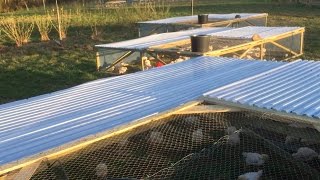
Richard Perkins and Matt pick up 800 boilers and reconfigure their market garden to supply restaurants instead of CSA shares, cutting those down to 50. They received 800 chicks in broods and 600 strawberry plants across five varieties, but got hit with an unexpected €8,500 charge.
Questions this video answers
800 boilers
About 50 shares
200 in each pen
600 strawberry plants across five varieties
€8,500
Chapters
So Matt and I are taking a road trip today to pick up the second batch of boilers, 800 boilers that make up batch two for the season. And we've also been using this time to replan the market gardens. We've been having some very interesting meetings with chefs in hotels recently. What's the meetings been about?
The meetings have been about how to supply the local restaurants, some of the local restaurants with more continuous food supplies. So some of them, for example, want to be providing seasonal produce for their salads and their customers. So that we're going to provide on a weekly basis. But then things like salads and nice ridged ale mescaline mixes, which will be provided on a more consistent basis. We're looking at calculated the weights per week and then changing our garden plan to be able to provide those weights every week.
So we've just been rocking that out in the car and we're basically going to reduce our CSA shares down to about 50 shares. We haven't sold them all yet. And we're going to utilise the rest of the space, basically the new north beds for growing lettuce and salad mixes exclusively for a very big famous hotel close by, as well as some new startup restaurant customers. And we've been working out the crop, scheduling and the seed required to make a swift change of plan whilst the season has already begun. And it looks great. It produces about half the desired revenue from the market garden from a quarter of the space of the market garden. So there's some pros and cons. It's been really great to have the CSA model to work with as a low risk way to start up the market gardens. But there's a lot more exciting possibilities with a couple of good larger restaurant customers. Because we're so remote in the middle of nowhere, it's hard to sell all these shares without large logistical issues. So to be able to drop to restaurants that are very close to us, that have a high demand, who also buy a lot of our eggs and meat products too, is a bit of a bonus. And a customer will likely retain year to year. So we're quite excited for the change and we've been doing the mathematics and we need to put in another seed order now and we'll be seeding the first REM lettuces and mescaline mix this afternoon when we get home at Farm. Do you feel phased at all change in the plan halfway? Well, when we've already begun the season?
No.
It's exciting and it's actually a necessary part of learning how to manage a market garden. Things change throughout the year and obviously you know you intend to succeed with an initial plan, but if you're not willing or ready or capable of adapting that plan, in my opinion, you're not going to succeed. Especially when you are trying to introduce the local community to what it is to get this vegetable box each week. And they're not so familiar with CSA out here.
Yeah, it's only about 10 or 12 CSAs in Sweden in total. It's quite a new concept here. But it's something I love about Richter, is that we are very good at adapting and changing our planning according to the time, place and circumstances. Something that feels quite useful.
Yeah.
One of the things I've learned about CSAs is that you generally don't. You would never want to be below 50% customer retention. You know, if you're up around 70%, you're doing a great, a fantastic job. So if the value of local restaurants equates, just for example, sake. If the value of local restaurants equates to about 20 shares, in order to retain that next year, you would need 40 CSA shares this year. Work towards retaining 50% next year. So it's quite nice to have these relationships to sit down with the chefs to find out exactly what they want and to have their support that they want to promote our products to their customers. And it can only snowball from there.
Yeah, yeah, yeah. It feels really good. And it's taken us just a few hours to think about and do the mathematics and then we need to get some seeds to change the plan and change the cropping calendars and spreadsheets that we're working with. But it's, you know, it's a day's work for someone to drive the enterprise in a different direction and increase its production per square meter quite radically as well as the revenue of the enterprise. So super excited.
Back with the new chicks. 200 in each pen. You have to be confident and swift, really. Yeah. It doesn't hurt them in any way, but they, they need to not. They need to not go flying too much. New chicks are doing fine. It always is surprising when a new batch come, how really tiny they are when they first arrive. It really doesn't take long for them to grow. Temperature is okay under the lights. You can identify. Here you see a light that's not. It's got a lower powered bulb and not many birds underneath it. They're enjoying the sunshine as well. And the birds on the fields are doing well. It's going to be minus degrees. The Next few days, actually at night time, so we're going to consider alternative options for keeping them warm at night. We wrapped the open side. The wind was coming from the north yesterday, so we wrapped the open side with some geotech stuff in the garden just to keep them warmer. And that seems to have done the trick. And a lot of people have been.
Mentioning about the audio. I'm aware it's not the top quality video production.
I'm a farmer, not a filmmaker and.
To be honest with you, I'm filming.
Often on the iPhone.
So the audio is just not very good quality. But it's because I haven't got time to go and set up a camera or anything.
I have got some good audio equipment.
And I'll try and use it where I can. I have set the levels of the.
Start and end tune to be more.
In sync with the audio. But yeah, it's got to take me.
No more than 20 or 30 minutes to do this every day for me to share in this way. So I hope you can dig that and appreciate that.
You know, I'm doing my best to.
Try and share when I'm already a very busy person.
I don't really need any extra work.
So sorry if it doesn't suit you, but thanks for everyone who's checking in.
Regularly and we appreciate your comments and feedback.
Anyway, Strawberries came today, got five different varieties, 600 strawberry plants. These are going in between the chestnut seedlings up in top field. They've been lost in the post for a few weeks. We also got charged €8,500 for them. I think they've missed a couple of decimal places, but we're going to report.
Back to the company.
They're quite dry in the roots and they've been in the post too long. So we're going to see what they say about this. Here comes Robin with another trailer. He just keeps finding these bargain trailers everywhere. And this one is perfect as a gobbledygo. It's quite a long wheelbase. So another bargain to be turned into some useful farm infrastructure. So we're just up and putting the boilers to bed with a bit of geotextile from the market gardens on the north side of the pens. We've had a lot of very cold wind today coming down from the north. All the protection on the pens is in the south because that's where the predominant winds come from. But these birds are only 21 days old. They're still feathering out, they're still very young birds and they're doing fine. But it's going to be zero degrees and down to minus two the next night. And so the ground is dry, so I'm not too concerned about that. But this cold wind is, you know, it's going to suck heat away from their bodies and I want to keep them in top notch condition. They're doing great. But this is like a little temporary precautionary measure we're doing. It's one of the things we, you know, farming at 59 degrees north requires a little bit of sensitive thinking. So I'm just tucking these under the roof and I'm going to go down do the others now. Early start tomorrow. We're going to slaughter the old hens. The first slaughter session of the year and we've got that space ready and everyone's been instructed in how that operates and we've organized the team for tomorrow. So thanks for watching our videos. Appreciate that as always and don't forget to leave comments and click subscribe below. If you want to keep up to date with the farm, you can find out a lot more in our book, Making Small Farms Work. See you next time.
More from Richard


A review of short and intensive season on a mixed farm and restaurant/event space in Sweden






Alskade Kyckling Exploring complexities of poultry production in Sweden and what we stand for


