Richard Perkins processes 250 spent layer hens at 63°C scald and 40-second pluck. Dress weight runs 1 to 1.23 kg per bird, selling for 75 crowns. The operation emphasizes chilling to 4°C within hours and swab testing for food safety.
Questions this video answers
63°C for 40 seconds.
About 40 seconds.
250 birds.
75 crowns (7.5 euros).
Between 1 and 1.23 kilos.
Chapters
So as our first slaughter day today, taking the old hens, it's been a very busy day at the farm, getting everyone used to the systems here. So a very quick update from the farm today.
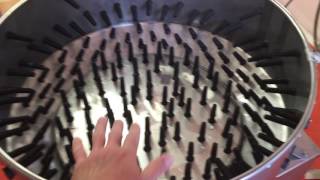
Just getting the scalder to the right temperature. We scalded amount 63 degrees for 40 seconds. Just letting out excess pots, fill it up and then we pluck for about 40 seconds. Although we have never used the new plucker. So we'll be testing that out for the first time today.
So we're in the flow with layers.
They're not plucking as well as we would have liked.
And we're just working out the skull, how it works with the layers because.
The birds are older and tougher and the new plucker is working okay.
I think it'll work a lot better with broilers, but it needs a lid is what we've discovered so far.
We sell them for 75 crowns, which is 7 and a half euros. It's the cost of buying a 16 week old bird. So we get the money back for the bird. And it's a little different eviscerating a laying hen because it's got the oviduct and eggs. See this one has a full egg ready to come out and so it's a little bit messier because the way that the chicken produces eggs is it has a few weeks supply of egg yolks up at the top of the oviduct like this and they are very fragile obviously, so they spill inside the guts. I'll just take this egg out. There's a perfectly formed egg in here ready to go. So these are birds that are laying an egg every 26 hours. So there will always be eggs in there. And they're very small birds. They dress out maybe between 1 to 1.23 kilos and they're very much tastier. They're full of really dark yellow fat. So they make a really tasty bird. But more suited to like. Older generations are familiar with eating this kind of chicken, whereas you younger people have typically only eaten broiler chickens for meat. So you have to cook them a bit longer and slow, cook them for soups and stews and things. But it's a very nice part of the process to be able to recoup the cost of the actual bird in the process. It just takes a little bit more time. We're probably running at about half the speed of when we're eviscerating broilers due to the extra work. And the oviduct is attached to the spine. I don't know how clearly you'll be able to see this, but you see all these little future eggs that you'll find a series growing up to like a full egg yolk size. And it's only then that the yolk starts traveling down the oviduct and the abdomen and the shell are formed on its way down in this spin motion. So there's one full egg often in these birds, but then the next egg that will come out 25 hours later.
Is just a full size yolk.
So little birds, but tasty and good for stewing. So we've done 250 birds today. Really nice needs and modification to this machine. We're going to build a lid for this because it throws out feathers and part of our clean down procedure is to remove all traces of feathers, etc. So we've just been through here now. With hot soaking water, we soak all the knives and hooks, etc. For about 20 minutes in boiling water and soak from top to bottom, every surface underneath. When they come and inspect the slaughtery, they take swab tests of knives under the benches. They're looking for bacterial colonies and it's been spotless whenever they checked. It's been a really nice team effort to clean this down each time we use it. So hot soapy water and then a pressure wash with cold water after the floor's been done too. And then outside there's been pressure washed. The concrete pad is unclean and all the aprons and boots get cleaned out here and it's ready and left in nice condition for the next snow decision.
So we're all done in here.
Great day, great teamwork and everyone's sort.
Of learning the ropes as we go. And it went really well. The birds didn't come out the plucket in the best way. Definitely need to put a lid on.
Here, stop feathers flying out. Other than that, the, you know, the.
Laying hens are a bit tougher and older and the feathers are a lot.
More well embedded in the body.
So it's going to be different with the broilers automatically and it'll be interesting.
To see how that goes. It went good today and got about.
250 birds done and nicely cleaned down. With a clean down, we're aiming to.
Have zero feathers left inside. I've been to some slaughtering facilities that just look manky inside and it, you.
Know, we take a lot of pride in our work. Slaughtering animals is, you know, it's a really humbling but really important part of the farm.
And it's something we take very seriously.
Both from a work ethic, but also like the health and safety issues of a high risk product like chicken.
And the team have, you know, done.
A wonderful job today, so it's great and really nice teamwork and communication between people. Nutella did a great job with their clean room and monitoring. And we record the chill down temperature.
Of all the birds.
We have to show that they reach 4 degrees within 8 hours. So we probe some of the birds in the deeper tissue and they reach temperature within about two hours. So really nice, great team effort. And the birds will sit in the chiller overnight and then we have a packing team. We use heat shrink bags. You dip them in hot water about 90 degrees and it's vacuum seals them up. So that's a job in the morning for a couple of people and get the birds packed up and we'll put them in the freezer for our meat supply throughout the year as well as selling a few for local schools that are interested in organic, local, sustainable stuff. And they buy spent hens for the, for the kids to eat, which is great. This is the deep litter from the.
Hens from the winter. And the new hens have just laid their first tiny eggs yesterday. So now the hens in here have gone. We're taking the nest box for a deep clean out.
So the old nest box has come out, the layers in the field have just started laying a couple of very small eggs and over the next two or three weeks they'll start laying a lot of eggs and it'll take about a month until they're laying regularly and then their production goes up to about 95% or so. But something important about nest boxes, particularly if they're made of wood, is to clean them thoroughly because you get mites that build up in the corners of nest boxes particularly. We're always changing the mats over. We have two sets of mats for each nest box and we'll change them over every few days or whenever they need it. But it's important. Now. We've just been cleaning out some of the dust and we'll bring the pressure washer onto this and get it spick and span and take it up to the new hens to get them used to this space. So these last couple of nights have been below zero and it's going to be zero degrees the next couple of nights too. I think it's a very good decision to put the landscape fabric around the north side of the pens. We've been getting winds from the north, but the birds are doing fine out here. We've had no more pecking issues at all since they've been out. So very happy we made those decisions and got the birds out early and we can go up and see the little chicks that arrived yesterday at the farm on Batch two. The new chicks are doing fine in here. We haven't had to use any gas heating and it's not so warm as it was when we had the heater on, but the birds are doing fine. They're not stressed and they're huddled up a bit, but that's normal when it's, you know, they keep warm, they run out to the feeders and waters and come back in again. But it's sitting at about 35 on the backs of the birds, so it's an ideal temperature in the beginning, but amazing to think about. You know, when you compare the birds in the field, they're three weeks old, and then in eight weeks, some of these birds will be four and a half kilos in weight, live weight. That's it for today, folks. Really quick video because it's super busy week for us and I've got things to do this evening. Thanks for watching the videos as always, and you can check out our book in the links below. Click subscribe. Share the video with your friends. Thanks for watching. See you next time.
More from Richard


A review of short and intensive season on a mixed farm and restaurant/event space in Sweden






Alskade Kyckling Exploring complexities of poultry production in Sweden and what we stand for


