S4 ● E42 More snow and a restful day at the farm...
A narrated farm vlog by Richard Perkins describing an unexpected snowy morning and a restful, planning-focused day on a high-latitude farm. Covers animal welfare in variable weather (birds, pigs, lambs, cows), practical eggmobile and nest-box design and egg-collection routines, greenhouse planting (strawberries, garlic, salad mixes), and brief notes on selling eggs and team planning. Emphasizes weather unpredictability and adaptation strategies.
Chapters
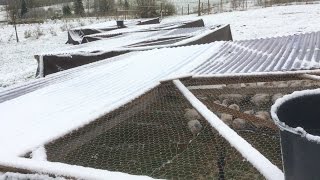
So we've just woken up to this. So we're going to go and check the birds in the fields because we weren't expecting snow tonight. Well, it's really something quite new for us. We've never seen birds out in the snow, but they're doing fine. And it's quite warm when you lift the lids up, the birds are cozy in there. Well, the pigs really don't mind. They're not really phased by anything, to be honest. We started carrying up the fence posts in the snow now over there to start building a new paddock. But on a day like this, it's a good time to stay indoors and we're going to really look deeply at everyone's learning objectives, why they've come here, things that we can specifically support them with on their journey. Here you can see where some of them slept. I don't know if you'll make it out in the film, but it's a little steaming patch and there's a little nest there and one in the. One in the background here they have trees down the bottom. Over here they have large trees they can shelter under, but they've never chosen to. I don't think they are fazed by this weather at all. And they've been growing. The young piglets are growing much faster now with the warmer weather, they're putting less energy into keeping warm. The younger piglets are really growing quite fast now. Farming this far north is, you know, the weather is always going to be unpredictable and each year has been quite extreme. For us, the second year was the wettest year in history and last year had the driest spring on record for about a hundred years. Just opening up this egg mobile. So we're all kind of done with this weather. It's, you know, it's flitting back and forth between like 15, 16, 17 degrees and 2, 3 degrees, which it is right now. Got pretty cold hands this morning, but the animals do fine. As long as they have clean water and somewhere dry to be sheltered, you know, it's no problem. And we're always keeping an eye on the weather, obviously. And with the broilers, it's just important they're kept dry. So if the ground is wet, we'd put straw down in the pens. But they're on dry ground and they're very well protected. They have 360 degree cover around the pens and 3/4 of the roof is covered, so they're perfectly happy. In fact, they're much warmer than they were last night or the night before. So not Concerned, there's nothing any birds getting sick from exposure, etc. So it's all good. But I would like the sunny weather to come back. Everything's just started going into growth and that's the way it goes. You know, the weather here can be very variant. We have about five months frost free, give or take up to 30 days. So we really are, you know, the extremes of the weather patterns are felt much more prominently here because we're at such a high latitude and yeah, it's a challenging place to farm. I mean, the sunlight intensity is very low here in the summer. It's balanced by the fact we have very long sunlight hours, which allows us to grow super nutrient dense herbs and berry fruits, etc. A lot of pharmaceutical grade herbs are grown right up in the north of Sweden where, you know, you know, it's constantly daylight. So you just have to go with the flow farming here and really pay attention to the weather forecasts, which can be highly inaccurate, we find. And you know, like this morning we weren't expecting snow, just a little bit of drizzle over the night. Let's go and see the cows and sheep. Here's Kung Fu Panda. Lambs are doing fine. They're getting much bigger every day and they're also really unfazed by this kind of weather. The sheep are very happy and they can graze through quite deep snow. They're very good at digging and cows have no problem in light snow. Now they can dig through half a meter of snow, but they have trouble when it gets icy and they're not very good at digging compared to the sheep. You see, you see, they're excited for their new move. So now it's after lunch and the snow is all melted. But by not moving the pens today, it's very dry still underneath the roof here. And the birds are doing fine. They're very young and they're still feathering out as you can see. So that's why we've taken the extra precaution with these night blankets and we've left them on through the day without moving them today. And it seems to have been a good decision. So it's a bit darker in here, it's hard to see perhaps, but the nest boxes, you need to look at your local regulations because there's regulations about the size of a nest box. Usually it's usually about 30 by 30 by 30 centimeters for a hen. We've built these just out of marine plywood to make it a bit longer lasting. And we have a bit of a Slope on the floor here to serve as a roll away the roosts to help the birds get into the nest boxes. Also serve to close them off at night times. You don't want the birds roosting in the nest boxes because they will foul the matting. And then we have simple. This one has Velcro so you can lift up the mats, lift up the lids to collect eggs here. They'll roll down and we have a simple little foam strip here so the eggs aren't hitting wood. Obviously you've got to make sure you build the gap here big enough for eggs to roll through once the mats are in. I've done videos about this in the past. It's industry standard egg mat, which is not the same as Astroturf. It has holes in the bottom to or broken eggs to drain through it. You need to clean these regularly because a broken egg will start to dissolve the plastic in the end. So people have often asked for plans for these, but we didn't really design them, you know, we designed them on the fly. We don't have any written drawings. You want to allow adequate room for the amount of eggs you're collecting. And you know, it's going to depend on how often you collect eggs. We'll typically collect eggs. We open them up first thing in the morning. And morning chores are really characterized by when the nest boxes need to be opened, which is about 6:30, 6, 45. You don't really want them laying through the floor, obviously. So first thing we'll do is move the eggmobiles, get these opened up and then we come back about 10:30, collect the eggs. And we also come back in the early afternoon and collect any leftovers. But the majority are laid in the morning. Some people like to have individual nests and some people like to have hay or straw as bedding. It's much nicer for the hens in a way that they can build their natural sort of nest, which a hen will like to do. But it's harder to get clean eggs in that way we found and it's really important we get clean eggs. You're not allowed to clean eggs with any water here, so we've chosen rollaways with communal nests. So each one of these boxes represents three nests and you'll find birds will they like to lay where other birds are laying, so you'll find four or five and then they'll cycle through or laying their eggs at the back here. It's screwed onto the wall and to ensure it can't fall forwards using a Bolt like this. We're able to level the nest boxes according to the slope that the eggmobile is sitting on that day. Because our terrain is quite varied, it's not set up right now. We just installed this box yesterday after a deep clean out and the birds are just getting used to going in it and see. So whilst we haven't got any detailed plans, I think it's pretty easy to make these for yourself. You just need to look at the local regulations that you're working with to ensure you supply adequate number and space in the nest boxes. Regarding any floor eggs, hens will start laying eggs randomly on the floor. Small eggs often in the beginning. It's important you collect those eggs up because the hens are habitual and they copy each other. So if some hens start laying outside, they will all start laying outside. So you want to pick those eggs up really early and always do that regularly in the beginning. You know, a few times a day is a good practice. So it'll be a few weeks yet until they start laying consistently and the eggs will increase in size throughout the season now and we keep detailed records. I'll talk about that later as the production cycle increases and let you know about the times and weight difference throughout the year. We typically sell our eggs by weight, by kilo to restaurants and we sell in mixed flats that are unsorted in their size to private customers and they're all mixed up so, you know, the weights average out as it were. Still a slow start for the garlic. We really haven't had that many days of warm weather. It's gone down to 2, 3 degrees these days. The greenhouse has turned into a bit of a additional potting space as well. We've eaten all the spinach out of here, but we've also been getting a lot of baby salad. Now the salad mix, this is just a two variety mix that we've been growing. The oak leaf and romaine, which has been giving us plenty of salad. We've got a couple of beds of this that we've been eating every meal, huge bowls and salad. So all the strawberries that came that got lost in the post have been put into root trainers here and they suffered a bit. They grew out a bit in the post and the roots dried out a bit. But the company were great about it. When we phoned up they saw that the order was very delayed and they immediately said they would be replacing them with younger plants which also cheaper. These are slightly more expensive plants because they will give fruit this year. Maybe now they're knocked back a bit. It's you know be lower production but they look okay. So these are either going to be all free, there's 800 strawberry plants in here in root trainers and we'll either get a replacement stock or we'll have these for free. So either way it's pretty pretty nice for us in the end. And these are going in the tree lanes for the chestnut and walnut plantings up in top field between the main silver pasture lanes so they're going straight through the black Mipex plastic and we put them in root trainers to facilitate planting them out with the interns when they arrive. So that's it today folks. We're having a pretty easy day and connecting together as a team as well as doing some behind the scenes planning etc. Thanks for watching our videos. Click subscribe, share the videos and you can find out a lot more in our book Making Small Farms Work. See you next time. You.
More from Richard


A review of short and intensive season on a mixed farm and restaurant/event space in Sweden






Alskade Kyckling Exploring complexities of poultry production in Sweden and what we stand for


