S4 ● E43 No Dig Market Gardens at 59°N, and Gracie caught her first pike....
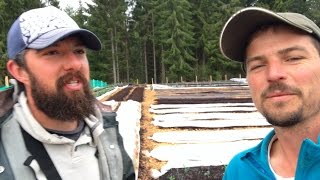
YouTube video (Richard Perkins, May 15, 2017) updating viewers on a no-dig market garden at high latitude (59°N). Topics covered: new bed layouts (north vs south), intensive romaine spacing (159 plants/bed), mesclun rotations (six beds/week aiming ~30+ kg/week), pest controls (row covers, diatomaceous earth, slug concerns), greenhouse practices (heated lean-to, sodium halide lights, transplant strategy), planned trials (biochar pre-soaked in urine, compost teas, foliar biofertilizers, Paul Stamets mycorrhizal inoculant), business shifts toward restaurant sales and reduced veg shares, and a closing personal moment where Gracie catches her first fish.
Chapters
It's been busy times. We're putting pig fencing up and receiving the silos we've been waiting for for a while. So there's a quick update from the market gardens. As you can see, it's really slow start to the season here. The beds are looking great, but it's been about 2, 3 degrees most nights and it's not been freezing anymore. But there was snow just last week and it's really quite a slow start. I saw some friends in Denmark who are way ahead of us with their market garden just because the weather is so nice now. So we're trying a few different spacings and changing the north beds. The new north beds?
Yeah, absolutely. Which is right behind us here. You can see some flat row covers down, which is pretty much all mescaline. There are a couple beds of peas. But we're now doing six beds of mescaline per week and anticipating about 30 plus kilos harvest from them per week.
We're supplying Selmouth Spa, it's a big famous spa hotel near us, and also some restaurant customers who want particularly romaine, lettuce and mescaline. So we're turning actually most of the new beds here we've planted out. How many of them did we plant out already?
We've now done eight for the mescaline. We've done eight and we've now seeded nine trays of romaine.
Talk a little bit about the rotation of the mesclan and the romaine.
So we're anticipating, well, the romaine. We're doing 159 plants in a bed, which is about three rows at 18 centimeter spacings, which is more intensive than even the intensive spacing we're already using. And that's going to be mainly for Caesar salads and then some extra to some different other restaurants. The mescaline is running on a rotation where we're going to be after the first harvest. We leave it in for approximately 10 days, depending on the weather, and for a second regrowth secondary cut. Yeah. So we're anticipating, based on last year's numbers, 5 kilos from the first cut and about 2 kilos plus from the second cut. So we will get to a point in time where when the second harvest is done from the first bed, it then gets reseeded on the same day. And we're looking at 41 beds rotating approximately three times for all of them until the end of last. Seeding will be early August, mid August.
Yeah, we're going to see how it goes because these north beds, they get less sun because of the late evening sun that comes from the trees right over here. So we've got higher yields in the south beds, but they are also beds that we'd cultivated for several years already. So I expect we'll get slightly better yields this year just from having cultivated the beds last year as well. But we'll see how it goes. And so we're going to be turning over. We just bought two and a half million odd seeds for the mesclin mix. So we invested quite a bit in this change of plan, but it's actually producing half the market garden revenue that we planned for this season with quarter of the space. So if it works well, it's a really interesting option for us to explore serving local restaurants who have a much bigger customer reach than we do on our own.
Yeah, and we will have a lot of extra other vegetables too, because what happened is before we made that change, we were planting enough vegetables for 100 boxes. And now that the vegetable shares have been cut somewhat, we have all those initial transplants and direct seedings that were initially planned for more.
So we actually have a surplus which we can take to market also.
Yeah, exactly.
Super. Nice. Do you feel good about being a lettuce farmer?
Yeah, I'm a mescaline farmer now.
Nice. And it's a six, mainly based on six varieties. And we'll be putting in Brassicas and other things later in the year. Right now is the time when the Brassicas start to get flea beetle now.
Yeah, we've seen a few. We've seen about just the beginning of the bed of the black. Summer is starting to be affected by a little bit by the flea beetle. So we're sprinkling a little bit of diatomaceous earth.
We're also using row covers and insect netting immediately after sowing.
Yeah. And we've just spotted the first two slugs today. There's a big slug, sort of a slug problem. There's an invasive species, the Spanish slug here. And the neighbor sometimes in the morning will pick 500 plus slugs up in the morning.
No exaggeration, they haven't come over our ditch yet, but we have a few slugs. But the Spanish murder slug is an episodic problem in Sweden we've avoided and we're going to keep trying to avoid that. I think we've got different kales and cabbages, spring onions and onions in now. All the onions for the season are seeded really nice pack choys, and they haven't actually suffered from slugs yet. We do get slugs, but they haven't come in force yet. And we don't get so many of the Spanish slugs. We get mainly the just little slugs that are taking leaves. Affect some of our salad crops. But very happy with these new north beds so far. We've got a pea crop peeking up under here. We got a lot of snap peas. They command a really good price on the market and the restaurants love them, they're super sweet and we get very good harvests over six weeks here. We've got about 20 beds of pea going in this year. More lettuces doing well. We're trying increasing the spacings on our lettuces this year. You can see there's diatomaceous earth put on the pak chois and we don't really want to lose those this year. But lots of brassicas at this time as well as onions. These beds are all in rotation. They're rotating so that different plant families are in different beds each year. Some nice spinach is coming up outside now. We have really delicious spinach that goes in the boxes. But also to restaurants. We've cut back on the shares we're selling. We're only going to sell half the shares and put the rest down into the. The salad cropping basically for local restaurants first, peas coming up now as well as some masculine mixes. You can see here with the six row cedar, some of the baby salads coming up. We're putting a lot of salad in this year. It's been a big shift for us to think about, you know, producing more single crops or certainly less diverse crops. But it's really interesting for us to start producing for the market for the restaurants and hotels because we are very remote and the market just doesn't seem there for the amount of veg boxes without a much bigger logistical issue. Going to get more wood chips this year and just fill up the paths back up to the level of the beds. But really nice tidy beds at the start of the year. Very happy with this no dig approach. The still crops in the Gallanto greenhouse and we've got some microgreens in there. Some of the restaurants are looking for microgreens and some direct seeded turnips. Salad turnips and radish there. Everything's just greening up now, really this week with a bit of rain, everything's really started to green up. One idea that we're going to look at more in the future to improve cropping in this short season that we have here. We only have five Months without frost and that can vary up to a month. So it's really harsh conditions to grow vegetables this far north. But normally we're transplanting very young plants and only getting like three rotations into our short season at the most. Here's some young beautiful Pak choys that we had as a surplus that we just potted on. And we were doing a little trial to see if we decide to put in the time and effort to really pot things on and grow bigger transplants that we put out. And there's two reasons to do this. One is to get an extra crop in in the year and the other is to get it big enough that they're not susceptible to the flea beetle. The flea beetles are usually attacking these young plants and for a leaf based crop they render it unsalable really. But these are doing really well in here and it's making us consider next year if we start our seeding a lot earlier and just grow things on and as larger transplants. Now it's an obvious thing to do, but it's a big logistical challenge because you need far more and space is limited here. And so it's something that we're going to play with throughout the rest of this year and decide if it's how we want to go in the future so we can drive more revenue from the same square meterage. We just need to invest in another polytunnel which is something that I think we need anyway here because the market gardens really scaled up to such a significant enterprise now. So in the lean to greenhouse we've left the insulation on. This is sort of standard greenhouse insulation here. We left it on and we've never used a heater in here. It sits up at about 18 degrees. It's about 8 o' clock at night now and it's still up at 18 degrees just with the heat of the lights. We're still using these sodium halide lights. They do grow very nice quality transplants, even though they're perhaps intended for the flowering stays more than they are for growing on lights. But people use them and we've been using them fine. Last few things in here we've got, you know, we'll be growing most stuff out in the polytunnels soon. Got beets. We like to transplant beets. Some people think that's crazy, but we do that and we've got the microgreens cycling through. We've got pea shoot and beets and really nice relish leaves as well as sunflower for the restaurants who are starting to want them regularly now. But this space has proven to be really useful. I was mentioning about, you know, growing on bigger transplants. This is basically the only space we can heat throughout the winter in the early months of the season. That's the logistical issue of having a bigger tunnel space. It's only useful later in the season. Even now it can be, you know, it can be snowing and freezing into June. Even so, you know, it's something we really need to consider. But we definitely really enjoy the market garden. Our original garden plan has been producing €40 in six months per square meter. And that's only increasing now with the restaurant salad sales. But to really increase without growing the actual space, because there's not really room at the farm for more market garden space. The only way to increase it is cropping more cycles of crops on the same space, which definitely, you know, big transplants is the way to do that. And so I'm excited to try that out and just really do some mathematics and think about what that looks like space wise and whether the logistics are a worthwhile investment for us because it meets our needs economically, that we don't really need to grow it. All those strawberries that got lost in the post have recovered fine. They've just been sat in here. They were put in with biochar and potting mix and just left under row cover. And they've been doing great. They've all survived and looking really healthy. Beautiful salad mixes. We've been eating a lot of salad every day from the garden. And the beauty of no Dig is you don't really need to wash the salad and you can, obviously, but it keeps a lot longer if you don't wash it. And the no Dig beds are just super clean. So even down at the base of the plant, it's just really clean and delicious cellars. We were a bit late seeding our tomatoes this year and this is as far as they've mostly got. We're growing five or six varieties and the whole hoop house here will be full of tomatoes and cucumbers. We'll be planting a lot of salad crops on each side. These are put in in anticipation of tomatoes coming in and cucumbers coming in in between. And we're just cropping out the rest of the salads for our own personal use. But this space will transform quite soon now when the cucumbers and tomatoes go in. But we'll be putting in double rows of salads and beets and things along the edges just to maximize the use of the spaces. Something I'm really excited to share with you today is that we're going to be putting on some trials with all these salad beds going in. It gives us the opportunity to trial and record the results, particularly yields and speed of growth between beds planted on the same day with the same crop in the same location. So with all the mescaline rotations, we're planting two beds of mescaline at a time. They're sown 12 rows with the six row seed that we have. But we're going to be testing biochar, which we make at the farm, and then we soak it in urine for two weeks, because biochar is hydrophobic. And so we soak it in urine before we put it into the compost that we put on the beds. And then we're also going to try compost tea, a bacterial compost that we make at the farm that we then make into compost teas. I'll share the recipes for those things when we do them. We're also going to trial beds that have biofertilizers sprayed as a foliar spray regularly against beds that have nothing other than the compost on the beds. And we're also going to trial putting on a mycorrhizal fungal inoculant specifically for vegetable crops from Paul Stamets over in America. So that's something that we've got a great opportunity to do this year and really share the results with you. We're also going to be sending off our chicken and eggs to laboratories, along with things that you can buy in the supermarket here to get laboratory vitamin and nutrient analysis. So that's really exciting things that we can do that perhaps a lot of farms can't do. And it's something as a demonstration site. I feel like it's really important we do because we really have to show what we're doing and if it's useful or not. So I'm excited to, you know, keep you up to date with those things throughout the year. Good one, Gracie. You're getting the hang of casting, aren't you?
And then I can pick up that one.
There's one over there. Gracie, you go for it. See if you can cast right out to there. Good one.
I think I caught one. I'm not holding, dad.
That's all right. I'll get the net. Grace, is your first fishy.
Yeah, my first fish is away. This is the next one and I won it.
Up a bit. You have to reel him in a bit. Reel in, reel in. No, I didn't get him. Gracie, you got a fish?
Yeah.
So you reel in? Reel in. Good one.
My first fish of the year.
Nice.
A pike just as big as yours.
Well done, lovey. So that's it for today, folks. Thanks for watching our videos. Quick update today from the Market Gardens. Lots of exciting videos to share with you this week. As always, click, subscribe. Share the video with your friends if you think they'll benefit from it. And you can find out a lot more in our book, Making Small Farms Work. See you next time.
More from Richard


A review of short and intensive season on a mixed farm and restaurant/event space in Sweden






Alskade Kyckling Exploring complexities of poultry production in Sweden and what we stand for


