Richard Perkins builds a permanent pig paddock with high-tensile electric fencing, spacing posts four meters apart and using five wires with the top three electrified. He positions it near a water source and treehouse path, argues the €4,500–€5,000 investment cuts maintenance and enables rotational grazing in forest patches.
Questions this video answers
About every four meters.
A five-wire high-tensile system; only the top three wires will be connected to electricity.
Approximately €4,500–€5,000.
About 20 meters.
Chapters
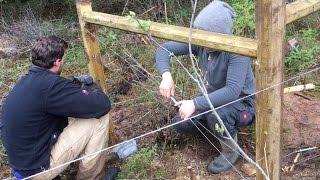
We're up at one of my favorite spots on the farm putting up the next pig paddock today and should be done later today and have the pigs up here really soon. I want to just show you around the fen. So the process of building the fence has been to put a string up in the line that we want roughly and allow us to clear a meader strip so that we can take out any young saplings or branches from past forest clearing. And that allows us to get the string in tight to corner post, to corner post. And then we follow that string putting up these short posts which we're in this fence. We're putting them every four meters along here. Down here is the riparian where we draw water for the ram pump. And it's really one of my favorite spots. There's a lot of blueberries here and the sun filters in to the forest. Even though it's quite dark in the rest of the forest. It's a magical place to sit with the water. Misa, the dog loves to come up here. We're taking our fence line. This is going out along a ridge line. It's a bit overexposed, so it's hard to see. But we have a pathway that comes up here and leads to the tree house. Now, we wanted to keep the tree house, obviously, and we wanted to keep the path intact because it's quite a beautiful little walk down to the first pig paddock that connects to the road. And I quite like that little track, so I wanted to keep that in place. And I also want to keep enough trees to really support the tree house to avoid it getting any potential falling trees on it. What happens when you cut bigger trees is that the trees next door tend to blow over if they've grown up amidst thick, dense monoculture. They just don't have very strong root systems. You can see where trees have blown over. They're growing on very shallow roots on pretty rocky ground. This path behind me is the way we've always come up to the tree house. It's how we carried a thousand kilos of wood up here to build a treehouse. So we've kept it intact by putting the fence alongside it. And it's worked out quite well for us. It's quite narrow, the paddock at this end, and it's got this young birch and spruce planting in front of the 70 to 90 year old spruce in the background there. I think the pigs are going to really love it in here. There's a lot of roots and fodder. If we look over to the bank here, you can just see some boilerpans there and you can see where the pigs are right now. And they've really disturbed the ground a lot now. They still haven't taken out many trees in the clip. You see they're doing fine over there, but the ground's ready to be rested and I expect a lot of pasture and forbs to be shooting back in there pretty quickly once the pigs leave. When you build a fence, it's good to put the corner assemblies in first. You see one down here behind me and that allows you to pull a straight line. And so you can put the supporting post, which really just function to hold the wire up at the right height. And then we use that same wire to go along and position the lowest insulator on each post because you need to take into account undulations in the ground. And that allows you to assess if you need extra posts or some kind of modification to the fence to get to the next post. And then we use a set spacing up from there. It's just a simple five wire high tensile system. And actually it's only the top three that will be connected to electricity. The bottom two we won't bother because pigs love to dig against the fence and they'll throw sticks and things up on there that would just short it out and lower the efficiency of it. It's important usually to put the insulators on the inside for pigs because pigs can charge a fence and there's a risk that they will blow them out if they're on the outside. However, in this paddock, it's actually connecting to the next paddock, which is the cut area under the telegraph poles there. And so ultimately they've got to be on the inside or outside of one or the other. Got simple H brace corners, really rigid. They still need a wire restrainers putting in diagonally. So when this post is pulling, it's pulling from the bottom of the corner post here up on this edge. This is the next paddock we'll be building underneath the electric lines up here. And the government keep that clear. We can keep that clear. And they've said that it was fine to build a paddock under here as long as we put metal fencing around the poles that they don't dig up and uproot the post there. You can see the pigs were actually here last summer, quite late in the summer. So this will be rested and we'll probably jump to another paddock before we come back in here. There's a roadway across just under the pole there that connects the two forest strips. And so that's where we're placing the gates. We're going to have a look at the gate up on the edge of this section. So this is the main gate assembly and it connects. It's an old forest track that connects to our other forest. We have about 50 meter wide strip that runs down here and we're obliged to keep it open for the neighbour's access as well as our own access. But it's quite challenging building the gates here because of a lot of water flow coming out of the ground at this time. And so we ended up having to use a lot of rock to support these posts because it's quite hard to dig through as layers of clay that are quite hard to dig and then quite big holes that we ended up with. So we needed to put a lot of rock back in. And we've got a nice simple tensioner here and it's become very solid. I can pull all my body weight and I can't move this thing. So I think it's going to hold up fine. We've built this exactly the right width for the two metal gates that are currently on the other pig paddock where the pigs are now. And that can just pin in with the metal connector rod. And this will be our access way into this pen. We have no other gate because we're not coming, we're just coming in and back out. And the next paddock will connect to this fence down across, leaving a bit of a water channel here protecting that. And it will come up on the edge of the forest here. Then we'll have an additional forest paddock on this side that ends with the young forest here. Then we have another big paddock over in the background there. And then we have a larch plantation paddock there and that will allow us to rotate the pigs through for the whole summer without returning to the same ground. Some people have commented in the past when I've made videos about fencing, that it seems excessive and it's a lot of cost, but in the context of our farm, it's really adding a lot of value to the property. These are permanent fences that we won't need to do again. They're also built in a way that gives us a lot of security that the pigs aren't going to get out and you're liable for damage caused by your animals. So it's not just about keeping predators out, it's about keeping your animals in. And up here in this kind of lumpy terrain with young trees around. It's not a place that you want to be using temporary netting for long. It's more work in a way to set up and maintain those fences than to spend the time clearing a strip and putting in a permanent fence. And this is an area of the farm we don't come to very often. So it's a lot more. It's a lot more peace of mind knowing that there's a good strong permanent fence that not only carries electric current, but also is a strong tensile wire in itself that the animals can't escape if the electric fails for any reason. We don't really get problems with animals escaping from the electric mobile fencing in the fields. But then they do have the perimeter fencing all the way around the farm. They can't escape even if they got out of there. And that allows us to really time control our grazing, which is important to us on our pasture. But up here, where we don't really come that often and you can't see it from the farm center, you can't really see if the pigs are there or not. And a bunch of pigs, you know, to catch pigs that have escaped up in the forest on the hills up here would just be a nightmare. So for us, all these pig pad, it's going to cost about 4,500, €5,000. But all that is just going to increase the property value. And it's really good investment in my, you know, it's a once in a lifetime investment and it really utilizes the space up here much better, gives us peace of mind and means that we don't have to move temporary fences through really bushy ground. Some of this land is impossible to walk through during the summer because the vegetation gets so thick. Fencing is really under prioritized in people's budgeting and design work of their properties. And it's something we've prioritized from the beginning. These are new fences that make up the last fencing we'll do here. And then the property is a lot more functional. We can easily just put the cows and sheep up in these forest patches. These are turning slowly to agroforestry patches. So they will give us a lot more grazing land. But yeah, it's something people really undervalue and underestimate the cost of in their budgeting. And I think it's a really important part of design and layout and management. That additional investment cost is easily recouped both from selling the timber here that's ready to be harvested, but also from the extra enterprises that we can run on this Land anyway, so it's a very small investment. In that light. You can see how we've used the string to give us positioning of each lowest insulator, but also identify drops in the fence. For example, here in this little ditch that's got a bit of water draining out of it, we need an extra post, obviously, to take the wire down again and that can start giving us problems when we tension. Sometimes we'll tension the wire and then pull it down into the insulator and that helps to tighten the fence even more. In this case, we're going to have to tighten with the wire in place already because it's quite a big drop. Some issues along some parts. The soil is very different in different parts of the property. It's quite wet along this side, but yet quite sandy. Down in this corner it's just pure sand and then a lot of rock on the other side. We've had a few problems with corner posts. This corner and the other corner just back there. Fine. But the gateways up here were quite difficult. There's a lot of rock and a lot of water there. So a lot of the water flows you see behind me here have come since they've cut down the forest above our property. And because of the clear cutting in Sweden, you get a lot of problems with changes to hydrological cycles as well as a lot of organic materials being fed down out into the lakes and causing problems in the lakes too. So this wasn't actually a permanent flow of water and it isn't a permanent flow of water. It's just been raining a lot now, which has led to everything greening up really beautifully this week. But it's an interesting thing and it causes major problems throughout Sweden, this clear cut approach to monoculture forestry. This is the front end of the paddock and the piglets will love running around through here. It's mostly birch, but there's hazel. There's a rowan. And these are the species that we would like to see long term. But they will also be creeping in now as we cut trees and start to allow more lighting on the forest floor. You can see there's hundreds of rowan here in front of us. And those species just creep back as more and more light comes through. There's a nice oak tree here just coming into leaf, but these are the species I'd like to leave my kids with rather than these monocultural stands. I still really appreciate this area of the farm. It's very different characteristics and it's very nice to come up here in the summer and just lie in the. In the forest and listen to the squirrels and the birds. All the blueberries are coming up now, but these are going to be for the pigs. We've kept a decent distance from the treehouse, about 20 meters or so. It will really drastically change the understory in the forest here. But we want to utilize the farm more effectively than just having monoculture spruce stands. And I'm kind of tended towards the idea of not renting the treehouse out for Airbnb guests that I was thinking originally, because we just don't have time to show those people round. And the money, the income that that could generate in the summer months is pretty insignificant in terms of the cash flow of the farm. And so I think I'm turning into a private retreat and office space for myself, which feels really good. Where appropriate, we're using the trees as very strong fence post because very rocky ground here, as you see where the trees have fallen. It's totally fine to do this. It's not really going to hurt the tree in any way, but what you need to be aware of is the bottom of the tree bows out in most cases, sometimes quite impractically. And you need to make sure you're not creating a 3D fence where there's actually a gap that the piglet can get out through the wires because they're sticking out horizontally. It creates a bit of a logistical challenge. But as long as you've got a guide wire, you can really visually see if it's going to work or whether you need to add another post to bring the fence down afterwards. Here's an example of the shallow roots that these trees are growing upon. I mean, it's 30, 40 centimeters thick at the deepest place. Here again, here's another stream flow that's come since they cut the forest here. There's a quite a few hectares up on the hill behind us that's been felled and all this water flow started. Since they cut the forest there a couple of years ago, it's become a permanent flow, small flow, but a permanent flow. All these forests are planted up on rocky ridges, which is an appropriate place for farm forestry because there's not land that's good for pasture or cropping in any other way. So it's good to keep perennial vegetation up here. We want to have a bit more diversity and, you know, mixed diverse woodland, which is much more beneficial habitat, but also could be more economically viable for diverse purposes. Also, you can see the grass is really greening up on our land. Still catching up on the neighbour's grass that's still full of thatch. This is the back end of the fence here enclosing our forest patch. It's very different vegetation where they've cut continuously every second year for the wires. There's a lot of prunus coming up. It's not much use for us. But these species will start to change now as we bring the pigs through and turn this ground over. The pigs were down in the lower section below the telegraph wire there. So the first thing I would expect to see is a lot more pasture species and this wood will start to break down pretty soon now. So I'm pulling the wire through. The jenny is over there and we're pulling. We've got help around the corners here because we're pulling through two corners here from the gate on the other side over there. And we're tying off in the middle opposite the gates. So we are tightening across two corners and that seems to be working fine. It's being fed through, which helps a lot. Yep. And we stop there. So we just join them together here with a knot that can't slip and we're away. Although we've run out of wire now, we've only got enough for this lane, possibly one more. So it'll be tomorrow until the pigs actually come up to this patch. Next. We're starting to build a laneway that will. This is the paddock they used into the autumn last year, about a hectare. And a bit over here and deeper into here is the Larch plantation. We're going to build a laneway that connects a crossing on the other side as a river crossing that connects up here. And we've got to build a bridge now with logs that will connect over the stream here to this gate and come into the laneway here. And from here it will lead up to the paddock that we build in the trees on the right. The paddock we've been building is up here. You see the steep bank that runs down to the river here. Why we've kept the paddock away from the top of that bank and there'll be another paddock in the middle here. So we'll finish up with building the top wires tomorrow on the fence we've been working on as well as putting in this laneway. And we're going to start putting a bridge across here this evening. Bridge building materials at hand. We're just going to put these logs down in the old fashioned way. Just logs straight over the river and then we put soil back over the top of them because pigs really don't like water. They won't cross the river without it. And they won't cross logs sitting there like this either. But if you cover it with some moss and a bit of soil, it will last many, many years and they will enjoy walking over it without thinking about it. This is where the pigs have been now. They're here a little longer than we wanted. There's some areas that are untouched, but all these areas that are dug through are just going to turn back to grass and forbs and give us a lot more grazing for the cows and sheep as well.
More from Richard


A review of short and intensive season on a mixed farm and restaurant/event space in Sweden






Alskade Kyckling Exploring complexities of poultry production in Sweden and what we stand for


