S4 ● E49 Collecting Good Data, Drainage Installation, Sorting Stuff Out and Thinking about Genetics
Richard Perkins walks through a day of farm work: weighing broilers to predict slaughter dates, installing drainage for the egg-mobile, acquiring silos to cut feed costs, and explaining why he culls weak rabbits instead of line-breeding for specific traits. Good data, he says, lets you make confident decisions.
Questions this video answers
About 195 grams of feed per bird per day.
Approximately 1.47 kilos.
1.16 kg, 1.26 kg, 1.05 kg, and 1.12 kg.
Birds putting on about 50–52 grams per day; expected average at day 42 ~1.7 kg.
Largest 1.782 kg; smallest 1.116 kg.
Chapters
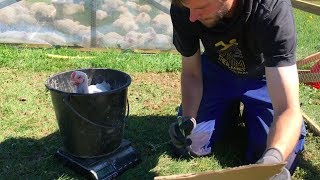
Today we're checking the weights of some of the boilers to anticipate the final weight, so we can adjust the last few weeks feeding if necessary. The gang have been fixing up the old boiler pens and we've got seven more coming out on the land on Wednesday. Normally we get new chicks on Monday and the old batch come out, but they couldn't supply them on Monday, so we'll be picking him up on Wednesday. Today we are weighing some of the broilers to get an average weight at this age and compare it with our last data from previous slaughters. And we actually had a year where we weighed birds every single week to build up a lot of data at the different sizes they grow to in the same time, but also allows us to anticipate the slaughter weight because we're selling 1600 kilos to a company that's running the theatre nearby us this year. And so we want to anticipate what the final weight of the birds will be so that we can address the feed ratio in the final couple of weeks if we wish to. Currently, the birds out in the field on day 38 getting about 195 grams of feed per day. This is milled organic wheat and oat from our local supplier and they also were mixing that with a starter based feed, and they're currently averaging out at 1.47 kilos on day 38. Now, I've looked back at the batches from last year and at day 35 they averaged 1.16, 1.26, 1.05, 1.12. On day 42 they averaged out around 1.7. Now, at this time, a bird is putting on about 50, 52 grams of weight a day, which means this average on day 42 should be up at 1.7. So we're on target with our calculations and it seems like everything is going well that year that we weighed each bird in the field every week. Whilst it was a lot of work, it gave us a huge amount of material to refer back to. That allows us to be very confident in our management, which is really important if you're pre selling birds. For example, we sold 1,600 kilos of chicken back in late autumn, early winter. So we needed to know exactly how many birds to produce. And this is an unusual batch for us because we're slaughtering all the birds over three or four days in the same week, whereas we will normally slaughter over three weeks because you see from the weights here, the birds grow at quite different rates. The biggest bird we weighed today was 1.782 and the smallest bird was 1.116. So half a kilo difference already. So it's really important to build up a data set for everything you're doing so you can make fluid decisions. Because if we're slaughtering over three weeks, that extra two weeks at the end of the bird's life is usually exponential in the amount of feed the birds take in, but also the growth they put on. Obviously, however, the smaller birds, who are just perhaps genetically weaker, just never actually grow so much in those extra two weeks. But it does balance the numbers out to give us a much more consistent weight of dressed bird. It's going to be maybe hard to see on the screen, but here are previous batches from 2015 where we measured the weight of birds every seven days for batch 1, 2, 3, 4, 5 and 6 that we fit into our season. So we have good data of what the average and maximum and minimum weights of birds are each week of the year. And then we can also see from our slaughter data, I've just taken an average because we slaughter over three weeks. I've now averaged the first. This custom batch of birds that we're doing now for the theatre, we're slaughtering over a four day period from day 56 to day 60. And so I've taken slaughter data from birds from two years ago on the same ratios, feed ratios from day 56, and the average is 2 kilos, which is what we anticipated when we made the plan for this season. So we're on target, everything's good and it's great and reassuring to be able to know this, having collected data from the past. So Yesterday we had 600 eggs, over 600 eggs, which is double what it was less than a week ago. So egg production is ramping out. It'll probably get up to about 750 eggs a day. Lucas is doing a great job with packing and about an hour's work to pack that many eggs. So it's a daily chore that needs to be. It's one of those jobs you've got to keep your fingers moving and get it done because it's an everyday kind of job. And eggs pile up super fast. Silo's getting prepped today. Pretty good deal for €500. We got these two silos and we're going to be putting them up soon. Just need to paint them up quickly and also grease the openings because they've been too hard to open. They haven't been used for many years. So we swept the inside Just to get any, any fungal dust or anything from old feed in there. And we're going to paint these up soon. And we're still waiting for someone with a forestry machine who can help us lift these into place. But it's going to save us €50,000 or €5,000 in feed costs alone just to be able to buy bulk food. So pretty good investment for us and very happy with the silos. We're going to bolt on some wood onto the top of this so that we can easily put a roof on. It's designed to be indoors, but we need to have them outdoors. And so we'll build a nice waterproof roof. And we need to connect the fillers up on this one. The other one has got the filler integrated into the other side here already. We've got the rams up now. This is our camping spot. We're just strip grazing them through the sea. Buckthorn and quince. So we have this area prepared for all the PDC students. Palm scale permaculture designs. Super exciting. We've got a big group of people coming from all over the world and we're just getting prepped here for their arrival. It's a new chapter in the farm season to have so many people around. And then we have our internship program straight afterwards. This is Benjamin. Time for sheep shearing. It's getting warmer. So finally getting around to sorting out the entrance to Nutfield. We're just going to try and clean up the ditch and put in one drainage pipe with some gravel, see if that's enough to drain this entrance. We have water coming. This is quite a sandy hill here. Very low fertility until we've brought chickens in here. This is where the grass was very stunted. I showed you in other videos. But the water comes out the ground here where it hits clay. It's very swampy, particularly in the gateway, which is where we need to come in with the egg mobiles. So we tried just a simple drainage. I prepared to put in a whole gravel entrance here, but if it's not necessary, we'll try and avoid that. These are the avenue plantings as an investment. This is a space the side of the road that takes up no room on the farm. But these are trees that we will prune the lateral branches of and they'll be for my children to build a new home with. Perhaps it's oak and chestnut, some quite big oaks now further down the line. But this is a red oak. It's less common here. So we're just putting some gravel on Top of that pipe. The handbrake on the rhino is not working. So I'm sitting here with my foot on the brake pedal. The module for the handbrake is broken off with the bolt. So we're taking it to the. One of the country's best repairmen who lives in the forest near here tomorrow. So job done for now. We put gravel over up to here and then we just used some fiber ducts, the landscape fabric, just to finish it off at the end of the gate and just covering back with soil now and track roll it a bit. There's already water coming out of here quite a decent amount. So I think this will. With the warm weather that's coming these next week, we will have a much nicer. A much nicer gate entry, which is going to be awesome. I'm going to just level this piece off too. The most critical point is this corner corner here as we turn off the road with the Eggmobile. But little things like this that make things a pleasure on the farm. Just slowly building up the infrastructure to make things more convenient and workable. While the digger's here, we've decided to fix up our neighbour's ditch. This is our neighbour's entrance to his forest and he actually owns all the land that we run the market garden on. And he's very relaxed about what we do here. We put the intern wagon and all the gardens and he's totally fine with us using the land as long as we keep this access clear. So we thought it's nice to pay it forward and just have his driveway a bit cleaner. We're going to fill this up with gravel tomorrow and it should dry up quite nicely. The first prototype rabbit mobile. We have all these old micro tunnels that they fit on these tree beds that we use sometimes. But now we're needing rabbit pens. The meat rabbit we've got is in the old boiler pan just up here, mowing the lawn first. But the other males and females will come soon, so they'll be out in the field. And so we've got to come up with a design for a new pan. Just moving the sheep to their next little strip. We're just clearing Bucky Field for the campers. I'm gonna have a bunch of tents in here soon. These rams have done their job. We're essentially line breeding with these and they'll be culled now for food supply. Line breeding, as the name indicates, is basically breeding in a line, restricting the mating of individuals of a certain family or a limited number of families with a common origin or of a similar type. There's some confusion in the minds of many as to the distinction between inbreeding or close breeding and line breeding. Inbreeding is more intensive than line breeding, and as the term is generally used, the distinction is quite fine, actually. And the mating together of brothers and sisters would be what we call inbreeding. And the mating together of a sire and daughter or a dam and son would be called lime breeding. The mating together of brother and sister doesn't really produce any change in the relative proportion of blood of the grandparent in the offspring, and therefore there can't be any improvement or progress in their genetics. The mating of a siren daughter or a dam and son increases the proportion of blood of one ancestor to the other, as the case may be. And therein lies the fine distinction between inbreeding and line breeding. The main purpose of line breeding with rabbits, or indeed any animal, is keeping the blood of certain ancestor of merit in the flock. And the longer line breeding is carried on, then the larger the proportion of blood of the original ancestors in the flock and the stronger the tendency will be to produce his or her good qualities and there'll be more uniform results. And, you know, line breeding has been done for centuries and intelligently carried on results in a strain or family with the carmine origin. That's more than ordinary excellence. And that would be the ultimate aim or ambition of anyone who goes into a purebred breeding business. What we're doing here is a bit different in that we're interested in the idea of mob breeding. Rather than selecting the best sheep, which, you know, humans are not necessarily capable of, we can select out the worst sheep from the flock. And so we let all the different animals have a chance to breed with, like the rams here, for example, allowing a bit of nature's competition so that the best rams get to mate and bring their own different diversity into the flock. And we'll just cull out any mothers who have difficulty birthing, any mothers who, you know, have too many lambs, too few lambs, any that susceptible to illness, etc. Also, a big benefit of that is to avoid bringing new animals onto the farm, which is always a risk with diseases, etc. So it's early days for that and we can talk more about that another time. But it's something interesting that's beginning now that we'll be working with, with our rabbits too. So thanks as always, for watching our videos. Thumbs up and share the videos if you enjoy them and you think your friends will benefit from watching them. Too. It's helped spread regenerative agriculture around the place. And you can find out a lot more in our book, Making Small Farms Work. See you next time.
More from Richard


A review of short and intensive season on a mixed farm and restaurant/event space in Sweden






Alskade Kyckling Exploring complexities of poultry production in Sweden and what we stand for


