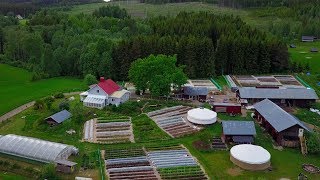
Richard Perkins walks through a farm with 3,500 chickens and 50 trainees learning holistic management and agroforestry. The week covers keyline design, water systems, perennial crops, and integrated livestock, with group meals and a sauna between modules.
Questions this video answers
3,500 (three and a half thousand) birds
Six batches of 800 chicks (typical batch size 800)
About 5,000 birds
About 4 cm of water per week (applied by irrigation, adjusted with rain gauges)
Chapters
Batch number three, day old chicks coming into the Buddha. So the cows and sheep are back in and I think their move went really smooth and They've got about 20 days in top field going around the boiler pans now. We're doing typically six batches of 800 and we will probably max out our Production at about 5,000 birds. Batch 2. The chickens looking good, Mr. P. The peacock is looking after them and Carlos fixing up a broken spline on this pen. Some of the wood we didn't select carefully enough has got knots and it leads to weak spots. One of the downsides of using such small dimension timber. But generally we're quite happy with them, aren't we? They're much lighter and they're working really good. They're very strong for what they are. I mean, they take the weight of us standing on the roof and it's only where there's imperfections in the wood like knots. So we had one of these bars that we're pulling it on, split and it's easy enough to replace them and keep them in good condition. So there's now three and a half thousand birds at the farm. It's evening time now, so they're relaxing down to sleep. We've been taking a big tour of the farm today. We went around all the different fields, explaining what's happening with the agroforestry systems, with the different animal enterprises, how the farm functions as a whole, and a bit about the economy. Just to orientate people to really what's going on here. It's an overview. We went into a lot of subjects. The tours take longer and longer. And then this afternoon we've been talking about holistic management, defining the context. So holistic management, most people come across in terms of grazing livestock, but it's actually primarily a decision making framework. So we've been introducing people to writing their holistic context, which is a foundation for design. In my mind. It replaces all the goal setting and objective setting in permaculture. Design really clarifies what it is we value in life, what we're shooting for and the resources in our management to be able to define the boundaries for decision making in the face of complexity. Everything we're dealing with as farmers is complex Ecosystems, social systems, financial systems, they're all unpredictable and evolve in their own way. Here's Ruben coming up to the fence line here, checking out the cows and sheep. And it's great, it's a great start to the training and a wonderful group here. And everyone seems to be getting on good and Looking after each other nicely. We've been eating amazing food. The chef are really just amazing this year. So a really nice day and tomorrow we get into the nuts and bolts of design, the toolkits. How do we take a site a blank farm like this? How do we start asking the right questions to gather all the data? We need to start the design process, which is really founded on our holistic context, site specific data, resource bases, skills that we have. We carry that on until the third day and then we get into very specific design subjects like keyline design, water management, tree systems, perennial cropping systems and grazing of livestock. All the integrated animal systems here at the farm and into soils and market gardening. And at the same time, everyone is presenting their different projects and starting to work in groups on developing plans and assessments of their own sites and enterprises. And hopefully we'll leave here with some solid business plans. Beautiful evening. This evening we're having sauna and looking at the 10,000 year history of agriculture and how that shaped culture and society. Really excited to see the grass take off now. It's really, you know, growth has kicked in and we're bringing the cows and sheep down through top field now, all the way down. And then they'll go up into front field and be more in view of the farm. It's always lovely when all the animals are in close proximity and you walk outside and see a lot of life happening in a small space. On the drone footage, you see it's really beautiful at this time of year. Things starting to blossom into life. Great to have the cows and sheep back up in top field and you can see really the impact of the boilers and how quickly the land has healed up behind them. Now. Coming up, first of the salad mixes is coming up. Going to the restaurants, looking really nice, nice seed density. And the crew have been working out the cedar nicely. We're irrigating different bed sections. We're tending to put about 4cm of water down a week, obviously looking at the weather reports and using rain gauges to measure the water on the beds. Direct seeded beds and young seedlings need watering a bit more regularly. Over here's south beds and we have east and west beds and then the north beds and the new north beds. So we can't, you know, to fit it into a rotation. We tend to water a different section each day to make sure we get enough watering done in the week. We can run the pump continuously, but it requires someone to go around and move the risers and turn it on and off. So we tend to do a little bit regularly, but crops are really kicking in now. It's looking great in here. Nice spinach crop. It seems like it'll still be in good shape for the first box, which is about two weeks away. It's easy for the spinach to go over before the first box because it's very hard to predict the weather. Kohlrabbies are starting to swell up. Amazing kohlrabis we grew last year. They're like melons. They're really sweet and juicy. Best eaten raw in my opinion. Carrots coming up. Lots of kale this year. Thanks for watching our videos. Don't forget to click, subscribe and share with your friends. Subscribe. Thanks for all the comments and feedback. We've been enjoying that and I really appreciate the comments about the farm cookbook. It's a really exciting project for us actually, and I really, you know, I brought it up as a vision just to run it past the chefs to see if they're excited because it's really up to them if they want to do that. And I think it's a great idea and it could be such a beneficial learning resource for so many people, you know, and really getting into the idea today. And they've been recording a lot of recipes and things that have been happening already and there's so much to share throughout the season here that I think it's going to be a jam packed resource that's really cheap and available to everyone and could be super helpful.