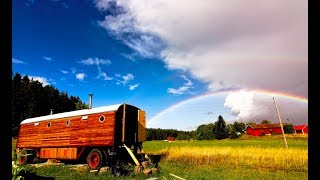
Richard Perkins walks through farm operations: moving poultry, packing microgreens for local restaurants, building a wash station with a 7-degree roof slope, and training interns on design, economics, and marketing. He's aiming to process around 1,000 birds in three days.
Questions this video answers
June 8, 2017.
50 trays, 1,500 eggs.
7 degrees slope.
Try to do 1,000 birds ('burrs') in three days to fill freezer capacity.
Chapters
Deep into design time. And all the designs of the different projects people have been doing are going to be presented tomorrow. And then people will be off the next day. After our famous no talent show. A nighttime move for these guys. It's about 11 o' clock at night. Still quite light at this time of year. Hens haven't gone to bed yet, but these guys are hungry. They've trampled probably 40, 50% of this paddock and they want to move to this paddock. So we're taking them down into the riparian here.
Well, we've been having a lot of success with microgreens so far. So we have some pea shoots, some sunflower shoots and some radish. These are going down the road to Selma Spa, like a famous local hotel and spa that's been around for many decades. And they're also taking 50 trays of eggs, 1500 eggs, another couple of trays for a local eatery. Very nice place, nice couple that owns it. And we're giving out some samples today. So we've got a sample of our honsai cai. It's a really nice Asian green for stir fries or just eating raw.
Super nice.
And a couple of pak choys in here, Black summer variety. And I think they're going to like it quite a lot. They're really nice chefs and they're into experimenting. And then it doesn't end there.
The bowling, the. The pak choi didn't get eaten by flea beetle this year, but it's bolted a bit earlier than we thought.
It has bolted a little bit, but I tasted it and it hasn't changed the flavor yet. But anyway, here we have some red boar kale. This is 5 kilos in these food grade plastic bags. Some Toscano kale. That's two kilos.
That's good.
And also another two kilos of what's called half tall. And this is also going to Selma Spa down the road.
Yeah, super nice. Looks good, mate.
Very excited.
So the multifunctional washing station for the veg is going up. And this will also be where we park the van and lawn mower in the winter, things like that. It's going to have two sinks set up on the outside and just a pole wall construction. And we'll probably put like an old style barn wall on the side here just to stop sunlight. Just have a cooler shady space for processing vegetables. It's quite a flat roof. What is it, 7 degrees? Sorry, 7 degrees. 7 degrees slope. So you've got to take into account the heavy snow load of a Roof that shallow. It's about the same as our porch balcony. So we've got good timber that we got from the pickup from the sawmill, the free timber. And there's going to be a lot of beams on top of here with some cross poles. And then we'll put tin sheeting on. Should be done. Ready for the first major veg box harvest. We're selling to restaurants already, but there's veg box harvest coming soon. Last of the microgreens that we're selling to restaurants are in the indoor greenhouse, but we're going to start doing them in beds outside now. And we've got an open bed for microgreens outdoors. Silos are up and roofs are on and just putting this filling pipe on now. That's all done. Doors are greased and we're getting a delivery of bulb feeds tomorrow, which is nice. What are the. What are the ones that we'd like? Trying out some different spacings this year. This is an example with the lettuces, where we've got five rows, where we typically only have three, where we've got remains which grow tall and bunched, growing over the smaller lettuces. Might have seen this in a clip the other day, but working well for us. We're trying out different spacings and seeing where we can get more crops per square meter, as it were. We're always doing this with the peas, for example, with different herbs or beets or flowers on each side. Bit slower growth here in the north where there's a bit less sun and a bit of shading from the trees late in the evening. It's very dark today. It's midday, but the rainy cloudy day. It's been overcast a lot over the last week. A lot of rain. No soggy campers yet they seem to be all doing fine, which is great. Got the slaughtery wrecks back today from our wilder friends in the forest. They look great. So we put in extra bars on every layer. Should allow us to do a lot more burrs. We're thinking to try and do a thousand burrs in three days and that should give us full capacity of the freezer room, mainly due to the racking we've got. And I've got some stainless steel sheet arrived which I'm going to try and make a lid for the plucking machine. So a bit of busy work to do. We've got presentations. Everyone's busy tonight on their final design projects and tomorrow is all day presenting, so I'm going to use the evening time to do a bit of work on this. So it's a rainy evening and everyone's deep in their design exercises. Some amazing projects going on with different agroforestry and animal systems. A lot of people interested in market gardening here and getting into the numbers and spreadsheets to make that work. And it's something I really value in our trainings is the focus on pragmatism and getting into the details and economics that make it all work in reality. That's what makes me sure that people can go away and get started on the right foot. And, you know, it's really why we run these trainings. It's our core motivation is to get more people on the ground farming in an intelligent, sensible, hopefully regenerative manner. We've had a really nice day today. Been looking at economy a bit and ways of marketing, dealing with customers, etc. As well as looking at the people side of things and how to manage people, how to deal with strategies, with placing yourself in the market, etc. But also with looking at how the dynamics of people work. Pattern language for the way that people change and communities change over time. Looking at spiral dynamics and integral theory and some interesting things like this. Just checking our new market stand we're using for our Ricohring store. It's a 6 by 3 meter stand which allows us to have two tables up for the different products we have. And wash station is going really well. Very sturdy construction, very simple, low cost, using the free timber we found from the sawmill. It's quite a big space. It's big enough to park the van in here in the wintertime and also make a really nice wash station that should be operational by early next week, which is fantastic. We got to watch Gracie's Backyard, the final version with the team yesterday and yeah, everyone was really interested and thought it was very nice. So well done, Olivia. It's looking very beautiful and all the sound is done very nicely now and it's just really special. It's a similar time of year to when the film is made. So all the things looking green around the farm and it just feels like perfect time to share in that way. Sharing more of the people side of the farm, the stories that make up the farm and the people and why they come here and all the different points of view that are shared by different people. People come here with very different expectations, goals and objectives and it's nice to hear that in the rounded, well balanced perspective because, you know, obviously when we're sharing, we're just sharing our perspective. And experience and so it's nice to see the human side really focused on in that film. It's beautiful and I look forward to more people seeing that and hearing what you think as well. So, busy days, not much time for videos. We're going straight from this training into the processing of the boilers and then it's into holistic management training for the interns. So going to be some busy days at the farm. I'll try and record some of that processing going on because that's quite interesting for people to see. These birds are going off to Smokery direct from the farm, so there's less packaging. We're going to be packaging into standard food crates and just weighing each bird to pack them into the right assortment because they want similar sized birds for smoking. But looking forward to getting this first batch through and seeing how well the birds turn out. I think it's going to be fantastic. Just got to build a lid for the plucker and then we're all ready to go. Nicholas is coming back. Nicholas has been here as sort of my right hand man each year in the last couple of years and been looking after the farm when we go away. So it's super nice that he's coming back for his fourth season here. He's only coming to visit for a short time. He's busy building his circus wagon in Germany, but we're really looking forward to seeing him as well as a couple of other friends that are coming by this summer. That's all today folks. Thanks for watching our videos as always. Click, subscribe, share the videos and we look forward to sharing with you again soon. See you next time. Don't. Be.
More from Richard


A review of short and intensive season on a mixed farm and restaurant/event space in Sweden






Alskade Kyckling Exploring complexities of poultry production in Sweden and what we stand for


