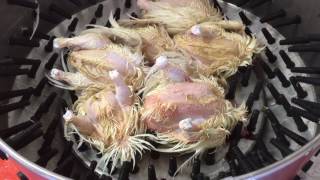
Richard Perkins walks through his farm's broiler processing operation: electrical stunning, scalding at 63°C for 75 seconds, plucking, and evisceration. He processed 1,000 birds over three days, targeting 2.0 kg dressed weight, and sells locally through Facebook and direct networks.
Questions this video answers
300 birds
Approximately 1,000 birds
About 75 seconds (1 minute 15 seconds) at 63°C
2.5 to 4.5 kilograms (range mentioned)
Business-plan target ~2.0 kg dressed; observed up to 2.8 kg, average estimated ~2.2 kg
Chapters
It's the first of three slaughter days. We're doing 300 birds today and everyone's getting ready and it's gonna be a fun. Sam. So we've got a thousand birds to do in the next three days and that's nice for us. We've got the racks sorted out now to be able to hold more birds. And I'm really excited for it. I really love this process and I mean, taking life and, you know, processing animals is always a humbling thing to do, but it's also so nice to be able to control the whole process from chick to finished product to the customer's hand. And I really enjoy it. You know, it's a sacred act and it's a really beautiful thing to be able to show people how to do skillfully and with respect and dignity. And, you know, we take a lot of pride in our work and I'm really excited for the next few days and see how well the team works together and deliver like premium products that you just can't buy in shops. You know, we're really getting into the Rico ring. That's been out in the paper recently. There's an article about it in the paper recently. There's been a few different articles, but here's Matt with our box totally from the farm and we've got, you know, we always feel like our box is just beautiful and well presented and everything's grown on the farm. Direct, local, fresh to the customer. And we're super excited about these Ricoh networks. It's just, it's such a different way to sell because it allows other people to sort of tap into the drop off concept that we developed in the last couple of years. And it's big in other areas of Sweden and in Scandinavia, but it's basically what we've been doing anyway and it's what we're passionate about and we're rocking at it. So it's really going to take off. We've sold a whole load of veg boxes and eggs and chickens through it in the last two days. And it's just a Facebook page managed by customers that will take a life of its own. And we just tell people what we got and what we're willing to sell and it goes from there. The new veg packing station is complete. It's super robust. So this will become. We'll put a wall at this end, like an old barn wall with gaps between the wood and they've got a table in here. We'll be setting up the sinks and water system for the first veg boxes that are getting packed soon. And yeah, really nice job. That will also be used for parking the van in the winter. A little multifunctional space. Lots happening at the farm. We've got lots to update you on in the coming days. So the birds are quite big now. They range from two and a half to four and a half kilos. And we restrict their feed from this afternoon through to tomorrow morning. Just aids clean and hygienic processing. We got the team prepped and the interns are prepped for the next few days and have a couple of projects to get on with. And a few of them will be rotating through the slaughtery with us. And then it's into holistic management training. Wednesday, Thursday, Friday, and then we're sending the interns off to Glasgowen, a famous nature reserve close by where they have a beautiful house on the water and get to meet each other as a group without the core team and without ourselves. And we're really looking forward to the next time. We've just been looking at the overview of the training schedule and the projects we're going to be getting into that relate to the trainings and amazing projects that this group have. It's dusk now, it's about 10 o' clock at night, and chickens are really enjoying Nutfield. They've been passing through up on this hill where we've had Leia's come for you a few times and broilers once, and it's really transformed the land here. But because we've had the cows and sheep out of the field the first months of growth, they're doing a lot of trampling and it's really nice. We're leaving a lot more organic matter on the ground, which is a new thing for us because we've always not had that much space available. And nut trees are doing good and looking forward to cleaning up the tree plantings and a lot of agroforestry projects this year. We're going to be putting in the strawberries in the tree lanes as well as putting up the hop poles along the riparians here and establishing new hops, putting in the vineyard plantings to finish that off and a bunch of tree care stuff. So really looking forward to these next few weeks. We're going to get a lot of work done in this middle part of the season. Now, this is where the birds are stunned first. Electrically, by law, you need to stun birds before bleeding them out and then they're bled out here before going into the slaughter here through this door. Into the dirty side where they are scalded and then plucked. And then we eviscerate and clean the birds before they go into the clean side here through a hatch. And that's where they go into a chiller. And all the data collection is done of how long it takes to cool the birds down, etc. Nicholas is back for a slaughter day.
First 300 birds in the new plucker.
And the water is not integrated. They look good. Now you have to turn that one off against.
Birds are coming out without the little.
Black pin feathers we had last year. I think it's going to be a fun day. We've been scolding today for 75 seconds, which is longer than we normally do. And birds coming out spotless. This seems to be the perfect time. 63 degrees and the birds are beautiful and super easy for processing. So I think we're going to be done in record time today.
First, take the oil gland off in the back. Paint the meat, Flip the bird, lift the thoracic on the teeth and slit the bird down. Separate the crop, Lift the crop and take the esophagus off the neck. Take the neck out, split between the rumps, rip the bird. There's a lot of ripping as opposed.
To kind of separate the fat from the gizzard.
And we reach in, pull everything out off the table. So anything splits, it's not on the table. Separate the liver, we keep that breathing. Take out the butt like so. Take the heart, check the heart.
That goes for eating, you know, some.
Lungs and testicles if it's the male bird. And then we just cut the neck.
Make sure we got the whole esophagus.
And bird done. It's a premium bird.
It goes now for rinsing and the final inspection.
And that bird is good to go.
You see if it's where you are.
Somewhere, you need it in like 15 minutes. How many birds are you changing over?
Nicholas.
What'S your changeover point for the water? How many birds do we have now?
Okay. Okay.
And then we can do hearts and Livingstone as well. So there should be then two more batches in that.
So it went really well today. We did it in record time. And three eviscerating, three cleaning down. And the new scalding plucking regime, we scolded for about a minute and a quarter at 63, which is longer than we normally do. And the birds just came out beautifully in the new plucker. And we did a great job. The beds look great, so. And they're above the weight that we anticipated in our business plan. We're looking at two kilo dressed weight and there are some birds up to 2.8. So I think the average is going to be maybe 2.2. We're going to weigh all the birds as we pack tomorrow. But that extra 200 grams per bird, if that played out across the whole season, that's another €8,000 in profit essentially. So it's, you know, these little data points in spreadsheets are really important and we're always planning to have happy surprises, as it were. Amazing effort from the team. It's best Lauder session ever, actually. I'm really excited for the next couple of days. We've had a really nice clean down in here that starts with hot soapy water soaping everything down and then we come in and pressure wash it and we try and leave it spotless. No feathers left, left. And we take a lot of pride in, you know, keeping it super clean and hygienic. And the birds are looking fantastic. So the birds are being monitored on their chill down. We have to show that the birds are reaching the correct temperature in the right time frame. But really great effort from the team today and really looking forward to tomorrow. Gonna set the story up again. Everything's cleaned down outside and we'll set the scalders to heat up again this evening and we'll wake up at about 5 o' clock tomorrow, a few of us, and pack the birds. Now the packing this time is really simple. We're using grey stackable food crates with a big food bag inside and we'll be stacking as many birds as we fit into a crate and they'll be picked up at 8 o' clock in the morning by the smoking company who will take all these birds for smoking. It's a really fantastic day. Great to have Nicholas back. He's been working this station many times before and it went really smooth. About 45 seconds of bird and three of us eviscerating. So we're done by lunchtime and we started at 9:30 in the morning. So tomorrow we might start a bit earlier and hopefully have the clean down finished as well by lunchtime. Thanks for watching our videos. As always, we'll be putting out some more videos about the chicken processing in the coming days. Three busy days ahead of us. And then we're going into holistic management training with Anders from Norway, who's part of the Sabi Institute called Collective in Scandinavia. So really looking forward to seeing him back here again. Really exciting times ahead. Everyone's pumped and it's an amazing crew that is staying on for the internship and amazing course we've just had with really amazing people. So really excited. Everything's been really nice and everyone's feeling good and the weather's turning good again. Beautiful evenings. We've been down at the lake today, fishing a bit and just relaxing and sleeping a little bit in the daytime, which is a luxury after, you know, some intense periods. Thanks for watching our videos as always and click, subscribe, share the videos and we look forward to seeing you soon.
More from Richard


A review of short and intensive season on a mixed farm and restaurant/event space in Sweden






Alskade Kyckling Exploring complexities of poultry production in Sweden and what we stand for


