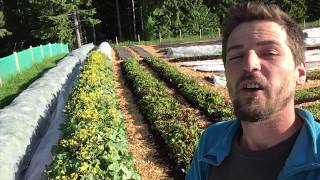
YouTube farm-vlog by Richard Perkins (June 14, 2017) showing the first CSA veg-box share of the season. Richard and Matt walk through harvested crops (Honsei Thai, various kales, purple and green kohlrabi, pak choi, radishes, spring onions, rocket/mesclun, leeks, lettuces, potatoes), note pest/history issues (flea beetles; some Honsei Thai bolting), demonstrate packing into full shares, half shares and a cheaper 'wonky box', and describe the new veg-packing station and needed drainage/washing improvements. Specific packing details and quantities are given for full vs half shares (potato kilos; mesclun and rocket gram amounts). Video closes with farm admin notes (slaughter pause, holistic training) and a sign-off.
Questions this video answers
June 14, 2017
2 kilos
1 kilo
200 grams
100 grams
Chapters
Today is the first of the year's veg boxes. Let's have a look what's inside. Honsei Thai is a beautiful vegetable as a cooking green. And these soft tips like asparagus, really delicious, straight as they are. So we'll be bunching the tips as asparagus and including bunches of leaves. The bottom of the plant is very woody and not so interesting to put in the box. So we'll be taking a bed of this and splitting up. We've got full shares and half shares as well as our new wonky box which is a way to offer people cheaper vegetables who aren't so particular about holes in leaves or wonky shaped carrots. That's been really popular. So we work out, you know, based on what the crops being planned, how much goes to a full share and then half that for the half shares. And let's go and see what else is in the box. Omar's on kales and we got several types of kales, greens and purples and so there'll be big bunches of that going in. So last of the chickens going out today, about one, well over half a ton today and we're done. We're going to pack other birds and necks and livers and nuts etc. And then no more slaughtering for two weeks. Packing chickens for private customers. We use these heat shrink bags and just dip them in 90 degree water 2 seconds and cable tied up that gets trimmed off. Birds have weighed and then we're sticking labels on telling us whether they're going in the fridge or the freezer and the finished product sent off farm. Unfortunately the Honsei Thai has gone over. This is a crop that we love to eat and it got decimated last year by flea beetles. Unfortunately it's bolting going to flower. Some of this is no good but some of it is fine. It's going to be perfect for making kimchis or as a cooking green. It's not gone too far that the leaves have changed taste or texture. So we're going to include it in this week's box. We're quite proud of it because last year we couldn't even serve it really because the flea beetles were out of control. And we just haven't had flea beetles this year which is, well a few but you know, really no problem. Then we've got our kohlrabbies and they're looking beautiful. Still quite small but we're going the purple variety as well this year, some small ones but these are scheduled over two weeks so we'll take the bigger ones and the shares today. Amazing vegetable, the kales we're harvesting lower leaves. Usually pull them off with your thumb at the base of the plant. You can't see so well through here, but purple leaves, green leaves, and some frizzy kales. So I'll be getting bunches of mixtures of the kales as cooking greens. Kale is always a good one as a staple cooking green. But many people fed back to us that their husbands won't eat it. A shame. It's one of the most nutritious vegetables and that will give us harvests over six, seven weeks here before it gets too old and we take it out and replace the crop. So the last of the chickens are leaving the farm. And we're putting in lettuces for these blocks. We sold some lettuce to restaurants, but we'll be putting in these beautiful modest stones. And also some of the romaine lettuce here. We've got some of the pak choi that's just gone too far. I don't know if you can see the flower heads here, but this is a scrap bed that we'll turn into kimchi in the kitchen and eat for the rest of the year. Bunches of spring onions in the box this week. And we have a nice bed of rocket here that's done well. There's a few holes in the leaves, but last year it was ravaged by flea beetles. This year it's going in the box. So nice bag of rocket. And then here's next week's rocket in the cycle. Lots of leeks and onions in this block.
All we have left after that is.
So the new veg packing station is being used. How is the veg packing station any obvious flaws?
No, not obvious. We're gonna work on having. Setting up two washing stations, having two hoses instead of one.
We've got to build drainage that goes out to the pond here. There's a pipe from the house guttering. It goes down and fills the pond that then goes on down to the paddy, some out to the ditch. So we need to connect up both the gutter here and the drainage for these things. But it's a really nice high roof with shade, which we've never had as a permanent thing before. And we're just using part of our market stand to stop the bright sun. We're going to build a wall on the back wall here to shade it even more. But still not a lot of air flow through beautiful radishes this year. A nice big bunch of radishes northern shares, Best veg boxes. How do you feel about it, Matt?
I feel really good about it, actually, with some nice hunsai Thai, nice pack of spring onions. This is very nice radish. This is an example of what Jean Martin says is just grow better, not bigger. And so we grew better. We're adding the leave this year. We're able to.
They were getting flea be last year, weren't they? Yeah. Nice kale bunch.
Kale bunch. Couple heads of lettuce. Got a nice red rosie, which is a red romaine. And first for this year, purple kohlrabi.
Very nice.
Green kohlrabi. So this is a full share.
That's beautiful.
And then here we have two half shares going out.
Let's have a look at a half share.
Here's a half share. So for a half share, approximately half the price, of course. Pretty much have all the same varieties, just some smaller bunches of it. Nice coriander. This is a beautiful modestone lettuce that we're doing for the first time this year. And green kohlrabi, a bunch of varieties of kale. A little snappage going on there.
Maybe replace before we go out. Yep.
And potatoes. A kilo of potatoes and a half. And two kilos of potatoes in a full shirt.
Two kilos of potatoes in there. Beautiful. Okay. And it's not just that. It's mesclim and rocket mescaline.
They're in the fridge. They're in the fridge separately. We're gonna hand them out along with this. So it's. If you have a full share, you're getting 200 grams of mescaline, and a half share is 100 grams. And if you have rocket, if you have a half share, you're getting 60 grams of rocket and 120 grams of the rocket in the half share.
They're going in the chiller and going out this afternoon with eggs and chicken. Good job. So here's the half share. It's honse tai flowers and stems and some coriander with some beautiful radishes, mixed kales, monster and lettuce. And some kohlrabi pak choi, some mescaline mix and some rocket and some potatoes, Keto potatoes. Beautiful. And this is a big share. A full share, normal share. So you get two pak choys and more kale, more spring onions, bigger bag of mescaline and rocket and more herbs, radishes, and a couple of beautiful kohlrabis, including the purple one and a couple of kilos of potato. These are a new variety for us this year, but we've really enjoyed the Kohlrabis. They're super delicious, like little melons. That's all today folks. Everyone else is in holistic management training and we're making preparations for the hot poles that we'll be putting up soon, as well as just doing some ground care and taking care of a deep clean of the slaughtery which is out of use for 2 weeks. Thanks as always for watching our videos. Click, subscribe, share the videos with your friends. And don't forget, you can find out more in our book, Making Small Farms Work. See you next time.