S4 ● E62 Holistic Planned Grazing and Broiler weight differences
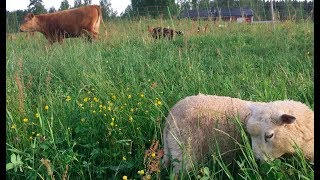
Richard Perkins (farm vlog) explains pasture and livestock moves under a holistic planned grazing approach, discusses persistent broiler weight variation he attributes to genetic variance rather than feeder competition, and shows on-farm activities (moving cows/sheep, eggmobile placement, tree and vine work, pond/alders, pig paddock thinning, and selecting hop poles). A brief car-diagnostics exchange occurs; the segment closes with adaptive grazing-plan decisions to prioritize landscape recovery and stocking strategies.
Chapters
There's been some comments about the broilers and the weight distribution in each batch. I just thought I'd clarify some things for folks interested in pastured poultry. Cows and sheep are waiting to move, and they are coming up here finally to get back in front of the eggmobiles. And we're out of sink. We're Normally following about 96 hours in front, both to keep the grass down and to feed the chickens with larvae from the cow pats. But we've got a little. We're not going to get fully back in sync today because what we want to do is cut the grass in front of the eggman mills here. So we're going to have a little paddock just in front of this eggmobile, jump across to that one after lunch, and then we can take the rest of this field before heading right up to the top of nutfield where we can't take eggmobiles because it's crossing a marshy sort of drainage spot. And it's getting a lot of woody regrowth there. So we want to leave the sheep in there to take that down. Then everything moves back to top field for the second cycle. And so we'll be out of sync for a little while, but we'll get back on our plan today. Here they come. So we decided not to move this egg mobile today. They've basically just flattened the grass. We've got beautiful sward here. It's really thick, really dense, and a lot of clover and things popping up underneath that. We want to take this down with the cows and the sheep just to make use of this forage before we move these guys again. And because they've laid down so much grass, they're not going to damage the land by staying an extra day. Some beautiful nut trees popping up in this savanna planting. But the move went well, and we'll be moving them after lunch over here. To make use of this grass, We actually took the smallest birds, put them in one of the pens of the birds we just slaughtered this week. And what you find is the smallest birds just never catch up. It doesn't matter if you feed them more. It's not about competition with the feeders. In our experience, it's a genetic weakness or variance that just plays up in weight range. So we're usually slaughtering a batch over three weeks. Taking the largest first, they're often male, and then the smallest, the middle size the next week, and the smallest in the last week. But even with two weeks extra feeding, those birds will never catch up with the Largest birds. So it's day 16 in the brooder for the third batch and already you see a weight range, you know, where the smallest birds are half the weight of the largest birds. Now, if you raise a bunch of these birds, you'll see that even when there's feed in the feeder, the smaller birds are not being out competed at the feeder and they're often just not feeding. When there's even food sitting left, they're fed five times a day. At this point, it goes down to four and then down to three. But it's not about competition for the feeder, it's a genetic variance. And so it's typical to swallow them over three weeks or so to allow them to catch up a bit. But as I said, they never actually catch up with the largest birds and small. So it evens the average weights out. But there's always a weight difference between the birds when you have this many. I filled up a pen with all these small birds from. From the bats we just slaughtered. Yeah. And they didn't actually perform. They didn't grow. No. It was quite evident that they were all very small. I did it to see if they. If they would have less competition and have more chance to grow bigger. But yeah, it's really. Even in the brooder, it's not about space at the feeder, it's just about genetic variance. Vines are coming up on their alders and we'll be training them onto them and cleaning up, doing some weeding. It's a bit overgrown now. Grass has been rampant and we've been super busy with chickens and getting the interns acclimatized, as it were. So we'll be coming in here and just cleaning up around the trees and mulching them again. Some nice vines sticking up. Let's go and see the new alders we just planted this spring. This pond is about 11 months old. 10. 11 months old now. Hard to imagine what it was like before. It's hard to remember what it was like before now. Actually, it settled in very nicely. It's maybe hard to see all the alders we've put in, so. Same sort of configuration as the alders over here. And they're leafed out nicely and developing well. Pioneer trees, so very hardy. We haven't really done any work other than planting them, but we will come and mulch these and kick back any grasses and get the new grape vines trained onto these. It's breakfast time. And here in our dining yurt, the swallows have decided to make a nest in pretty inconvenient position now. It's very nice to have them flying around, but it gets quite windy and stormy. And that roof flap gets opened as a chimney to vent hot air out. So it's not the best choice for nesting. They're also nesting in our workshop. Here they come. They're bringing in mud and sticks right now. It's kind of cute, but I'm not sure it's going to work out too well for them. So we made a decision to let them build a nest and we put a GoPro there and we got photos every five minutes and hopefully we'll see them building their nest. We've come to the neighbors to pick up a free trampoline. They've been putting up fencing and we're going to take some drone photos in exchange for a trampoline. Every car needs a trampoline. Is it worth having for the farm. If we don't ever hear ourselves working then? So we've been getting some footage for the neighbors. We did some winter shots for them. Now we're doing summer shots, taking the trampoline and off we go. Nice little homestead. These guys started off last year building their homestead. And they have woofers from different parts of the world coming up here that we get to meet at times, but they're not in right now. So we just take some photos and videos and send them to them. And we're off with a trampoline. Very nice. Farming is, you know, a lot to do with priorities and decision making. They're studying holistic management in here and we're working on quality of life statements. How do you like it, Miso? What do you think? You're not sure about that. So secondary veg box is going out and also microgreens and restaurant orders. Feeling good about it? Yeah, it's going very well. So we're down in one of the pig paddocks. This is the larch plantation. We're selecting trees for hop poles. And the hops are really putting on some growth that we want to fast track this process. The pigs won't be in here until very late in the year. And the larch is going to be more resistant in the ground from rotting. And so we're trying to select out 20 trees that will go along the riparian between the field and the riparian. And we're scaling up to 350 plants eventually, which supplies the local brewer with all his hop needs. So we're deciding to also take some of the spruce if we don't have enough larch. And we're Going to open this ground up for more light. We might end up taking about half the trees out of here and also using some of that to build a bridge over to the neighbour's land that we're grazing. And the pigs have been through here once. But there's not enough sunlight to start growing pasture and forbs under this. So we want to thin it out and use the wood for projects around the farm and start getting more light on the ground here. Plugging in the sirts to find out why it's not working. Because the engine. The ABS lights come on and the engine stalls randomly. Yeah.
You have.
A diagnostic computer.
How should we.
Basically it's got problems. Big problems.
Nope. Yeah. And no.
Yeah.
Quite common problems. But the one. The last Fault. This is 16706. That's the one that is also that I have on the computer. So it's a. It's kind of a sensor that's sits on the.
The.
Not camshaft. The other shaft.
What's it called? Crank. Crankshaft.
Crankshaft, yeah. You have a sensor on it that feels the turn.
Yeah. And tells you if it's.
And that sensor is broken. So it loses connection sometimes and then it do.
Yeah.
And it probably won't stop because it takes another measure from the camshaft instead. But when it loses that, it does that.
How does that computer know that?
Not that computer. The car's computer. And I only read what the car has registered.
Clever car. Yeah. Can it fix itself?
Probably not.
Not on the 97 model.
No. You should have bought a 98. I should really erase this.
So you erase the data and then we know what the problems could be. Yeah. And then.
Because they should really the best thing if you. If it stalls again, come back and I can read then I can tell exactly if it's. Or it's are all back, then it's. It's all problems, but probably just one.
So we're resetting the computer's brain. Nice. So the cows and sheep have done their trampling work in here. You can see the line where the fence was here and we moved them on. So this gives us a move with this egg mobile to here. And then we're clearing the land in front of this egg mobile to move them tomorrow. And we'll come back and take the middle piece with the cows and sheep. And we've got probably two or three more days for the cows and sheep to take the bottom here before they go back up to the top. We want to impact some of the woody willow vegetation that's Coming back there. And then we've got to go back into top field on our plan. But it's not recovered fully in places because the boilers have had quite a big impact in there. In some parts it's looking good and you've got a few leaves. Looking for four leaves on the grass plants to know for sure that they've recovered. And it depends at different times of the year and depends on what was grazed off last time. But we'll see. We're going to go and look over in the neighbor's land, see how that's recovering now. Maybe we'll adjust our plan and go back over there. So we'll make an evaluation and a decision later on. The rams have been strip grazing through medicine cabinet. This is Saskatoon and aronia and elder, different cultivars on little contour plantings here. So here we are coming into Kent's land. Now. This is where we came in six weeks ago. And you see that we have three or four leaves on some of these grasses. Cock's foot here and there's timothy here. And it's put on four true leaves. So this grass is recovered and ready to graze again. So I think we're going to change our grazing plan and come in here again and let our land recover for a couple more weeks. And we're aiming for as much active root in the ground as long as we can throughout the year. So I think it's a time to consider. And it looks pretty obvious to me that we come back through here before we go off back around our land again. It'll be interesting to see how the cows respond to this. Now, when you have tall grasses like this gone to seed, a lot of people are not into grazing this because it's gone past its vegetative state. But actually there's a lot of energy in these tips near the sun and a lot more protein down low to the ground. So it allows the animals to select the material they want to make up their diet. And naturally, they must be pretty, you know, naturally they're the best at deciding what it is they need to eat. So we'll watch very carefully coming through here. If we make our way through the shelter belt here. I really love this little shelter belt between these paddocks. We come to land that we were on just five weeks ago, and it's very shaded here after midday, but a lot of seed formation and you see some of the rye grasses. You've got three true leaves now, so not quite recovered, ready for us to come back in. But it would be another 10 days or so till we make it up to the top corner here. So probably it's totally fine by then we'll go and look at Top Field, because I was looking there this morning and that's why it prompted me to change the grazing plan. So we're going to have a look up there and compare. Well, as I always say, forests grow on dead forests. Here's a nice example of a birch, one of the pioneer species, growing out of an old spruce stump. There's also some wild raspberries here. Regeneration in action. This whole area is where the pigs were last season. You see the species that start to come up here. There's some wild currents here, but a very different assembly of species and a different flurry of succession to what's in the pasture immediately next door. So here we are at the top of top fill. These pens are empty now, but you see the ground in front of the boiler pens. The ground hasn't recovered from the first pass. The cows and sheep, most of the grasses have put on two, some three true leaves. So we're gonna leave them obviously where the broilers have been. It's not recovered at all. So that's the beauty of managing holistically is we're totally flexible in our management according to what's most beneficial to the whole, you know, in terms of the landscape and in this case the grass and forbs that we're grazing. And so I think we're changing the whole grazing plan tonight. And it's a holistic management training. So it's perfect example of flexible management, shifting things around to do what's optimal for the land and the animals. And so we'll make a new grazing plan that takes us back through Kent's land, probably in a very fast rotation to get us back round the farm again before we leave the farm at the end of July to stockpile our farm and take the neighbour's land right down because that's one of his conditions. And then we will try and graze as slowly as possible through our land to be able to reduce our winter needs for imported food, as it were. Okay, so interesting times. And we knew things would shift around as we went because we've never had the animals off farm or had as many animals as we have this year either. So based on the grass, we're changing the plan. So we're just making a new line in the plan. Focus mainly on the cows and sheep who are spending a couple more days in Nutfield then going to cycle back through Kent's land fast as the grass is growing fast. Back through our landfast to reconnect with our plan to stockpile our farm from the 1st of August onwards. And again, it might change, but, you know, plans change and we knew it would change because we've never grazed in this way before. But I'm happy with that. To go into Kent's land when the grass is fully recovered and is tall standing grass with mixtures of species, with high energy food, high protein food and allow our grass to go up. Now we're going to have to keep the egg mobiles in our land, so that will affect things too in terms of recovery as well as the next batch of boilers going into nutfield. And it's planned that batch four of broilers go in there too. But I left a question mark because we'll assess it when we get to that point. We're trying to avoid going over the same ground twice with boilers for the nitrogen loading. So I've based the new plan around the cows and sheep because the layers can't go into the neighbour's property and so they have to keep cycling and they're mainly trampling at the moment and they're not. They're trampling vegetative grass still, so it's not breaking the stems, it's just pushing it over and then it pops back up again after they leave. So I think it's. It's a good plan. As always, thanks for watching our videos, appreciate your views and comments, etc. And please don't forget to like and subscribe the video. Share them with your friends. You can find out a lot more in our book, Making Small Farms Work. We keep getting amazing feedback from that, from around the world, from people that's helping out with their work on their farms and their design of their landscapes. So I really appreciate hearing those comments. It's a real pleasure to send out the books from the farm and thanks again and we'll see you next time.
More from Richard


A review of short and intensive season on a mixed farm and restaurant/event space in Sweden






Alskade Kyckling Exploring complexities of poultry production in Sweden and what we stand for


