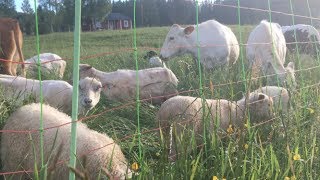
Richard Perkins and team host an open day on their regenerative farm, drawing over 100 visitors. They discuss practical work: selling eggs and produce, managing grass to seed and build fertility through trampling and manure, and stockpiling feed to cut winter costs by roughly 30 percent.
Questions this video answers
Around 7,000 eggs.
About 180 people last year; this open day had over 100 people (nearly double last year according to Richard).
Aim to cut winter feed cost by 30% this year.
They plan to leave the farm on 1st August.
Some people traveled around a thousand kilometres to attend.
Chapters
Pastured hands, savannah plantings and floods. Today is the first open day of the season. Yeah, Natalie's prepping some awesome kohlrabis and we're setting up a little farm shop down here and any amount of people might show up. This afternoon we're going to be selling eggs.
How many eggs do we have, Lucas?
Right now around 7,000. 7,000 eggs. So we're selling eggs, vegetables, books, fika, chickens and everything else. It's quite windy, so the stand's blowing away. It's a bit of an organizational feat because we're going on a tour of the farm for a couple of hours and we don't want all the vegetables to wilt in the meantime. But we never know how many people show up. There's about 180 people last year and some people are turning up already, so we'll see. Looking forward to it. Chickens are trampling and just look at the manure coverage. This is what makes chickens very good grass growers. Someone was commenting about the grass looking like it had gone over, but actually we're doing something very different this year. Grass is biologically programmed to go to seed. That's all it wants to do in its life. And the thing is that we've always been managing our grass to keep it in a vegetative state, like most people have been trained to deal with pasture. This year we're doing something very different. We're letting our grass express itself physiologically because we want the longest, deepest, most active roots as long as possible through the year. Now, when you have a plant that's going into stem elongation and seed head formation, you've got quite a range of nutrients throughout that plant. You've got a lot more energy on the tips of the plant closest to the sun, and a lot more proteins at the base because they're closest to the roots. This allows an animal to graze the different parts of the plant that suit it. And, you know, they naturally know which nutrient balance they need. Rather than us prescribing the nutrients we think that the animals need, we let them choose for themselves. So having these long standing grasses that haven't gone over into really woody state yet allows the animals to get greater nutrition. But also what's happening is we are trampling.
So let's head over here to where.
The cows have just moved from and you'll see that a lot of grass is laying down on the ground and there's a high manure coverage. Now, some people would see this as a waste, but there is no waste in nature. And by putting such a large amount of material on the ground, if the stems have actually been crushed, which they have on these grasses that have elongated, once that stem is crushed, it won't stand up again. If the grass is vegetative, it'll stand up and will carry on. But if the stems have actually been put down, like you see here, then that will start getting broken down as new grass grows up beneath it. So this is what we're actually looking to do this year. It's very different for us because we're used to keeping grass in a vegetative state, but actually now we're changing everything we do to manage for grasses to grow as fully as possible without going totally rank that the animals don't want to eat them. But, you know, we have a lot of misconceptions with grazing because we're so used to feeding hay and worrying about our animals in ways that aren't actually necessary. You know, cows and sheep live for thousands of years without hay. And these are actually old breeds. These are mountain cows that are designed to be thrown up into the mountain lands and fend for themselves all winter. So they're perfectly adapted to, you know, find food for themselves. And they're very good at browsing as well as foraging on grasses.
They eat a lot of woody species. So the comment on the YouTube video was talking about, why don't we take.
Hay from the land and not let it go over? We actually want it to be in this state, so that's clear. But the other element of that is that we're going to leave the farm on the 1st of August and stockpile our grass to get it back to this state again, and then graze that through the winter to try and reduce our winter feed cost, because that's the most significant part of keeping herbivores here. There's a lot of feed costs if you need to bring in hay, whether you make it yourself or buy it in, because hay is really expensive to buy and hay making gear is also really expensive to operate and maintain. And so our aim is to cut our window fee cost by 30% this year and see if we can do that by stockpiling the whole farm and keeping on our neighbours land throughout August and part of September. We should have a good full regrowth. There won't be boilers on the farm, the chickens will still be here doing their rotations, but they're typically flattening the grass without actually breaking stem so it pops back up not long behind them. And so we will graze our Land as slowly as possible into the winter, back up to the farmyard, and we'll keep the animals in a barn with outdoor access for the rest of the winter there and hopefully reduce our feed cost significantly. So we collected all the hot poles.
It's a bit of a mission to.
Get them out of the forest.
There's a time when a horse would be quite handy. A bit of a logistical challenge. We're thinning these woods to allow more light down to the floor. Turn it back into silver pasture, essentially. And we stripped all the poles before the interns went off for their break at the nature reserve and getting ready.
For the open day. So holistic management training has finished and.
It was good, no?
And we're in Glasgowen and interns on holiday. Look at this place. This is a beautiful national forest.
So I just dropped the interns off and it's going to be such an amazing time for them. It's a very beautiful place. It's the nicest houses for rent in the whole park. And they had originally been fully booked, but we booked another one. And then they told us yesterday that they couldn't give us that, but would we mind taking this one? We were like, that's perfect. And, yeah, we sent them off early in the internship just to bond as a team without us, which I think is really important to their learning and, you know, enjoyment of their experience here. I've just been really just loving this group so much already. Like, it's such a coherent group and.
Everyone'S taking really good care of each.
Other and we're not actually officially meeting them as a core team and myself till after they get back from this experience. We're gonna. I've given them exercises to do in the national park, so aside from bonding and meeting and looking after each other, they'll also be spending some time reflecting on their learning context.
Why are they here?
What do they really want out of this? How do we design this program? We have the skeleton of the program set up, but how do we design it to meet everyone's needs and really focus in on the priorities people have and to really get clear about the skills and gifts and strengths that everyone brings to the group? Because everyone's coming here from such different life experiences. So early next week, we'll pick these guys up on Tuesday morning and we'll get to really meet these folks probably for the first time and clarify the context before a few practical projects like the hot pole and processing sheep and butchering and making sausages, etc. And then we're straight into keyline trainings, agroforestry, etc. So we're really excited for the time ahead and really happy for this group. And beautiful weather this weekend in an amazing place. I think they're going to have a blast. Cows and sheep are ready to move.
Again this morning and it's our open day today, so we wanted to have.
The cows and sheep here so the.
Kids can see the lambs and see the cows. Look at all this trampling.
We're leaving a very thick ground cover.
And investing in the ground with new growth coming back on top of it. Yesterday when we came up here and pulled away this thick layer, it was full of life under here. Earthworms. And this is the sort of amount of material that we're able to put down everywhere we go this year just from having an extra month without animals in the ground.
Sam.
He's like, am I really allowed to do.
Yeah, very good.
I want to eat my birthday cake like this.
It's Ragnar's birthday. He's got cake.
No eggs.
Magna, have some cake.
No, no eggs. Want to make like this. Really crunchy waffles as well as a.
Quickening pastured broiler feathers for bedding. First car's arriving. Ragnar's first birthday.
Whoa.
And a bit too bouncy on the trampoline. It's a beautiful day, sunny, and we're excited to show people around the farm tell them why we're doing what we're doing here.
The open day is really great. It's an opportunity for us to meet new people in the community and to share what we're doing and, you know, the passion and insight that goes into this kind of farming. It's a very different type of agriculture to what you see in the fields around us, most of which, you know, not actually farmed in any productive way. They're running on subsidies, etc. Cutting open grass. And it's absurd to us because Sweden's a very rich country with quite poor standard of food and yet we're importing toxic beef from Brazil grown on cut down rainforests and all these open pastures. So we're really here to really show people they can make thriving rural enterprises and make good livings doing this work. That's what we're most passionate about, is getting young people set up in an intelligent, smart way. And great did it turn out? It was, you know, over 100 people. It was less than last year. It was nearly double last year. But very new faces for us and some familiar faces coming back too. And it's a chance for people to really see inside the farm. Because we're busy running our intensive education programs in the summer. We don't really take short term visitors and we don't work with woofers or short term people. We see far more learning opportunity with people that are really committing to the season or for extended periods where they can see these processes playing out in front of them. That's really been our educational focus for some years now. Because it's very rare to get opportunities to see the inner workings of a place like this and really get, you know, deep knowledge and hands on experience with these things which is what makes people go out and do it in our experience. And so it was a great day and lots of kids around and families and we got into a lot of technical details and numbers and sharing sort of the back end of the business which we do openly with the people who come here and sold some bits and pieces from the farm to people. And it's great to share our products in different ways. And really looking forward to the RICO ring that's starting up this next week. We'll do a video about that which is really changing the way things are.
Selling from the farm and opening up.
A whole new customer base for us which is fantastic. As well as collaborating with other local businesses. It's a really great day and great to see a lot of people smiling and happy and excited about the farm. People traveled, you know, some people traveled for thousand kilometers to get here just for the open day. So it's amazing to see that curiosity and yeah, it's great day to show people around.
And then some nice purple spring onions. These are very nice. You can punch on those. It's long drive or something. A couple of our first garlics and rocket salad.
That's really nice.
Really nice flavor. Three different kales. You're already healthier just looking at this stuff.
Yeah.
Some dill.
Some dill for your potatoes. That's a beautiful book for midsummer.
And some.
And a big bunch of mint.
So we're back in Kent 1. It's the first paddock of Kent's land. Growth is good and we're moving fast through this lot now. There's not enough animals here that impact this strongly enough. So we're going to watch and make decisions in the next days based on what they get up to here.
Sat.
More from Richard


A review of short and intensive season on a mixed farm and restaurant/event space in Sweden






Alskade Kyckling Exploring complexities of poultry production in Sweden and what we stand for


