S4 ● E68 Turkeys on Pasture, Stringing Hops and Keyline Design Training...
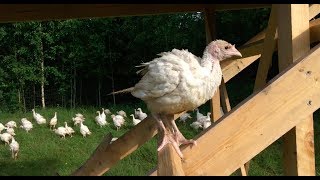
Richard Perkins moves 131 six-week-old turkeys to pasture, strings hop poles, and runs a keyline design training on his regenerative farm. The vlog covers practical work like wire tensioning and trailer use alongside building a pond and planting strawberries.
Questions this video answers
131 turkeys.
Six weeks old (approximately day 44).
Four to six kilos (dressed).
New Zealand red.
June 26, 2017.
Chapters
Today we're putting up the hop poles, tightening them up, putting the hops on the lines and we're getting into keyline design training. One of my favorite trainings, Moving hens in top view. Mr. Duffy's on egg moving. This is that area of the farm that was just moss when we came here. Thick sword now. Lots of dandelions coming up this year than. Turkey moving day. We've been here five days or so and now we're putting them into one of these old livestock trailers. We got half the batch of the tide and we're taking them to the riparian to the neighbor's land. So we'll be running these in poultry netting, same as the chickens have. We've got a couple of new nets because we're using a bunch. These are from Germany, where most electric nets are made. Time to see if the turkey mobile makes it over the stream. It's quite a heavy trailer and the stream has a bit of a dip into it to get over to the neighbours. So we'll see if it grounds out or not. Look overly go. So the cows were here five days ago with the sheeps. Now this field will be where we raise the turkeys for the next six, seven weeks before they go for slaughter. We're aiming for four to six kilos, dressed to make up the differential between the hens and the toms. Bit smaller than last year. People complained that they couldn't fit them in their ovens. Turkeys are in. They gotta go. A bit off road now, but I think they'll like their new home. So These birds are six weeks old. I think it's day 44 today. They're going to the great outdoors. They're strong birds. Gobbledygo. Here's Jasper. He's one of the head builders. He's coming to inspect his work. And we got all. There's 131 turkeys. They all fit in this trailer. Turns out to be a very handy trailer. The guy we bought them from was converting them for log storage for firewood. But they are perfect intermediaries for gobbledygo moving. All right, let's get these birds out and see what they think of the grass. These birds have never seen pasture before. They're raised in a rearing barn. It's much cheaper to buy turkey poults than to raise your own. They're very fragile. For the first sort of four to six weeks, it's quite hard to keep them alive. And then after that point they become extremely robust and they're quite Hard to kill. First day of key line training. Hands some partially confused folks. We're learning to use real time landscape architect to lay out key line cultivation patterning, which seems to be going well. It's late in the afternoon. We're gonna go and tension some pot poles. So tensioning the hop yards. This eyelet has been cemented in and dried and we are just setting up the first end and getting some basic tension from the other end. Then we're going to work out how to tension this wire without the correct tool. So, John, what have you got going on there? Two opposing knots. One to try and choke the cable assembly and one to try and hook down to a come along. Very nice little knots she done there. So we're putting that on the come along as far as we're getting on the chain now we want to decide if it's tight enough. We don't want to over tighten this thing. The way we could do that is whack a string over and pull on it a bit, see what we think. Okay. So first test worked and we put a string up the top and just pulled on it to feel the tension in the wire. And we didn't have enough room to tighten as much as we want. So we just pull, put another little clamp up here and tie the knot again higher up and give us the room to really tension this. It hasn't bent the wire, so we anticipate these bending in towards the direction of the stretch cable. So that will give us an indication how tight it is. But we don't think we need it that tight because it's only a single line of hops. They aren't going to be that heavy. So we're just going to play it by feeling. So hops getting strung up very pretty. And they're quite small still. We've had this one here. We've had them growing in the bushes. So now they're up on strings. They're going to get a lot more light. Just wrapping them up clockwise and they're up about 2, 2.3 meters. Very nice process. Down in the riparian. This is the first lion's mane. And we haven't had much luck with these logs because the birds ate all the wax out. There's a lot of scrap logs, some shiitake just coming up. And these logs have been knocked down by the sheep, but we missed a whole flush. I didn't come and check because we just weren't expecting them. That's shiitake coming up here in this little riparian. Here. So we're tightening the other end, but we're right under a power line now. This is the line that's going buried under the ground in August, September. So what we're going to do is just miss this pole out this year and tighten this one to the next pole, get the hops up so they can grow a bit this year and next year we'll release it and put the last pole up before we come in there. Tightening is going on at this end. So we've got a simple assembly like this with a turnbuckle at both ends and they're starting to come along over the other end. Getting a lot of rain this afternoon. People are on shores feeding all the animals. A few thousand chickens here at the moment. And the turkeys came out in the field today. So busy times, intensive training, lots of farm chores and reflecting upon what's happening within those chores and the economy, etc. And then little projects that we're doing every day. So the internships broken up with theory and then putting some of that into practice. We're just finishing up this hop pole and hop training. And then part of the keyline training will be the pond build here that we saw in the video yesterday. As well as putting in all the strawberries on the keyline. Patterning. Some really nice lupines coming up in the tree lanes. I've always wanted to have more lupines here because when they get thick and dense like you see on the edge of the road here, they really shade out the grasses. So I'm thinking to seed these heavily into the tree lanes, this few. So the rabbits are out in their new mobiles and we're going to start line breeding with these. They're in New Zealand red, they're good meat breed. They're eating premium mescaline mix because we've been over producing, but it's a new thing for us. We've always been talking a lot about context and holistic management and we've been talking about, you know, idealism and pragmatism in this sort of field of regenerative agriculture and farm scale permaculture. And for me the difference between farm scale permaculture and permaculture is that we're working with economy and we're working with regulation. So things are a bit different than idealistic homestead setups, which is all great and all groovy, but things are a bit different when you're farming for a living. And so one thing we've been talking about is the pastured chickens that we raise. They're based on industrial hatcheries and they're based on, you know, monocultural bare soil grain production, which we need right now on planet Earth, but long term we don't need. And so being pragmatic, we're looking at enterprises that are scalable and that are profitable and that are good for our lands. All the grain that we bring in is a nutrient input into our system to get our pastures up, pumping again. And it's amazing what they've done in three short seasons. Making some of the best purses around here. And we're planning to overhaul that with an enterprise such as rabbits or ducks or geese. Ducks still would need grain at any scale, but once we've paid off all debts, which hopefully will be within a year or two, then we don't need to produce so much and we can move towards more idealized truly pastured animals like rabbits. But you got to be realistic if you're making a living farming. There are very few profitable regenerative agriculture farms in Europe. And so it's important to me that we keep it realistic and pragmatic so it really supports a new generation of young entrepreneurial farmers, which is what we're trying to do here. And so that's part of our strategy is develop the market in the next couple of years for truly pastured things. And we can do that. So you need to be a, you know, you've got to be in the game to start affecting change. And so you need to be a price setter and be producing viable products that people want before you can be a trendsetter and start encouraging the market to change into ways that you would like. It's, you know, most people don't know the problems associated with pastured poultry and any poultry production. And they don't know that rabbits are really good alternative that doesn't require grain inputs. These are raised on pasture and vegetable waste. Really good low fat meat. You can't only eat rabbit meat or you get protein poisoning, but you know, much more sustainable local food supply. So something important to consider, pragmatism and planning for the long term, how you'll overhaul things that aren't ideal as part of holistic management. Decision making is whenever you make decisions you know are compromised either economically, socially, ecologically, you plan already how you're going to overcome those problems. And that's all we need to do to keep moving towards where we want to be. Thanks for watching the videos. Don't forget to hit subscribe. You can backtrack through the season by looking at the playlist of all the videos of this season to date, and we appreciate your views and comments as always. Thanks a lot. Find out more on making small farms work. See you next time.
More from Richard


A review of short and intensive season on a mixed farm and restaurant/event space in Sweden






Alskade Kyckling Exploring complexities of poultry production in Sweden and what we stand for


