S4 ● E70 Keyline Plows and 1000's of Salix cuttings...
Richard Perkins plants thousands of willow cuttings using a keyline plow to create fast windbreaks on his farm. He walks through cutting lengths, spacing, and planting logistics, plus updates on rabbits, water lines, and the veg box.
Questions this video answers
90 centimetres between plants (three plants per metre with 45 cm longitudinal offset for the second row).
Two-row (diamond) pattern with three plants per metre, 90 cm spacing, approximately 2,000 plants for 664 metres of planting.
Approximately 50 centimetres long (they plan to use longer cuttings when planting into grass).
About 25 centimetres deep.
About 60 centimetres from the first shank (with ~15 cm clearance from the wheel), so they plan 120 cm out from the fence for the planting line.
Chapters
We're putting in a windbreak with the keyline plough. It's going to be willow cuttings along the edge. They're going to cut this forest in a few years. And we're also putting in quick wind protection before we establish more native hedgerow around the farm. So one of the rabbits escaped last night and May woke up a bit disturbed because the rabbit had come into her tent. So she woke up at three in the morning with a rabbit in her tent and she put it back in the pan, but she couldn't see any holes. But I came this morning, rabbit was out again and he had pushed up. We just stapled the chicken wire on, so it got out again. So I thought to myself, well, where's rabbit in this jungle? And either he's in the riparian or he's been eaten, or he's sitting just in the tree lane next door. So I went looking around with Misa and Misa is quite good at finding things. So we found her sitting down in the riparian having a nice time. And rabbit's quite hard to catch, that's what we learnt. But they're also quick to tire. So I sort of went round and round the tent this morning until she got too tired. Then I picked her up and put her back and fixed the pens up. But rabbits doing really good. They eat incredibly little and drink very little and they're doing fine on the pasta. And we give them a bit of salad mix that we can't sell all of it, so we give them a bit of that. But very beautiful rabbits, very happy. It. So I'm moving the water lines that supply water to the egg mobiles and cows and sheep, etc. Pretty long grass in here. It's a bit shorter along the fence line, so I've been getting away with cutting. I've done the other side of Nutfield and the other side of the road in Topfield, around the bottom there. And just deciding whether we're going to come along here because it's going to block their view if we plant willow along there, but we'll come down this edge. We already have a windbreak up here, but for the keyline plough to come in, we're thinking to do a couple of rips like. Well, not rips like subsoiling, essentially 25 centimeters deep. And I'm thinking to. Normally I'd put black plastic down and poke cuttings through, but I think we're going to do this without plastic, just to not have plastic sitting in the field indefinitely. And willow's hardy enough that you get away with doing cuttings any time of year really, as long as the ground is moist, which is no problem here because it rains every week. It's time we get a four wheel drive lawn mower. It's not really built for this. The wheels have no traction. I'm cutting up along here, but I tend. I turn too late. I can't get back up the hill. I'm cutting a line all the way to the top of this field and then I'll be cutting down there and missing breakfast because I don't know when the tractor's coming. Matt's going to help pull me now. More. You want to be up there? Can I come across here? Yeah, I think so. Happy days. Get the lawnmower out. Carry on. Veggie box day. Veggie box day. Ordered to sell me microgreens. Happy gardeners. Look at these beautiful things. What's in the veg box?
This week we have kohlrabi. We have new cabbage.
Very nice. Wow.
We have more turnips. We have the first fennel.
Beautiful.
We have broccoli.
Very nice.
We have the three types of kale and beautiful radish. And beets.
And beets. What about mespoon mix?
Yeah, for sure.
Okay. And then garlics. Fresh garlic still. Yeah. These are the half shells. And the half shells are really big too, aren't they?
Yeah, they're really nice.
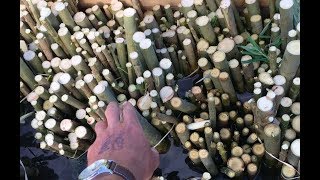
Very nice. Super. Amazing beds. Someone's asking about the price of the box. We sell the large shares for 295. It's about €29. So it represents good price in Sweden. It's a competitive price and you know, we feel good about it. Customers feel like they're getting good value. And at Ricoh we sell for 350. We're quite open about that. On the website it's like, hey, if you want to subscribe for the rest of the year, this is how much it costs. If you just want a one time box, this is what it costs. And people have been happy with that because they like the convenience. Half shares, half of that 150. So it's a small increase, very small increase if you only buy a half share. But both the half share and full share, always over the allotted value. We're always adding a few little bonus things into to keep everyone happy and good. And we enjoy it and it works for our economy that we've planned. And everyone's winning. If everyone's winning, everything keeps playing. Garlic. So we've worked out we're going to go for 90 centimeter spacings. So these are put in as pencil thin cuttings three seasons ago. Just look at some of them. I mean that's the scale. You can see my hand there. And so we're going to not use plastic on the next lot. These did very well because of the anti grass properties of the plastic. But we're going to go straight into grass with long cuttings. So these were 30cm cuttings, put 20 in the ground. We're going to pull the keyline plough through 25cm and put in cuttings of 50cm long. When you've got grass competition, bigger cuttings, longer and thicker, they have more stored energy, will do much better than shortcutting. So we're going to try without plastic, see how that goes. So what I want to do, there's six rows of willow here and I always want to alternately coppice rows. So we just took a couple of these viminales down. It's a hybrid fast growing willow for biomass. And we're working out how many 50 centimeter cuttings we can expect to get as we come through here to determine if we have enough material. We've worked out we want 664 meters up around top and nut field. And we're putting three plants a meter, so 90 centimeters between the plants and two rows. So there'll be a plant here 45 centimeters long. There'll be a plant in the next row and then 45 centimeters along another plant. So 90 between each plant on the row, three plants a meter. So we need about 2,000 plants and we want to determine how many rows we need to cut to do this. And then what we're going to do is cut these and soak them in buckets of water. Hopefully the tractor is coming today. And then we would actually plant these on Monday or Tuesday before they actually go to root. But that they're just on that point of starting to root because we don't want to be planting sticks into the ground when they've already grown roots. And we want them to have the best chance possible to compete with the grass. 92 cuttings from two of the plants and we know we have enough plants in not even half a row probably, but we've got 100 meters times six rows, 600 meters of plants. So we've got plenty of cutting material. Okay. So we determined a few things for this project. We know now that the keyline plough and the closest it's going to realistically get to the hedge is about 60 centimeters because the wheel. This is the depth wheel that stops the plow digging itself into the ground. It's about 60 cm from the first shank, leaving 15 cm that I expect the tractor driver to be able to come up to the fence. And then because there's frames within the plough, we're looking at about 60 centimeters between the row. So we're going to use 120 out from the fence. And we got 664 meters times three plants per meter. They're going to be at 90 centimeters with 45 longitudinally for the second row. So in the diamond pattern like that, so three plants per meter block is going to give us approximately 2,000 plants. And so we're planting up in nutfield. We've got a windbreak here already and they're going to cut this forest one day. So we're going to put in a row here, two rows here, two rows here. This is in front of people's homes, but we're putting it in there, I think. And then we'll keep it trimmed a bit lower because they have a view of the lake down across our farm. So we want to consider that. And we'll be cutting down here and then putting in the two rows down here. There's a gate in the middle there and then in top field on the other side of the road. I've drawn this incorrectly. It's here, here and here. So that's the plan. We know what we're doing. We're growing without plastic, so we expect the grass to have more competition. When you pull a keyline plow through the ground, you get a bit of die back on the edge of the cut, which is what people use to establish cover crops or pasture crops or whatever. So we're coppicing mostly viminales in this room and we're putting that material out here to then be stripped and graded. It almost reminds me like working with bamboo, really nice amount of biomass and that's going to open up this wind dynamic a bit. But the aim here is to alternate. There's six. So we want to alternately coppice three rows each year and get a cycle going. And we're then grading and selecting the big cuttings to make sure they get away from the grass. We'll bundle those up and cut them with the biggest saw here just to make a large amount of 50 centimeter cuttings. Some of these alders are two seasons old, so they've had 12, 12 months of growth, essentially. And you see some of them are up at over 4 meters now they were put in the 60 centimeter whips, single stem leader whips. That's a super nice process, taking some of our windbreak yield and multiplying it around the rest of the farm. We've got now 1800 cuttings. Some are quite big, but that's alright. With willow you can be pretty merciless. So we're going with willow because it's free, it's easy, we can just do it. That's a nice project and it's going to give us very quick windbreaking. Very different size of cuttings, but I'm happy with that. The, you know, willow is so hardy, vigorous as willow popping up in the fields as it is. And then we'll plan to. I might put alder inside just because alder is so fast growing. These are two year old whips that are, you know, four meters tall in places now. And I'm happy having just some basic windbreaking up as quick as possible. It might be that we decide to put a hedgerow in later. It's kind of designed on the fly. We know we want some wind protection, but it's not that important to me, the specifics. And right now I just feel like I want to get it up quick and so that will be shading off some of our inheritance plantings, I like to call them. There's chestnut here, these are badger set chestnuts and oaks. We have red oak and English oak here and that will shade them out a bit. So you can see the line of cut behind me ready for the tractor. But that will just make those trees grow straight and tall. I'm going to prune the laterals at some point soon and then we'll just have them grown up nice and straight as timber trees in our avenue planting. So we're just setting the keno plough up ready for the tractor to come. He might come tonight, might come tomorrow. And we're using this to put in the cuttings. So we've set up two coulters that cut the grassroots just above the plough. So this is the wombat point of the yeoman's plough. That has a really good soil dynamic for breaking open compaction in subsoil. So we've set these together 60cm apart and we've got about 60cm of clearance to keep 15cm off the wheel, so be able to drive up along the fence line. We've dropped the other shank and coulter off and we've dropped our roller bar off the back. And when we lift this, we'll set the depth wheels and we'll drop off these bars to allow the tractor to reverse right up to our fence line, just to get the most out of the machine. Work as we can. And then we can do any last bits by hand as well.
More from Richard


A review of short and intensive season on a mixed farm and restaurant/event space in Sweden






Alskade Kyckling Exploring complexities of poultry production in Sweden and what we stand for


