S4 ● E71 Keyline Plow work to prep Salix cuttings done and river caught Salmon
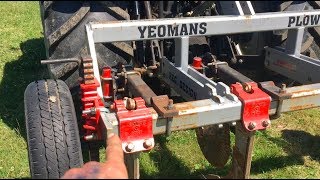
Richard Perkins sets up a keyline plow to cut 27-30 cm slots for 50 cm willow cuttings, checks on his turkey flock, updates the garden, and catches salmon from the river.
Questions this video answers
Seven weeks
About 21 kilos per day
Around 300 grams per day
About 30 centimeters
About 27 centimeters
Chapters
So tractor's here and we're just hooking up and lifting the power to drop the shank. We're not using. We set this up for the Pedro spacing. Morning turkeys, feeding time. So turkeys in their seventh week and they're growing visibly daily. They're on about 21 kilos of food a day. Their feed ration goes up by around 300 grams a day at the moment. And so the growth since they arrived is pronounced. The toms are obviously growing proportionally fastest. You can identify the toms already just from their size. One there, walking off, one here, very obviously, but they like their gobbledygo. Good effort, intense. Nice job. And they've been crashing the fence a bit, but I think they're getting used to it. It's good to throw a bit of feed in before coming in, because they'll come and crash the fence. They're very heavy birds. So if 100 decide to go out the fence, then off they go. Fence goes down. So ploughs on set up. We've just been tweaking the coulters to get them exactly over the shanks here. You need to have them lined up properly to get effective cut cutting of the grasses. Their function is essentially just to cut the grass. Because grass roots are so intensive, it takes a lot of horsepower to pull a lump of steel through the ground. So that just reduces the amount of horsepower needed. Typically, on the keyline plow, they use fluted coulters, which have a more graceful arc in the curves that you typically associate with keyline ploughing. Straight coulters would sort of give it a bit of compaction and smearing on the edge of the cut. So ground condition is good. It's not too wet, it's not too dry. That's when we have to do this work. And we're not really doing any subsoiling so much as just making the pattern to be able to plant our cuttings really very fast. So the driver's been instructed to go right up to the fence and we see how it goes. You can back in there. We've taken these mounts off the back and we'll see what we think of the first cut. So we're doing a little test run for a few meters to see how we like the cut. The fibre optic cuts through here and off to the neighbours. This used to be their lawn. It's actually our property. So the fiber optics now in the middle of the field. So we want to make sure we're not going too deep so that we make sure we don't break anyone's cables. It will swing in once it's turned. Now it's sitting on the depth wheel. We just go a few meters forward and let's test the depth and in here, see if we like that. Is that 30 centimeters? 30, yeah. So let's lift it up. We lifted up a couple of notches. So test number two. We just changed the depth to about 27. Now it was cutting about 30. And we just tweaked the coulter in line again because the. The hubs on the coulters were slightly different heights. So the left one wasn't padding. See if it's any better now. So the cores are still off, which is giving us a chunky cut. But we're putting a cutting down in there that deep. So it's perfect for planning. It will be instant planning. We're not subsoiling. We're just getting ready to plant curtains. So it really doesn't matter. You can see how it heaves here. I think the angle is. So we're hitting a bunch of tree roots, as you'd expect on the edge here. It's cutting through little ones. If you hit any big roots, it starts to pick up the soil like you see there. So if it's too big, we just lift out and lift up over it. I think he's got on that. And then we can just tuck the soil back down. Obviously this wouldn't be good if we were subsoiling past it. It's too lumpy leaving the ground like that. It sort of defies the point of what we're trying to do. But we're just trying to get in the cuttings so it's really not an issue. This is an area that won't be, you know, used as pasture anymore. It'll be a rapid growing windbreak. So not the cleanest job compared to when we've done this in the past. Jeff. But not bad. It's going to be perfect for putting in these cuttings. And that's just a nice 27 centimeter hole. Perfect for 50 centimeter cuttings. Okay, so we'll truffle the side of that. We've already got a windbreak up here. This is alder with some spruce behind. And they cut the forest down here. They leave a bit of a cut at the back of our fence. So that helps with the wind a bit. It gets very windy down here. It's little spruce in the background. You can just make out. But the alders are popping up. And then we're going to do willow down the side here and then in front of the houses. But we will keep that pruned nice and short. So we're coming along the front of the houses here and we're planning to put the willow in but then keep it trimmed so it's not blocking their view too much. There's actually a covenant on this piece of land saying that we can't put trees here. But we've been researching it, but it's a very old sort of paper and I think it means no monocultural sort of plantation. We put in nut trees. So we're hoping to have a like open savannah planting here with pecan and walnuts and chestnut, etc. So that's all the little posts you see in the field here. Some good growth on some of the trees this year. So we're coming around the inside of the bend in top field. So we need to hook the the water line up. We could just take the water line apart as well, but it's less work just doing that job done. And we're putting it away this weekend so we're leaving this until Monday and we'll get that planted up in probably an hour or two and maybe we'll keep an eye on it for the first week, see how the weather goes. It looks like we get a bit of rain later in the weekend so I don't expect to have to water anything. And they're deep enough that they'll stay moist and covered anyway. So all done and chopped the plough up. This is really what makes the Owens plough work. These little toes are sitting at about 22 degrees, so it's not got a flat bottom like many subsoils do that just smears the soil. It's just this little tip and the wings and the front edge that are in contact with the soil. So today we went about 10 inches down. That's a measurement from here to the tip and that's perfect for our cuttings. Didn't break any pins. This is the shear pins that you put in 18 mild steel. It's got about 4 ton braking force and that if you hit a big rock it will snap the shear pin and you don't need to undo the bolts. In the field. You drive a wedge pin in here, it lines up the hole and you see there's holes in the frame here or in the coulter assembly. So you can just pop a new breaking pin in there and that protects the expensive cast shank. So tomatoes are doing good in here. Still quite short, but lots of thick fruits there. Cucumbers are getting food on now. We'll prune some of them off, getting them grown up a bit before they start producing. Really a lot of cucumbers and a lot of very nice looking tomatoes. We've been just smacking the wire on the top to help with pollination and keeping them pruned. Suckers pruned off and keep stringing them up. Very robust plants. Bit shorter than I would imagine before the fruit set begins, but looking. So. Peas have really shot up now. We're taking the first of the snap peas off. There'll be a lot more coming soon. You see the baby ones here, but there's some nicer ones on the south. I've been walking through chomping the bigger ones. There's some nice little peas developing. A lot of growth recently with the nice hot weather and all of the squash have really come on now. We've got courgettes coming and kales are soon on their way out. More broccolis developing here and some nice head broccoli in there. This is the grey lake. I'm just sitting up here taking time out but it's about 20 minutes cycling. There's one little summer house up here but there's no one there and there's some ruined houses a bit further up. I can't remember how far it might even be. Be 10 minutes that way. There's a little road up here that you go along and there's some abandoned house. It's beautiful up here. Well, it's now 9:30 and I've been out fishing this evening, just taking some space from the farm. Got some beautiful salmon from the river.
More from Richard


A review of short and intensive season on a mixed farm and restaurant/event space in Sweden






Alskade Kyckling Exploring complexities of poultry production in Sweden and what we stand for


