S4 ● E72 Pastured poultry and Salix planting
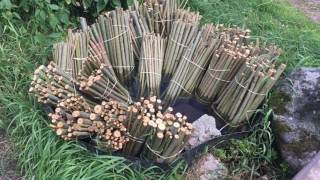
Richard Perkins processes 250 pastured poultry birds per session, averaging 2.1 to 2.2 kg each, then plants over 2,000 willow cuttings across the farm with 4-day soaking and careful drainage planning.
Chapters
So tractor's here and we're just hooking up and lifting the power to drop the shank we're not using. We set this up for the Pedro spacing. We're expecting calves in a few weeks. They're almost ready to pop. The cows are in good shape. Got a couple of skinny sheep, probably parasites. I'm just going to consider what to do with this. Ah, It's Monday, which means thorough day. And every day now for the end of the season, every Monday, Matt's on scolding and we're scolding 75 seconds at 63. New plucker's been working really well with that ratio. And horrible rainy day. That's quite nice and warm in here. So we're doing about 250 birds today. And that will be the same now for the rest of the year. Every Monday and Tuesday will be packing day as well as vegbox day. Birds come over here. Everyone's set up with a sharpened knife. So last night I set up the scaulders. They sharpened all the knives with a whetstone. Secretaries for necks, keeping the necks overs hearts. Waste goes down here. Clean team do inspections, rinse out, make sure the bed's good and great for Polycras. Ms. Lang is back. Sarah was our Coldland mice for her last year. What is the process when the birds come in to clean side, Sarah?
So the birds come in on the table and one of the first things I do is write down when they come in.
When they come into the derby sign? Yeah.
No, Well, I write when they come in over there as a group, as a group of six. And then each individual bird I write down when it comes into the clean room.
So we know exactly how long it took from a bird being killed to getting into the chiller. Exactly. And then what have you got down on here? And then?
Well, with the birds, the next thing I do is wrap them and flip the neck skin over and hang them up. And then I just do a final check if there's anything left and give it a grade and then go put the grade next to the time when they came in.
So we grade the birds like a grade is perfect bird, perfect condition. It's a premium bird. And then we have B grade is like a minor mark on the skin, something like that. And then C grade is a broken wing or something. We will eat ourselves and not sell to our customers. Yeah. And then these are for organs. Yep.
So organs come in, in colanders. And then I separate them into.
Bags.
Based on what they are and the date so that when they're in the freezer we know what they are, we know when they're from. And then they just get the air squished out and they get zip tied and clipped and then they go into a cool box.
They go into a cool box in the chiller with ice water usually. And so Sarah's responsible for keeping track of all the beds and then she will probe them in the deepest tissue like in the breast meat. And we have to show the chill down procedure and that's all papers. These papers go into the folder each time we do a slaughter session and we have to send a copy of them to the regulators. Thanks Sarah. Have a good day. So the slaughter went well. We've came out with 250 birds over 2 kilos and just got to update the spreadsheets today to know the actual average weights. But I think it's about 2.1, 2.2. So bit fairer. Weather definitely helped. And also in this case we're selecting out the bigger birds for each slaughter session. Hens are enjoying the late evening sun, having their dust baths here and I'm on my bike so it's a little bumpy. Off for dinner. Yeah, that's good. So it's time to plant the willow cuttings. We're just going to gather them all up here and head up to Nutfield. So Michael's distributing bundles every 16, 17 meters which is when we'll run out of plants and then we just poke a stick in every meter and guess the offset in between. So got a big team but it's taken about 20 minutes to do the whole farm and that's over 2,000 plants. So very nice job. Some messy bits where the roots have been ripped out in the ground here but generally it's a nice cut and you'll get a bit of die back on the grasses. But it's 27cm under down and the roots have been soaking. The cuttings have been soaking for four days and some of the nodulation going on at the base of them. But no roots formed yet. So perfect time to get them in the ground. It rained heavily the other day and it's going to rain again this week. So perfect. Here's an area where there's some field drainage that doesn't work. This whole marshy area running down the farm we're going to turn into pocket ponds. It's full of sedges, it's not very good for pasture anyway. We might do pocket ponds one day when we have some Surplus time with a digger and just have receding level ponds that fill up as it rains and dry out again. That's a nice little habitat to have on the farm. And we'll make a crossing over here so we can get the egg mobiles up into this quarter that we never usually bring them into. So this is the area at the bottom of the field where the drainage ditches come down here. There is drainage pipes over here that never worked. There were two excavations. If you go on Google Earth and look back in time, there are two pipes about 1 meter 20 down, trickling water. So some water comes out of them and it's failed. I saw on the old Google Earth and I asked the local digger drivers and they told me they had actually installed it and it hadn't worked. So so they've dug it all up and done it again. It still doesn't work. You see, it's full of wetland species. And so rather than try and change this into something else, I think I'll accentuate it by digging pocket ponds. There's clay in all of this soil here. And so with a simple excavated clay walled and over spilled series of ponds, they would fill up every time it rains and their spring flow and then dry up when it's dry weather. So we got some spare time today because we planted that up so quick. And look at these beautiful broccolis going in this week's Rico box. We've got chickens tied onto the Rico deliveries this week, but our friend Joe is coming tonight. He's an arborist, very skilled arborist. He's going to do some tree care, chainsaw safety, chainsaw sharpening maintenance and rope work with the guys is Reuben and the farm managers are working on new fencing. So we've got a laneway to come in here and along the pathway here to connect up to the larch paddock. And then we're hoping to build new paddocks in the spruce up here and the paddock from last year behind the trees there. Hopefully with the intern soon. But they've been working on the paddock under the electric line here, which is a twofold paddock. So there'll be a laneway here, connecting, connecting to the laneway here. And the reason we're putting in permanent fences here is to be able to move animals around easily without, you know, pigs are hard to herd and it gets quite dense in here. So it's not fun trying to catch pigs that escape out of temporary fences. And so they've been putting all the posts up, but it just Needs wires now. So what the pigs were up in the top half. There's a road that joins. You can just make out a gate post here. So there was a top paddock and there was temporary sheep netting across, but that didn't work out so well because the piggies wanted to go and explore. So pigs are back in old paddock. New line goes down here. This is very wet here, so this hill is quite steep on the other side. We're leaving this out of the paddocks just to protect this area a little bit. And the laneway will come up here up there. So this in the trees will be a whole other paddock. And then the old paddock at the back will need a permanent fence that was on temporary fence last year. This is a triple wire temporary fence. And we got water installed all the way up so we'll be able to bring water to these paddocks. That seems to work out okay. And considering not having so many pigs next year already to allow because we're thinking to cut down over the winter and let it start regenerating into mixed species like here. And to allow that to happen, we'll need to reduce the pig numbers. Otherwise they'll just turn up any new saplings and eventually turn this all back to grasses. This is where the pigs were last year and we want to turn it back to trees over pasture for overwintering the cows and sheep. Dinner bell's gone. These guys have been hard at work getting this fence together. Chicken's doing good, strawberries are good. And our friend Joe's arriving in half an hour to do tree care and arborist sharing. In the next days, some of our chickens for dinner. Yeah, Beautiful. Have you cooked them? Marielle. Second butter cooked in butter.
Oregano and salt and onions.
Just that looks awesome. That's all today, folks. Thanks for watching our videos. Don't forget to click, subscribe, share the videos if you find them beneficial and you can find out a lot more in our book, Making Small Farms Work. See you next time.
More from Richard


A review of short and intensive season on a mixed farm and restaurant/event space in Sweden






Alskade Kyckling Exploring complexities of poultry production in Sweden and what we stand for


