S4 ● E73 One of Swedens finest Arborists and Compost Tea Brewers...
This is a recorded conversation between Richard Perkins and an arborist named Joe. They cover practical arboriculture: chainsaw types and maintenance (chain sharpening, clutch behavior, recommended drive-link visibility), climbing and ropework (carabiners, French prusik, Blake's hitch, bowline, ascending techniques and pulleys), chipper/compost operations (alder chipping, Jean Pain pile, using woodchip in compost and mushroom beds), and felling techniques for trees in constrained sites (assessing tension/compression, escape routes, sectional felling). The recording also includes farm updates (vegetable box contents, escaped pigs and fence repair) and site logistics (bentonite pond liner: 40 x 5 m, 1.1 tons).
Questions this video answers
40 by 5 meters, weighs 1.1 tons.
200T, 241, 342, 441, 661.
Chapters
So Joe is here to talk about the healthiest soil community and tree Ken. And it looks like we've got a digger being dropped off for Saturday pond building. This is Eric dropping off his digger. So Joe's brought some of his gear, different saws and a nice winch and felling levers. And so today's going to be about felling, safety maintenance with chainsaws, different theories about felling in different scenarios. We've got some interesting trees to work with. We're going to take some of the alder out of the peat bog. This is a chipper that Joe and I made a Jean pain compost with over near Stockholm a few years ago. And we're going to take that alder chip and put it here and make a king straferia or wine cap mushroom bed under the deep shade of these oak trees. So this is the roll of bentonite we've got to work with in the new pond. The jig is here and we'll be starting on Saturday. So you see it's a layer of bentonite clay sandwiched between two layers of geotextile that are needle punched together to make that secure. It says on the label here it's a 40 by 5 meter sheet that weighs 1.1 tons. So the barn swallows have made a nest on top of the gas pipes. I don't know how well you can see but there's some newly hatched chicks which probably take two weeks to fledge. So have our gas pipes back soon. So we have field microbes. Well they got peas, sunflower, radish and we're doing a comparison, see how they do outdoors in length and yield wise. Look healthy so far. There's some spades or something here. So we got a fence down, trees falling down on the fence and Joe's the arborist specialist, so perfect timing. We got some exercises to play with.
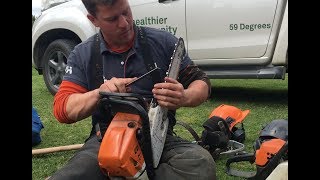
This is going to be a part of that. Right? So this is a top handle chainsaw, not a one handed chainsaw. Some people call it a top handle, sorry, one handed saw which implies that it should be used one handed and that's frowned against. I never use the chainsaw one handed ever. So this is like tied to my harness when I'm in the train. It's obviously light and mobile. This is a 200, referred to as a 200T referring to the kilowatts it produces. This is a 241, very nice, nimble sulfur limbing branches, trees and then going up in size. We have a 3, 4, 2. This is probably my Oldest saw but still very faithful. And this is. My cousin calls this a don't argue saw. It's like. Yeah, gives you a really good kick if you're not using it. Right. And then the 4, 41 which is the second to largest saw I have, I have a 6, 61 as well. Which is. That's pretty beefy. Nothing that we need to use on a daily basis. So I didn't bring it. We'll probably use this saw for the tree that's fallen. These are all two stroke, obviously. Two stroke. This is a four stroke winch and is used for. We just use this for sort of moving pieces of timber, dragging pieces of timber. We can tie up big mounds of brash and stuff which saves a lot of groundwork. The idea or the kind of. The more efficiently we can work and the less energy we can expend and using small tools and pulley mechanisms, the, the quicker we can work and usually the safer we're going to go through. Maintenance, chainsaw maintenance care of what that involves and how we can ensure that the tools are well kept so that they work when we need them to work. Invariably a tool is going to pack up when you need it most. So to avoid that happening we can. We can sort of take some pragmatic approach to looking after equipment as well as we can. Yeah. It drives me furious when tools don't work and people. I employ a few people and they don't take care of the equipment as well as I would like. So that's the kind of thing that gets me a bit crazy. But yeah, all the tests. Right. So anyway, rope coiling. Some people like to coil ropes like this. But you can see in order to do that I am actually having to twist the rope and then I'm making coils further down the rope. So I don't do this. This is basically how I'm coiling rope. So just taking an arm length each time and then it doesn't really matter if I'm not making. I'm not creating any loops in the rope. You can see I can give you.
A go at this.
I'll just do it quickly so you can see how it looks. And if you do everything consistently then you know that there's a way, there's a kind of process behind it and packing and unpacking becomes automatic. So to say. So that's how I pack ropes. And then I would lighten the rope, lighten the box and you know where to grab it. And then when you're unfolding it, I mean this is all I never talk about. So I'm having to kind of un. And then when I want to unfold it, you know, it just comes out like that and doesn't tangle. I mean there are a million and one harnesses that you can buy in the market. This is kind of quite a straightforward one on the whole. My climbing saw sits on here, my side strop. So you always attach the two points in the tree. This is one of them. So you're either roped in around the stem, around the branch here. And this is an adjustable strop. Hand saw, a small branches and my climbing rope. You can all try this equipment out in the oak tree if you like later. I forgot to say that these are triple action carabiners. So there is bearing. I don't know if I have any screw gate. I don't think I do. No, I do. Yeah. So you'll notice that there are varying action carabiners. This doesn't have any locking mechanism at all, just a kind of quick release. This is a screw gate. So I lock up the carabiner and that doesn't open. These are the kind of the old style, you could say. And then this is a triple action. So the prints. The idea being that it doesn't open, it can't open accidentally. So to open it you push it up, twist it. That's how that looks. So this is a triple action carabiner onto my main anchor point. And I use a. This is called a French prusik. So it's just a friction nut. You can see that when I'm touching moves and when I let go, then it doesn't. Then of course my. I'm anchored over a branch. So this is how I get out into certain areas of the tree. Here I have a cambium saver, a rope guide. Again, you've heard me talking about friction. Friction can be your biggest enemy or your best friend. It depends in which context. So I have a 90 kilo frame approximately. That's quite a lot to kind of pull yourself up a tree. So the less friction I have in the tree, the less effort on my forearms and shoulders. It's a pretty physically demanding job, as you can imagine. And instead of my rope being over the branch, I'm now attached just on this little pulley. And then that's a significant saving on friction. So I have this little bobble on the end of the rope. So if you imagine that I've just pruned a tree that I'm now finished with and I can descend instead of climbing all the way up to the top of the tree. I can just unclip and it comes out retrieve. So sometimes it works. If it doesn't, I can tie the Isuzu onto the rope and something will break. And it has happened. Driven forward, which is taking them into the knives. Chipper knife controlled by this. And this red lever is reversed. So if you want to reverse anything or if it's a safety mechanism. Also if you get caught in the, in the branches, you'll automatically trigger this and everything will stop. So yeah, the feed rollers driven hydraulically and then the knives driven by the belts.
This is the chipper we're going to use to chip alder for the wind generation.
As a result of these knives spinning is taken up through the chute and then out in the direction that we choose and we can chip a lot of material. Richard and I some years ago made a jean pan pile. Exhaustingly we got through a lot of material.
It's amazing what a tree turns into, isn't it?
Yeah, exactly. So wood chip, I think is a really phenomenal, phenomenally useful material in varying applications. This machine is obviously very good at doing that for us. So yeah, it's a principal ingredient, a key ingredient to the compost that we're making. Are you picky about what type of tree you can do? Try not to use too much conifer and too much oak, high end tannins and other stuff. But yeah, so I try to make it diverse. So cherries and aspens and willows, sort of early successional trees I find are really, really good. And then the birch is also. We get a lot of fungal activity from these, from these trees. Stuff that's kind of easily broken down, I would say. Can I ask just a quick question? Yeah. My chainsaw is.
When the brake is on, it's. It's running just a wee bit.
I can't remember. So. So that could be a. A couple of reasons. Your mixture is out. So when you're. I don't normally talk about this, so I'm having to think about how. So you of course have your combustion in the. In the chamber here. That turns your piston and converts this into the drive of the shaft. And so if you have a spring broken, this is the clutch works on the centrifugal mechanism. So the faster this spins, then these clutch plates expand and then they grip this which then in turns a sprocket, which then turns the chain. That's the principle behind it. So it could be a couple of reasons. Either your mixture is out, which means that it's idling too fast, which means that the clutch plates are spinning, are gripping the housing. Or you have a broken spring, which. Which also will ensure. Because these springs are keeping the. Keeping it together so loose, so pulling it. Ideally speaking, you shouldn't be able to see more than two drive links. The bottom of two drive links. That's kind of optimal, you say. That's about right. And then just tighten these to a reasonable length so they don't come off. I've been scrabbling around in the bush for a few of these nuts. Tight, but not too tight. So sharpening, get yourself a nice file handle knot like this Husqvarna. Do a really nice one with an orange one. It sits in really nicely. But the principle of sharpening, you could say, is getting a consistent edge. You can see on. Well, in fact, you can see on this saw, when you're looking, you can look a bit closer, you can see that there is a bird edge on each of these teeth. That means that you're not going to get the performance out of the chain. Here you have an angle which is sort of dictating the angle you want your tooth to follow. So you can say that if you were to have a flat edge, if you can imagine this is spinning into the wood, you have a. What are these called? Depth gauge. Thank you. These are a bit high, so you can see, say that they're shiny. If they're shining, then they're getting a lot of work, which means that you could do with taking them off. We'll do that in a bit. So as the chain meets the wood, the first part of the chain to meet the wood is the depth gauge, which controls the amount of the amount that. The kind of slice of the wood chip. So the more you take off of that, the greater you will expose, the greater extent you will expose the tooth to. And so if you take too much off, it's going to be really aggressive and like vibrate like hell and really horrible to use. And if you don't take enough, it's just going to be skimming off the top and you're not going to get the performance either. So really it's about kind of just going gently with the rakers, is what we call them, or depth gauges, but in the industry we call them rakers. So if the rakers are too high or too low, you're not going to. Your saw is not going to be performing. So I'm covering my tooth with my thumb and I'm using It as a guide to just gently run over and about three or four, three or four brushes and then I keep doing that.
And you like fruit sharpening in the field now just for like efficiency sake?
Yeah, I mean I learned to sharpen a saw in the forest in mid Wales. So they don't have a vice. They don't give you a vice in the workshop up there. So you got a wood stump and a file and I really think that that was the best way for me. But I mean if you have access to a. If you have access to a workshop then by all means use it and a vise. This is a good way to sharpen when you're out in the field. So you're just sitting ideally on a stump on a raised platform. So you've got the saw between your legs and resting on your. On your arms. So it's kind of locked in place. Invariably the most challenging part of sharpening is the. Left hand variation. So I will get this saw ready to use. Because it's a little bit blunt.
You can't.
The depth branches. No, I see that they're shiny. So if you can see. You see here, that one's the one I've done.
Yeah.
And that one. So what I. How am I going to do this? So half hitches around the rope tying is going to be your. It's going to be really. Yeah. Really important for you. So like a half hitch and there it's fine sort of just locked off somehow when most importantly it doesn't come undone. That's. That's really the. I've got three half hitches there. So that shouldn't be coming down. With tight forks you, you could, you could put it through there. But here with a nice open. Nice open fork. Union branch. Union. You won't need to. So you pull that through there. Show you a couple of knots that you can use for climbing just on single rope. May or may not remember this, but I can show you at least. In fact I don't even have to use a carabiner. So I always. The Americans like to use figure of eight. I always use a bowline. It's my preferred knot for an end of. And if not your fort with bowlines and then theoretically that should never come undone. And what you can also do is tie a figure of eight on the end of that which means that that's impossible for literally an impossibility for that not to come undone because that figure of eight has to come through there.
But the bowline is easy to undo after it's been put on the bow.
Yeah, exactly. So that's the advantage with the bowline, as opposed to the figure of eight, is that you only have to. If you approach the untying of the knot in the. In the right fashion, which looks like using the. The slack end and just there, then everything, everything loosens. So I'm going to start like.
The beauty of knot tying is that most good knots are easy to undo unless they're designed not to be undone.
And then I'm going to use a friction knot. This is a prusik or a Blake's type of prusik. It's a Blake's hitch. I'll show you these knots individually as well, but I just want to show you how they can be used. You see, I have my hand and using my thumb to separate two, round my thumb and two. And then I'm taking the live end, I think you call it. I taught myself not. So I. I don't know the terminology, I'm afraid. And then I have a. Hopefully I have a Blake's. Blake's hitch. Yep, that's good. And then I tire. I'm glad I got that right. So, theoretically, I should be able to find out. So I can put myself up like that. So the disadvantage with this is, of course, if I want to take this off, I have to untie everything. So I have that equipment there that means that I don't have to do that. And just a thrust for people that want to try. You're wrapping your hand around it, pulling while you thrust. This is how you get up in the. In the tree. This is one way. I have some ascenders that I didn't bring with me. So using a mechanical ascending system, you can use your legs because, of course, you're using really small muscle groups to pull all of your body. The more of your legs you can use, the easier. And this is probably the most physically demanding part of the job is actually getting up to. So this system that I'm about to show you is actually how I work. So you have this little Petzl pulley. I'll show you why it's important or how it's so functional. So I'm attaching that. Instead of actually tying the bowline to my knot, as I did before, I use the carabiner instead. And this is called a French Prussik. So I would say that, like, if you're interested in farm work, then really do invest in a good book and a bit of rope and spend nights by the fire learning knots. That's the only way you're going to do them. Do it. I'll show you the principles of tying. Tying the French Prussik. They're all variations on the theme using. Using friction, of course. So that's what a French Prusik looks like. And I use the same pulley to clip into. So everything is on one, Attached to one point. The disadvantage with that is that if something felt then I'm dogmaked. The advantage is that it's a very quick system. So quick system to use. So just keeping on top of your equipment and making sure that it's all in good working order is pretty imperative. And then you can see here that I think it takes a bit more effort to do like this. And then you just have to hold yourself. And you can see this pulley is used to feed the rope through. It's kind of a self feeding mechanism. There's one in the library. Sailing books, like any good sailing book will have all of these knots in technique.
Man hips, hip hips.
Don't forget that. That's great. And just make sure that your rope is gripping when you stop. That rope is gripping the rope. The green rope is gripping your. Yeah, there.
Boxes, bags, mini boxes, big boxes. What do you guys think in the boxes this week?
Oh, this is really full.
Really full. Kales, garlic, baby fennels and romanesco.
The new.
Yeah, Romanesco and peas. We've got some nice turnips, iceberg lettuce, kohlrabis, first of the sugar snap peas in here, more turnips and some radish and some, some purple kohlrabis, some romanesca and lovely head of cabbage. More broccolis. Very nice. Nice boxes. So they're going off to Rico now. They sell chickens and eggs as well as boxes. Matt and Carla off to Rico with eggs and chickens. These cool boxes are really good. And everything's all organized. Bit of an issue to get everything together. It's a bit a hectic morning for them, but then everything's quite easy when they get there. They're doing great job with the sales and customer communications. Ready for Rico. Ready for Rico. It's another awesome box. Man, look at these radishes. Yeah, Beauty. Good job you gang. I might buy a box on the way and apologize to somebody. So two of the rabbits escaped and we're getting some heavier Julia wire. They're not digging out. They are coming out of the wire by chewing it. But Miso, good girl. She found one, chased it under the barn, found one and chased into Mae's tent again. So we're going up to the forest, learn about felling trees, climbing trees, and sort out pig fence. So in the meantime that the fence is down, we're coming up to fix this fence.
Now.
We found little mama with new piglets escaped outside the fence. So this is going to be the new paddock that we've got the wires in. Just need stretching now and then they'll have all the way down to the bottom here. Good Mama, have a girl. So it just goes to show, you need to do a lot of observation daily. This is escape piggy territory. You see these trees have just come over and the fence has lifted up with it. One of the fence posts is actually stuck in the tree root mass. So the plan is to fell this, drop it down, re erect the fence posts, and look how thin this soil there is that these great trees are growing on for 60, 70, 80, 90 years 30 cm thick.
If you can imagine a lot of really tightly packed straws together, that could resemble sort of on a mechanical level, what a tree looks like and how it lays down carbon to optimize strength. And so when you have this lying, this stem lying down on the deck as it is, you're going to have these parts of straws, we could call them under tension and under compression. So if I go in and attack the compression side first, I'm going to get at risk of getting my saw trapped. So the trick is to ascertain where the tension and compression lies. So if this weren't here, if this mound weren't here, it would be very easily to determine. You'd have the compression here and you'd have the tension here because it's sitting up there and you get this kind of sagging effect. But because we have this cluster of earth and root clump here and here, that kind of alters it. So to be honest, I'm not exactly sure where. Where it's all lying, but I can feel when I'm kind of boring in with my saw, I can feel what's happening and then I can make adjustments. Standing here, I'm most vulnerable. I've got lots of sort of trip hazards. And over here I have a really nice kind of escape route, you could say. So I'm going to work on this side first and just try and try and sort of get as much of this as I can with the saw and then I'll climb over.
Sam. So this is how the little mama got out through this gap. So it's just temporary fence while we sort this out and we're going to use a winch to hoist this root assembly down. And that should bring our fence back in line.
We can patch that up. 99, 100. Yeah. 1, 2, 3, 4, 5.
Yeah. 105. Call it 103 and a half.
Yeah. So what I would say is that if you have branches close to the ground, just pay super care. Put super much attention to to where your blade is in relation to the branch inherently. If you're going to blunt your saw, you're going to do it on ground or on rock. I think it's worth paying an extra five seconds to the branches close to the ground as opposed to blunting and saw and all of the palaver that's associated with getting your chain sharp again. So here I've got some branches on the ground. I think it's probably better for me as opposed to trying to risk the risk the sharpness of the blade. As you can see, the saw is really sharp. It's cutting really nicely. So I don't want to jeopardize that. So I'll just try and manhandle these branches out away from the ground so that I can cut them freely and then I can negate that problem altogether. It.
She was just taking a lever up and fell in the top of the tree to show a sectional felling. For felling big trees in close quarters.
It. More than 20 meters. This is 40 meters.
He hasn't even eaten it up. He seems happy with the food.
Sam.
More from Richard


A review of short and intensive season on a mixed farm and restaurant/event space in Sweden






Alskade Kyckling Exploring complexities of poultry production in Sweden and what we stand for


