S4 ● E83 BioFertilisers, Compost Teas & CalPhos
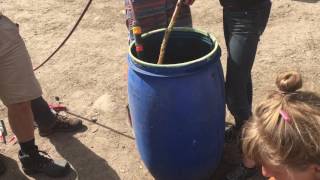
Richard Perkins shows how to make compost tea, an anaerobic biofertiliser from compost and molasses, and a calcium-phosphorus fertiliser by soaking charred eggshells in vinegar. He examines the microbes under a microscope and walks through fermentation times and retail pricing for loose vegetables.
Questions this video answers
7 liters (7 kilos) compost + 0.5 litre molasses + a bit of rock dust (per cited batch).
Fermentation time: 1–3 months (depends on ambient temperature).
18 litres of fresh cow manure (in the small barrel).
"Eight yogurt and about eight milk" recorded; quoted total ≈1.6 litres (raw milk/yogurt).
Five parts vinegar to one part eggshell (5:1).
Chapters
So these poor little birds are firing themselves on the electric line. We hear them up at the farm and sparks fly. But they're at the rate of one or two a day, so maybe their population will balance by the end of the year. We've got a second batch of compost tea in here. First one was a great success. Second one looks perfect too. We've been looking at that. Even though it's just molasses and compost, there's no additional. Oh, and a bit of rock dust. There's no other things in there, but it's pumping with light. So we'll do the other half of the garden beds today. So. So new compost tea batch. Someone was talking about looking at 400 times magnification and not being able to get a reading because the objective was touching the slide. But it shouldn't do. Your slide should be. You should put a drop of any sample. Typically you would use the same sort of sampling method. So a cubic centimeter of compost with 5cm3 of water or whatever it is, but if you look down closely, should have half a mil off the slide. This is a hundred objective and you wouldn't be able to get that down without hitting the slide, but you should be using cover slips and you should be pretty much flat, otherwise you won't be able to get a sampling. So this is the compost tea and.
Again.
Full of bacterias. This one is just. What did we put in the recipe? Just 7 liters of 7 kilos compost and half a litre of molasses and nothing else. And a bit of rock dust. But this is full of life again. So this is from one of the piles of compost that we combined with old compost. If you see old videos. It's not technically finished or complete, but it looks very full of life, as you'd expect. This is a slit here. Let's see. We'll zoom out, see if we can find a. We'll go down to 10 times. So that's 100 times magnification and see if we will need to turn the light down to monitor the amount of light coming through the eyepiece. One nematode. So the compost sample is good. It's very full of silicone and flagellates as well as bacteria and nematode here. So we're making biofertilizer. It's a bio stimulant with N, P and K and all the other trace elements, maybe cow manure, milk, molasses, rock dust, things like this. We've got a lot of nitrogen, phosphorus, potassium and trace elements to stimulate plants to photosynthesize more, release more sugars and exudates, to feed soil biology and get more nutrition. So we've tipped the old one into biochar to soak the biochar with biofertiliser. We have raw unpasteurized yogurt, very milky, but you want unpasteurized raw milk if possible. And we've got molasses, so we're going to mix those in a bucket. We haven't got quite enough yogurt, which is sugars for the bacteria, but we've got lots of sugar for the bacteria, so we're just going to have to go with that. Bread, yeast, we'll put in last to expel the oxygen to kick start this anaerobic digestion. We've got 18 liters of fresh cow manure because we've got a small bucket. Typically we make them in the 180, 200 liter blue barrels. This is a small barrel and we're going to seal it with silicon because we don't actually have a lock for this lid and put this airlock on. All anaerobic digestions produce both carbon dioxide and methane and we don't want oxygen getting in, just like making beer or something. So we could add the manure now and start filling it with water. We want the final product to be no higher than this so we don't get things bubbling over the top into the air tube. And someone could record the recipe with the pen so that we can remember what went into. Lots of splash back. Okay. And apparently we got more raw unpasteurized milk, so we're gonna get the correct recipe. How much molasses are we putting in? 8d leaves. That was the scale down recipe. Very nice. And this is a very tasty little mix. And how much more milk are we going to add to this? Anyone do the mathematics for the milk? What we short of milk or tortoise? About the same. So we have to cook everything. So I would add like about as much milk as there was yogurt. So. Okay. You could fill it up in here even. Yep, perfect. It's like treacle cake. Anything that you can do on farm to support your soil without needing external inputs is a winner in our book. Very nice. So this ferments in one to three months, depends on temperature, ambient temperature, you see it bubbling away in the corner. And once that's finished fermenting, it's ready to use. Once the it's an anaerobic digestion, obviously so the bacteria, once they've exhausted their food supply, they will die off. But everything, all the minerals and nutrients have been through the bodies of bacteria and now plant available. And there's hormones and other bio stimulants in here. That's really what this preparation is about. It's stimulating photosynthesis and that allows the plant to secrete sugars, feed the soil food web which feeds it. So we'll write the recipe down on here as we go. Eight yogurt and about eight milk. So that's 1.6 liters. Yeah, raw milk yogurt. So bread yeast is used to expel oxygen in the beginning phase. But in some ways this mimics the digestion going on in the cow's gut. In other ways it doesn't. Good. How much ash? You could add two or three kilos of wood ash for some more trace elements. So we're putting rock dust for the phosphorus source, manure as a nitrogen and inoculant source, and lots of trace elements through molasses. Could add kelp, liquids, fumic acids from worm castings, etc. And anything synthesized biologically is then plant available. I'm adding some bone meal just because we can. So you can put a few other things in here and it's all going to be synthesized nicely. So we could aim for that black line as our fill line would be good. So we can add a bit more water and then the only thing we're missing is rock dust, which we can buy. Rock dust, they use it in road building here. It's high impostor. So granaceous phosphoric rocks is what you're after there. That rock dust is going in very nice. So the recipe is completo. Yeah. So all that's left to do is put on the airlock. You ideally want to use a bigger bottle if you can, just so you can walk away and forget about it. Because if it dries up, obviously oxygen can go in. This will do because we'll have it in the front yard where we see it all the time. And we've written down the recipe we used and we are now going to glob a lot of silicone around here just to make sure it's airtight. We'll know if it's airtight because if it doesn't start bubbling in a day or two, then air is coming out inside. So before you put the lid on, let's put silicone around here in large quantity just to make sure we get it airtight. We'll stick the lid on, put a heavy rock on it and then we're done. This lid is missing the rubber seal and you would have the metal clamp to hold it on. So add lip in. That's fine. As long as it's airtight. We don't really mind. Yeah, it's heavy enough. Cool. All set to go. So we'll come back and see if it's bubbling later. What is this for? For the Rico.
This is for selling loose veg at Rico.
So what is the concept? We're going to start offering veg in a different way.
Yeah. So Instead of having 10 different prices for 10 different veg, it's going to be 30 crowns for one unit, one bag, one bunch, for example. And if you want four, it's 100 crowns, so you get a 20 crown discount right there. So, for example, in here is portioned out, for example, 30 crowns worth of peas, 30 crowns of muskin, 30 crowns of kale. And you can't see everything that's in here because it's so full. Chard, different carrots, beets. So if you were to purchase, for example, that's a 30 crown bunch of carrots and a 30 crown fennel. It's based on weight. Oh, don't miss out on the turnips. And if you were to. If you were to buy each of these 30 crown bunches, keeping in mind you get 4 for 100, this would cost you 300 crowns. This is smaller than the small veg box, which costs 200 crowns.
So what you're saying is.
What I'm saying is we're offering loose veg if people want to just have peas. But ideally what people would see is that there's a huge, huge value, like 10 to €20 value. To get the small box or the.
Big box, we're just going for pure abundance all over.
Pure abundance all over. We have it in the ground. We're giving it to people, we're offering it to the restaurants. Everyone's happy and healthy.
Love it. Yeah. 30 crowns bunch.
Yeah. These are all 30 crown value. Yeah. They're just a different customer base here. The veg boxes are becoming more popular, but there are still quite a lot of people that want to choose their vegetables on a daily or every other day. And not necessarily you get the mystery of 15 varieties once a week. So we're catering to everybody.
Very nice, Good idea. And we'll see how that goes. Other people are selling this model. It works quite well. Very nice. So this is making calfos. This is a calcium and phosphorus reclamation from our eggshell could be done with bones of animals, could be done with lime, things like this. But we're basically charring these eggshells and smashing them as they char. And we will end up with black and white particles. The white ones are relatively high in phosphorus, the black ones are relatively high in calcium. And then we'll react them five parts eggshell to one part, sorry, five parts vinegar to one part eggshell. And it will go through an extreme bubbling reaction and the resulting liquid can ferment for a few weeks and we can store it indefinitely as a phosphorus soluble phosphorus form that we can spray on plants, particularly when they're coming into fruit. Fruit development is time when plants need a lot of phosphorus. So I'd keep smashing that as we go. Doesn't have to be powder, but we will powder it when it's charred to get more surface area for the reaction. Eggs are done. So you see some particles are white, some are black. It's very hot in here. We're now going to powder this. How long did it take to char them up? A few minutes, 10 minutes, perhaps five, 10 minutes. And then we paddle them and we'll go and cause some chemical reactions. So we've got some surface area in the broken up eggshell and we're just working out how much we have. So we can. We're going to use 5 parts vinegar to 1 part eggshell and then we've got a nice clay pot that we can use for the reaction. We want all the dust in there. Ideally you would take a mortar and pestle and really get the surface area. So we got 4/5, 4/9, just to make it easy. So we whack that in there and we want to put basically two yogurt pots, I'd say two. It gets bigger at the top and this will start to foam and react. If it went well, never done it with apple cider vinegar. This is premium organic apple cider vinegar. Normally we use the etiquette, the sort of clear spirit vinegar. This will start to react now in here and it might start bubbling up. Baking powder and vinegar. Yeah. So once this is completely reacted, we would then strain it and bottle it off and let it ferment with a cap on for three weeks and then you can store it indefinitely as a soluble calcium and phosphorus source. Holiday time. Look, Marie's got a holiday visor. The core team having a weekend away in a very nice looking house and we're looking after the farm.
This is my favorite song.
Tammy. It.
More from Richard


A review of short and intensive season on a mixed farm and restaurant/event space in Sweden






Alskade Kyckling Exploring complexities of poultry production in Sweden and what we stand for


