Richard Perkins documents a week on his farm: fixing an irrigation pump, processing chickens, and building infrastructure like a biochar pit and spit-roast. Updates on tomatoes, grapes, shiitake, geese, pigs, and bees, plus experiments with chicken feed and grain milling.
Chapters
Well, it's a busy last week for the interns. We've got B day all day tomorrow and Joe is coming back on Thursday afternoon. Friday morning, the last day for the interns to do compost tea for the tree systems with his new rig. Today's slaughter day, but I'm not in the slaughtery. I'm fixing the water system. Morning chore time with Jasper catching salmon for this beauty. Okay, into cooking breakfast. What are we going for, Jasper?
Pancakes.
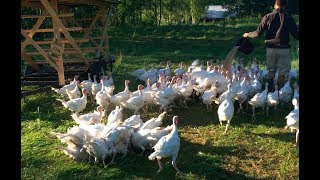
Four pancakes for the porridge and berries. Fruit should be tasty. So it's chicken processing day. The team are halfway through and I'm not in the slaughter today. I'm fixing the water system. Tomatoes are coming. We've got several varieties in here and they've been pruning the lower branches to keep their head up off the ground. Some really big varieties of tomato that are coming on and lots of cherries making nice trusses at the moment. And apparently they said on the radio we're entering a heat wave but it hasn't rained for quite a while now. It's so hopefully we get all these ripened up ready for the boxes. So back in Nutfield and it's Monday slaughter day. I'm not actually in slaughter today. I'm fixing up the water system for the market gardens because pump has got some issues. Either air bleeding in or something's wrong with the impeller. But I think it's air bleeding in and it needs a whole. I'm going to take the whole water system apart and put it back together and make sure everything is set straight. Some very nice grass in here. These are timothy with five, six leaves. It's very nice grazing for these girls and boy. So we've got one male calf. Nice job on the nut trees here. So we've still got boilers marching down the field in a row. This is the field supply line and it runs on both sides of nutfield. And I'm installing a new quick release point. So these are the quick release valves we use and they have a simple key. This is 100 meters of gas pipe that can take us right over across the field and then we have a line on the other side for whatever is easier. But I always say to people like, you know, really think about where you buy stuff. These fittings in Sweden are eight times more expensive than if you buy them say from Portugal on ebay where they use water pipes all the time. So you got to really look around. I think if we've spent a hundred thousand dollars doing up the farm, we've saved about $400,000 from buying locally. And while some people might say, you know, it's good to support local business, it's not good business to me if it's eight times the price of something I can readily buy with a postage stamp attached to it. So for me, it's been really critical. We're doing this all on a shoestring budget. Some people talked about an old video I made, starting a farm with no money, saying, hey, well, there was money. Well, of course there was money. I mean, it costs money to build up any business, but especially a farm. But it's been done on an extremely low budget with very good returns on enterprises, as I've detailed in other videos. But I think it really bears reflecting on because it's, you know, it's the sort of money most people spend on a house here. And we've set up a thriving habitat of agro ecosystems that is driving a lot of revenue and high return revenue at that. So our special fire pit has become a biochar pit. And we made a rule that anytime anyone wants to light a fire here, they become the manager of the biochar pit. What is this? This is gonna be a spit roast. Spit roast for our final feast. Yeah. Utilizing old cartwheels. And the idea, the objective is to make a battery drill powered spit by. What are we doing sticking a big wheel on this one?
Yeah. The crank of an old bicycle.
And then we're gonna stick the battery driven to this top.
Battery driven. Somewhere from down here, on the far side from the fire. Fire here, drill here, and a chain to power the whole unit.
I got inspired by the tilther that we haven't put together yet. But back to power tiltha. The tilther is a very powerful machine, but we're figuring if we can use the string to hold the drill on at a slow speed, we can have perfectly done piggy. We were thinking about using the water to make a water mill, but the stream is so low at this time of year, Sweden's lacking groundwater and the stream extremely low at this time of year. So we thought we'd make it over. We turned the fire pit in our sort of social space into a biochar pit so that we always make biochar when we have a campfire and it puts off such a good amount of heat. We're thinking we'll make biochar whilst cooking the piggy.
With some kind of fold.
And you'll attach it to this frame and. Yeah, exactly.
It will go down here on the next. Yeah, exactly. And then the chain will drive.
Beautiful. Yeah. Let's see. Okay. Mark two is belt driven. Chains are too cold. Manic belts work there. That is precisely the right speed, wouldn't you say? Very nice. We like it. So it's a pretty rudimentary setup we've got here. Built in an emergency last year. And basically there's a lot of leaks. There's a tension on the joins here, so I think air is getting in there. And because you've got a couple of reverse threads, so when you tighten bits, you loosen other bits. So I'm going to take this whole assembly apart and make sure it's all properly sealed because it's just been wiggling loose over the course of the last year. And then inflow here. It's got a weight and a float. I'm going to extend it with some 50 mil pipe I've got right out in the middle of the pond and a bit deeper. It's quite shallow here, but the ducks like to play around the edges. And it just clogs up extremely quickly when the ducks are here. We have tried excluding the ducks before, but it's not so easy to exclude the duck. They just fly back in. So, bit of a project today while the others are slaughtering. But it's a good thing to do with the hot weather we're having, so we don't have to resort to hand watering. So last chicks and the Buddha for one more week now. And we've decided we're going to do like a test, different feeds. Not different feeds so much as different regimes. So currently there's a lot of time goes into weighing feed to follow a very specific growth curve. We've determined and we've been milling grain because you get slightly better feed conversion with mill grain than whole grain. However, chicken is designed to grain Miller's home grain in this gizzard. So we're going to do a quarter of the birds, as we always do, quarter of the birds with the same ratio of feed, but unmilled grain. Then we're going to try same ratio of food for unrestricted for a restricted time, possibly 10 hours or something like that. And then the same ratio of food but with unmilled grain for the restricted time frame, too, and then collect a lot of data around it, which will be very interesting for us, but also for the people and may save a huge amount of time in the sort of prep work that goes on with the feed. So I'm going to rebuild this whole section and I'm just taking the head off the pump to check the impeller because it's possible that it's just air leaking in. That's my guess is that there's some little slight air leaks that are reducing the capacity of the pump. It's sometimes pumping. The water is quite dirty. We have a disk filter in here and it's not that I pressure washed that and had it running at times and then blocking up again. I can hear air in the pump. So I think it's mostly down to that. But it could be the impeller is corroded. So I'm going to check that while we're breaking it apart and rebuild it all with it. Longer pipe over the dam wall into the middle of the pond and hopefully we'll have some luck today. So everything seems to be fine with the impellers. This is a Lewara pump. It's about 4 cubic meters an hour. It pumps and calculated for the head. We're pumping about 8 meters vertically up to run up the bank here, up to the north beds, the market garden beds in the north there and then it splits under the road to the other side for the south beds, etc. So you have to calculate all these fittings add resistance obviously. Now each time you go through a different fitting or up or down size through a pipe it adds heads. You need to calculate that. It's quite a complicated thing. As well as the head in vertical meters and then make sure your pump is suited to the setup that you need. So team are nearly done in the slaughtery and I'm nearly done here. Up there you can see a sprinkler on and I'm timing how long it goes for. I'm just seeing it looks like it's on full power. So I've done a few things here and it seems to be working but we'll see how long it lasts. I might start. There'll be air to bleed out of here. But what I've done is rebuild this assembly and took the pump off that you saw and just checked the impellers. And I've rebuilt this assembly to take the stress because this was coming down the hill before. We had a drought last summer and we put the pond in specifically to water the gardens and it was getting late in the season. We've been doing a lot of hand watering in the first year of the sort of commercial market gardens and we'd run our well dry because the groundwater is extremely low in Sweden and we were irrigating out of sprinklers from the the well. But we only have a 40 meter well and it just hasn't got the capacity. So we tried having the well pressure washed with a special tool to sort of clean the seams in the rock, but that didn't seem to do anything. And so we built the pond with the interns and then set up the system. But because we were in a rush to get the irrigation going, we just put a siphon coming down and everything was slightly at tension, which isn't ideal. So now I've just sent it off this way and got the filter sticking up right now. So I've just reinstalled it all, made sure it's all tight and clean. The filter. And I've stuck a longer pipe on here, here. That's a bit deeper in the water because when the ducks are getting active they kick up a lot of mud from the edges. So sitting a little deeper on the float there and it seems to be working so far. So hopefully I'll check back in later and see if it's been going good. Pump's working perfectly. Very happy. We've had it on in the deeper water for over two hours without it getting clogged up. So it helps a little bit. We're usually on an hour and a half at the mirth, so a bit of a better sighting and good to get a lot of water down. The pump puts about 4 cubic meters an hour down, which is ideal to simulate rainfall in a way with aiming for about 4cm a week for most of the crops. It's been incredibly dry here. We've been needing it badly. These are the alder that we're putting the grape vines on. Hard to believe that two years ago these were 80 centimeter whips. It's a good nearly four meters tall now. Pruned quite hard laterally. Some of the grapes are doing okay, but some aren't doing so good. Yeah, they had a knockback in the post. If you've been watching our videos, you'll remember. But getting up into the trees here, some holes that we need to fill in. And some of the alder damage by the cows and sheep last year is picking back up. And grapes seem okay on this side. It's been very, very dry. But most of the grapes here are doing okay, which is great. So, you know, this is what those trees over there looked like two years ago about this time of year. So in two years it'll look more like that. Our geese have settled in really nicely and the first rye grass is starting to sprout on the banks. We're not irrigating it. You can see how the water is wicking up the banks there and on that shallow shelf. So it will take a little while to get established. But first signs of repair are on their way, which is fantastic. So Patrick will be coming back for a full day tomorrow. Some of the girls have been cleaning out the whole top bar hives. We'll be putting new sawdust in the bottom now and installing the bees and having a whole day thinking about bees out flying to there. Exciting to have bees back again. Shiitake is back. A little bit of rain. It's made some of these pop up again. We've got a few to harvest. It's a shame we missed a bunch but we'll make sure we get some of them. Getting a lot more mycelium coming. There's a lot of slug damage on some of these but we're getting mycelium for Phoenix oyster which is a good one for spruce as well as turkey tail. It's another one we can do on spruce. And if you can turn spruce into food and medicine then I'm really happy about that. I think we're going to soak these logs to see if we can get another good flush out of them now. Still got another 50 odd kilos of blackcurrants to harvest. Looks like we got some help here. A certain time of year. There's 56 kilos of black currant in the freezer and probably the same to go. Abundance. We got freezers and fridges just full of food. Sort of went. Wow. Birds in by midday? Yeah, just 12. Just after 12 o'. Clock.
250 odd birds.
Yeah, they went good. Yeah birds are good. Yeah they look good people good. Yeah.
We had today we went with, what would you call it, a karaoke session. Two hour karaoke session for the second half.
It's quite nice. It's quite dark in here. Got a whole freezer full of chicken. Really nice birds. Now this warmer weather makes it much easier to produce. More stable harvest as it were. Good job on the clean gap. It's really nice to see people like really stepping into their roles here and taking pride in what they do and keeping spaces, keeping notes and organization, etc. That's what I want for them because that's what they're gonna have to do. Setting up their own project. St. Green. I love the beer. Do you want a pallet on the ground? It's fine. So this is. Oh it's still very nice and warm. Fresh out the batch this morning. Yeah. So we're off to do delivery to the local spa now. Nice carrots, lettuces, micro greens here, cream peas and radish micros. Some really nice leeks and courgettes. This is all for Selma.
All for Selma. We ordered deliver twice a week.
Twice a week delivery to them. And they are really nice customer first. They buy a lot of eggs and other things like this too. And we are hopefully picking up some stainless steel to make the lid on the skull on the plucker in the slaughtery. So get that all working as it should be, too. This is the paint we're going to do with black on the barn doors now. And quite like this format. So we've got two bags of this powder to 8.8 liters of water. And they come with eight bags in each bucket. Says enough red for all the barns and enough black for all the doors. Then we'll do the white trims later. Neaten this all up. I want to start on the workshop today. So we couldn't get steel, but I did get some lime. So mixing up a lime wash and finishing this barn. This is the barn that hasn't been painted since 1938. We did the workshop, including the doors. They put black on the doors here and really brings everything back to life. I'm hoping to get everything painted this year just to give the farm the sort of care it needs. I really like having things looked after. So lime wash on the bottom here that goes around the outside of the barn will really neaten this up and that will dry really white as a sacrificial lime there. Very nice. The lime is drying away. It dries up beautifully. Nice and white. Such an underutilized resource now. But it's such a good material to work with. Same as these clay and pigment paint. You can see how the barn was built here. It's cordwood with mud adobe mix in between. It's probably been here 100 years already. Really nice to give everything a bit of a brush up. Take a bit of pride in the farm. What are you up to, Matt?
Well, we have some awesome outdoor bucket shower stalls here that Nicholas and Jakey built. And you can see here, there's still some wasps left. There's always tons of wasps nests here in the farm center. And this is where they are this.
Year in the showers between the walls.
Yeah, it was quite big. It was like, you know, cantaloupe size. For those that are familiar with cantaloupes, what'd you do?
You pulled it out and.
Well, I started with this, the Executioner Pro, which Is better designed for the house fly.
Yeah. Or the mosquito. Humble mosquito, yeah. I think wasps are a bit armored, aren't they?
It was hard to get to them. They just, you know, as usual, they just find a little crack to get.
In and out of and they took.
Off these boards and put on this awesome bee suit. Feel extremely safe.
Yeah.
And then got a plastic getting ready.
For B day tomorrow. Yeah, love it.
Got a plastic bag and just held it up. Scraped the top of the hive off and it fell into the bag. And then we lit a little fire and just dumped it on. You can probably still see some larvae and some comb over there in the fire and it's not an endangered species.
But, you know, so you might recall right at the start this one of the pre season updates. Matt and I were building this pig fence, but this is where the pigs first came out. But just to keep you updated with the regeneration that goes on through the summer. So Reuben, the boar is still in here, but the pigs have been out of here now for, ooh, two months and things are greening up. There's a lot of forage that could be grazed by the sheep in here. That's all today, folks. Thanks for watching our videos. Just a quick update today. Really looking forward to the B day tomorrow with Patrick and you can find out a lot more in the book. Making Small farms work. I'm just about able to keep up with posting of them. It's great to see them going off all over the world. Thanks for your support in that way. I love to share in this way and keep putting out information and you can find a lot more detailed information there. When our online training comes up this winter, there'll be access to a huge amount of information. I'm super excited about it. More updates on that later in the season. Thanks for your time. It.
More from Richard


A review of short and intensive season on a mixed farm and restaurant/event space in Sweden






Alskade Kyckling Exploring complexities of poultry production in Sweden and what we stand for


