S4 ● E87 Compost Tea for trees, a whole roast pig and the internship ends...
Richard Perkins' farm hosts an end-of-internship feast with a whole Swedish pig roasted over hours, served with black pudding and fermented sides. The episode covers compost tea brewing and application equipment, plus plans for oyster and shiitake mushroom spawn.
Questions this video answers
July 29, 2017
About 60 kilos
150 crowns per kilo (~€15 per kilo carcass weight)
About €900
About 50 people
Chapters
Tomorrow's the last day of the internship and so tonight we're having a final feast. As well as applying compost teas, painting barns, getting winches fitted to our rhino. And we just got Paul Stamet's mushroom delivery and we're going to turn spruce trees into food. Last day of morning chores for interns. They're doing broilers up here. We've just finished layers. I'm off to do turkeys. Calving sheep ready to move. What have we got, Benjamin?
Got black pudding in a bit of a strange mold, strange format.
Fresh pigs blood, Very, very fresh pig's.
Blood, oats, allspice, bit of black pepper, a bit of salt and some oats.
And how long would you cook that?
I'm gonna have to stick it in the oven and then check back on that one. I should imagine it's going to be about half an hour.
Half an hour. Fair enough. English breakfast.
Proper English breakfast.
What have we got? We've got black pudding from the pig. Pudding, fresh black pudding, homemade baked beans. Homemade baked beans. What's this?
This is going to be Welsh rare. Bit not traditional for the English breakfast, but we're more making it more of.
A British breakfast, UK breakfast. Exactly.
Oh, yeah, yeah.
Yo, English breakfast today. Today a feast. We got poached eggs, hash browns, blood pudding from the pig, kind of Welsh rabbit and homemade baked beans. Can't say better than that, can you? And so what we've done is taken the feet off to make it a little bit more manageable, taking the tail and ears off because they will burn easily. And then I've split through the spine, but not all the way through to enable opening it up a bit. And then what I've done is the ribs will tend to curl up when they cooking, so I've split them. It will also make it easier for serving. And I took out the front four ribs to allow to expose the shoulder so it will cook better. And we'll get a bit more bark on there too, which I've done with the hams. I've taken the skin off the hams to expose the meat again. And then I've just trimmed some of the skirts and trimmed some of the connective tissue that we don't want to eat anyway. And it's looking good. It's gonna maybe take six, seven hours. So we've lit the vine now at breakfast time and we're hoping for dinner at 6 o'. Clock. What's in there? Is it most of salt and some cayenne and the pepper we'll put in the base. So we've rubbed the pig with mustard and then just a little salt, pepper and cayenne. And we'll be coming back to oil it every hour or so. We'll see what the chefs put together for that. And we'll cook it mostly on the back. We've scored the back actually about 5 mil in, so we get a nice crackling developing. And we'll probably turn it over for the last bit by keeping it upside down. Some of the juices and the bastings will be kept in here and keep it moist, slow and steady. It's quite high off the fire. Perfect. So this is a bit of a special feast to end the internship. We always do something to celebrate the time we've had together. It's a very intense and potent time. And it's just interesting thinking creatively. This pig is an heirloom Swedish pig raised in the forest. This is meat we would sell at 150 crowns. That's about €15 a kilo carcass weight. So this is actually a €900 pig. It's actually quite a bit heavy pig. It weighs about 60 kilos. But thinking creatively, always thinking like, how can you do more with less? And, you know, how do you turn this into a two and a half thousand euro piggy? Well, one thing I always thought of doing here is like a spit roast with a water wheel running in the stream. And we do a tour of the farm for the family, have kids activities, and invite our local brewer to talk about brewing and bring some of his beer. Charge people €50 a head, which in Sweden is, you know, you pay that for not even a good organic meal, just a meal at a restaurant. So how much does a pig feed? Well, 50 people at least. A pig this size, so, you know, that's a two and a half thousand euro piggy for a bit of organization in a nice farm. Maybe white tablecloth tables out in the pasture. But it's little ideas like this that, you know, make a big difference. Thinking the same with a, with one of the cows. That's enough to feed 400 people. It's a 48 hour spit roast. And I've always thought these interesting ideas. I saw this back in, it was an old book talking about when the River Thames in London used to freeze and they would build a wicker cage around the cow and people would be paying money just to come in and see the spectacle of this huge piece of meat. This is a couple hundred years ago, 150 years ago, but Then they were paid to come back again and eat it. And I always thought this would make a good base for a tour of the farm. You know, you can feed 400 people on the cow and if they paid €50 each for, you know, an afternoon farm tour, kids activities, learn about their local food supply, meet interesting people from all over the world who know a lot about these things, be served an amazing meal in the silver pasture lanes out here with some local beer or ciders. €50 is a very reasonable price and that one cow is now worth €20,000 and the costs are pretty low to put on such an event. It would be a lot of fun, but it's this kind of creativity that, you know, we can leverage as a small farm. We can always out compete with farm freshness, with localness, with quality and the intimacy of marketing, you know, the personal sort of story that is what we're selling through this kind of farming. It's, you know, why we're doing this that's important to people. So it's something to think about and we're really looking forward to epic feast to end this amazing time together. So first turn on the piggy is now two hours. Nice colour developing, no burning. Very nice, very nice. And we're going to baste it back again now while it's turned over. So it's three hours in and I turned it over just for half an hour to just tighten up the belly. We'll cook that last of all. And we've been applying some basting. We've used some milk there and then I've gone back to oil to really seal it up, but a really nice color and smelling really good. Boxes, boxes. How's the big box? Nice. Half. Carrots. Turn it. Cucumbers first. Tomatoes going in this week. Really nice. Turnips, beets and chard, Leeks, garlics, cabbages. Abundance. Piggy's roasting barn's been painted. Joe just arrived with his compost tea bowser and we're doing a foliar application for the trees. And he's just got a brand new setup for his application, which he's happy with his hands. Egg.
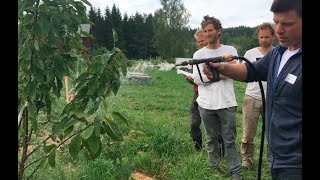
On the last turning, you would expect the temperature of the pile just to be coming down to some sort of ambient temperature. So at each of these points, I'm watering the system, watering the pile as much as. As much as is necessary. Obviously, if you're using that as a planting compost, you'd need to sift them out. This is an applicator we use for applying the tea on the above ground part of the plant, just see that you have a nozzle here that is big enough to allow the organisms out. If your nozzle is too small, you're going to be obviously, obviously filtering out the organisms that you want to colonize the plant surface. And then here, your root needle injector. I bought this from the States. Very simple tool that squirts out compost extract around the roots of the plant.
Do you know who you bought it off?
Green Pro Solutions.
Is that the compost tea company?
Yeah.
Yeah.
Well, not strictly compost of landscaping, but they do deal with. This is what the. A new compost brewer I bought from Britain looks like. Supplied by the Growing Solutions is an American company. Martin Lishman, he's the European distributor. So if you wanted to buy a one of these, you'd have to buy it from them.
That's the unit you have at home?
This is the unit I have at home. Pardon? They come in varying sizes. This one is 400 liters. When you're brewing tea, you can dilute that three to one, so it'll make 1200 litres of tea. So you can see here we have these little aeration. What do they call them?
Number eight.
I'm just from aeration discs. So your pump is blowing air through these discs and creating a really fine air aeration bubble.
More surface area than just big bubbles like we have on ours.
Yeah.
So it's a finer.
And then on top of that you.
Have saturated air stones.
So in. Yeah, you can pass this around. So you have this plastic lid that's sitting inside the brewer itself. And then inside that plastic lid you submerge the baskets that you fill to about three quarters. And then inside of those baskets you're putting the air stones that are kind of blowing air through the. Through the compost.
So six hours in and we're trying to keep the coals at the edges now to get some heat on the hands, then the shoulders. It smells super delicious and the crackling is all bubbling up here. Very nice.
If anyone wants to come and sort of hang out in Grdinger, where I live, and just see the operation, do get in touch and come and see what we're doing. I'm operating the business from a farm. Now. I can show you the whole brewing system, I can show you the compost production, I can show you the raw materials and that way you'll get a sort of real understanding and idea. But I can. This, this introduction here was mainly to do with the application of compost teas and Its benefits and we can delve a little bit deeper into the science. Look at the microscope perhaps tonight or tomorrow morning. But yeah, so that's, that's what I have to say about that. This is a new piece of kit. So this is a diaphragm pump, petrol driven diaphragm pump which can deliver about 70 liters of a minute. We're restricted here by the hose diameter, so it's not delivering. That's delivering probably about 30, 25 or 30, but that's plenty.
What's the pressure?
The pressure I'm not the pressure I can alter here actually, but so up to six, six bars. And at what pressure do you inject? Because I could imagine that some bacterias are very sensitive, vulnerable. And the bacteria are actually the most recalcitrant and hardy organisms of them all actually. So it's more the fungi and the larger nematodes. These are going to be the ones getting smashed up. So that's a really good point. You can get like this bug against the windshield effect if you're spraying too hard. Just like smash everything. And then you'll be still delivering bioavailable nutrients. But the organisms that are responsible for the cycling of nutrients aren't going to be nearly as intact. So you want to deliver the nutrients that are in the tea alive basically, so they can do their job. Okay, so diaphragm pump, hose from. We've got a thousand liters of tea in the tank there. And then obviously from. Someone connect the black pipe for me. This one? Yeah, exactly. So one end goes, the female goes in there and then the male goes on to the. And so this, as I said, this pump has the capacity, I think its capacity is 70 liters a minute. We're only delivering 30. So the, the other 40 liters needs to go back into the tank and we're getting this agitation process because all of the sediment likes to sit. It's heavier, so it likes to sit at the bottom of the tank. It's really important to let all of this sediment kind of mix through. So then you get a uniform delivery of organisms and nutrients. So this is the return and someone can screw that onto the top of the tank. Yeah, I want to know when this is connected.
Thank you.
Okay, so we have two on this particular system. We have this wand here. This is only a 10 meter hose. It's really shit. So I never use it. And I have this 60 meter hose too. And this is the one we're going to be using. So I'll just start her up you point out the ground. Yeah. Getting a little nervous, Something like that. And you just want to kind of soak the. You want to soak the whole plant. So the whole of the plant is dripping, that's. That's desirable. And you see any excess, excess tea that's applied is just dripping down into the root zone of the plant and working its way down to the carbon source. And then you're also going to get an assistance to the breakdown of the mulch here too. So something like that, I would say.
So down in the cellar we've got a box for Mr. Stamets in America. Now, interesting things in here. This is pearl oyster. Grows well on birch and alder. Then we've got a bag of turkey tail. Now, we could only get it on plugs and we prefer to use sawdust spawn. It's more efficient and we have better tools for, you know, rapid inoculation. Turkey tail will do well in spruce. And then we have blue oyster, another one that does well in alder or birch. Then we have shiitake. But what's interesting, we've just got shiitake fruiting at the moment, but porcelain strain can produce mushrooms in even four months, as little as four months. So there's, you know, a big difference between strains potentially. And this is phoenix oyster, which I'm very excited about because this is an oyster that grows in spruce. And if you can turn spruce into food, you're doing good in Sweden, where monocultural spruces everywhere. So we've got loads of bags. Again, we could only get this in plugs, but our new chef Benjamin is here and he's really into mushrooms. He has a little lab at home and so we're gonna do some serious inoculation. Rhino's just back from Arnie's. You might have seen his beautiful little small holding in the forest in a previous video. But he's just fitted us super nice little winch and I haven't tried it yet. It's just come back, but apparently we have a switch there, remote control there. Do we like it? I guess we do. It's going to be useful for pulling things up into the air.
Pulling things.
Very nice. Lifting up carcasses and just generally moving stuff around. I think it's a ton and a half winch which is perfect for what we need. So it's been nine hours. We're up to 70 degrees inside. Time to calm it down and then we're gonna have a feast. They're making bunting sauerkrauts and kimchi sprouted that's kimchi here.
Kimchi.
Simple sauerkraut. And the rest of it is not prepared at all. It's just. Just put. That's an apple sauce. For apple sauce. Pork. We would in Europe traditionally eat apple with pork. Mustard. There's quite a lot of mustard on the pig already. Bread baked. Baked potatoes. So please eat well and be ready for battle tomorrow.
That.
More from Richard


A review of short and intensive season on a mixed farm and restaurant/event space in Sweden






Alskade Kyckling Exploring complexities of poultry production in Sweden and what we stand for


