S4 ● E88 "Yeah BUT".. (Part 2) Doing more with less labour
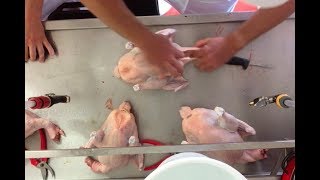
This is a YouTube farm-vlog by Richard Perkins (July 31, 2017) focused on improving farm efficiency by working with a smaller, more committed core team and applying time-and-motion studies. Richard reports recent team reductions (interns and some core staff leaving), then demonstrates operational efficiencies achieved: faster pen moves using a dolly, moving eggmobiles (16 minutes for two), egg collection/packing (32 minutes for two eggmobiles), poultry handling (two minutes per pen for layers; 800 layers across ~20 pens), and a record slaughter session (250 birds processed; strong performance by a Michelin-trained chef averaging ~50 seconds/bird). He discusses feed experiments (layer feed ~17% protein; broiler feed ~21% protein—stated tentatively), unmilled grain trials, scalder target temperature (~63°C), and plans to scale egg production (current ~16+ tonnes/year potential to ~32–35 tonnes). He outlines next-season staffing and business model changes: a smaller paid core team, selective six-month interns (first half paid by interns, second half paid if targets met), profit-sharing and investment in processing infrastructure.
Questions this video answers
About 800 layers (20 pens mentioned).
About 16 minutes to move both eggmobiles (usually 20 minutes alone).
About 32 minutes for cleaning and packing two eggmobiles (one full stack each).
Approximately 2 minutes per pen (40 minutes for 20 pens).
250 birds processed; started at 7:30 and the last birds arrived about 10:20–10:30 (record time).
Chapters
The interns have left, which means I get to do farming again. I want to talk today about the importance of time and motion studies and challenging yourself to do things smarter and faster. So it seems like the last video of the year, but Attitude was quite popular and people had a lot of things to say. And so I want to follow that up. Not that I'm out here to convince people, you know, what their experience is or whatever, but more that I think there's a lot more to say on this topic. It's a theme in our trainings and we talk for weeks about these kind of things. But I think there's naysayers out there who, you know, come with pride and arrogance and find it hard to believe that there's models that outshine the models they've grown up with or have been practicing for often decades. And it's out of, you know, wanting to be of benefit to people that are following us and wanting to implement some of these models. So I'd like to share more about that. And our team has got smaller suddenly the interns have left at the weekend and a couple of the core team have left and we've got, we are now down to a cool group who are much more clear about their commitment to this place and with much better communication between us. And that's been a bit of a process. I won't linger on too much, but we sometimes need to eliminate weaker links in the chain for the chain to be functional. And so this place has some basic requirements and people don't living up to those requirements. You know, it's not the place for them. But I wanted to just show you a few of the enterprises and how much more efficiently they're running with less people. And we put a lot of data out online about the number of hours involved in running these enterprises, but I just want to show you the results. In the last couple of days, since a lot of people left the farm, these beds have been sorted for processing days. Monday processing day again at the farm. Much smaller team, but I think we're going to have an awesome day. Part of the intention of the internship program is to give people exposure to really how to run these enterprises, how to manage them, the back end of them, as well as the detailed running of day to day operations, how to make them really efficient and smooth because ultimately that's what allows you to generate the revenue need from a small farm and have time for the quality of life you're looking for. Now, the boilers were the least favourite enterprise based on the feedback I Got. And part of the issue, I think, is people didn't choose to use the dolly. So a lot of people left the farm not really understanding how this enterprise works efficiently. Now that the interns have gone, I get to be on the ground more. And I love challenging myself to see how efficiently and well I can do these jobs. Each day I'm working with Astrid and we're doing layers and boilers together, and that's quite a big job. There's thousands of birds. We have 20 pens on the field and we have 800 layers on the field too. It took us about 16 minutes to move both the eggmobiles this morning. Takes me usually 20 minutes on my own, so that's the first time in three months it's gone quicker by having people. Now, I'm not saying that as any criticism to anyone. A lot of jobs take more time with more people. And I'm bouncing on from the video I made about free labour, because people think that because there's many people on the farm, a lot gets done because of that. And sometimes it's true. If we want to paint the barns, it's obviously a lot quicker if there's 10 people painting the barn. But all of the basic enterprises, as I've explained in many other videos, are quicker with less people. And today we've got the smallest slaughter team we've ever had. And I think we're going to be the fastest we've ever been because everyone is focused and there's no superfluous people. Now, Astrid is a rocker and together we did all the birds, two minutes per pen, that's 40 minutes. It's normally taken four people an hour and a half. So it's really important to track these things, otherwise you don't know what you're capable of doing. Now, I went along and moved all the pens using the dolly, and it's a very quick process. Using the dolly is very efficient to move the birds without risk of harm or injury. And then Astri came along, did food and water. Times like this, when the water's on the back and we're moving this way, we don't need to empty the water. If we're moving the opposite direction, we need to empty water. I've talked in the past how we need to leave the plastics facing in the right direction because of the dominant wind patterns here. And that's a major part of the pen design here, is keeping three quarters of the roof sheltered and keeping two sides alongside and a short side. But two minutes a bird is quite nice because we've got four pens at the top of top field, three pens at the bottom of top field. We've got four pens here and we have 10 right up the top of there. So part of the time it takes is just moving the dolly and food etc around the field. Water lines we have at the edge of each field and so we've been moving them around. We have a hose in each field and we move that manually. Some people have asked why we don't use automated waterers, but that's just impractical in the setup we have because we have tree lanes. We need to split the pens up quite dramatically so that as they go around the tree lane and back again, they don't create congestion. So we also had another calf from Juliet, who's feeding her calf right now. And. And it seems like the cows have come a bit of a cooperative dairy. They're all feeding each other. Viola is quite skinny, she's got twins and they're both quite big twins, so it's taking a lot of toll on her. But the twins are feeding on Clovermay and Violeta, but they all seem very well. And I think we'll be looking to sell the calves and calves as well as the sheep. I think we will send the sheep off at the end of the year and put them into next year's food supply. We might sell some live, but the cost of the meat is worth more to keep to us than to sell on in a way. And so we're going to put away next year's food supply. There's only going to possibly be eight or nine of us at the farm. I'm going to do a video about how the business is changing, but things are clarifying and we're going to have a lot less people at the farm next year and really drive the efficiency. In double productions with a small dedicated group, we'll probably have four interns who will be highly selected and be here for six months, but will also earn some income during that time. But they won't be doing class study, they'll be working hard alongside us, learning each of the enterprises inside out. It's so important to see how efficiently you can do daily things on a farm because ultimately, if you want to set benchmarks for an employee or have time to go fishing or spend with the family, whatever it is you want to be doing, you need to do these jobs that you do daily very efficiently. The only reason our farm is so profitable and works efficiently is because we work with that dedication and the core people that come here Multiple years, all have that capacity to work very efficiently, spot any errors at the same time as moving things. Because in the beginning, what happens is someone focuses on moving faster, trying to keep up, and they're not checking the tops of the wires or breakage in the wire that needs to be identified to be dealt with later. So it's not just about moving things quickly, it's about checking them at the same time, checking all these birds, any birds that look sick, any birds that have injuries that need to be addressed with, and double checking other people's work so that there's a backup system. So eggs has been one job that obviously needs doing every day, seven days a week, 365 days a year. That's a job that a couple of people have been doing over the last two months, typically taking between 35, 40 minutes and an hour for two people. Yesterday I did all the eggs from two eggmobiles. That's two of these big stacks. And it's 32 minutes to do that job. So it's really important to understand I'm not putting these videos out to criticize anyone or to one up anyone or anything like that. It's really important to me and to anyone running these kind of things to really know what you're capable of. Because ultimately you can't scale your business or plan any expansion if you don't know what that fully involves. You also can't do a gross profit analysis and see which enterprises give you more income for your time put in. So you really aren't in control of your business if you don't know what you're capable of. And you know that desire to push the edges and find smarter ways to do things can really pay off and make the difference between a couple of weeks off and being able to afford to pay for someone to come and look after your place so you can have time off or not. And so for me, that's been really important. This is an enterprise where we actually could already sell double the eggs that we have. So that's about 16, over 16 tons a year we produce, but we could sell about 32, 35 tons of eggs. So we're thinking to build two new egg mobiles and have four eggmobiles going around the fields next year. And so it's, you know, it's 32 minutes for cleaning and packing and stamping two lots of eggs. So it's an hour to an hour and a half's work to do double that. So I know I can plan that into my day and feel really confident that it's a great enterprise that will be an enterprise. You know, €120,000 each year. Matt is someone that we employ as a market gardener. Someone who I'm bringing into the business not primarily because of his vegetable growing, but because of his attitude and aptitude to get things done. And he's also interested in time and motion studies too, aren't you, Matt? Yeah. Any insights? I'm making a video today about how things are going much more efficiently with less people. And contrary to most people's idea that having more people helps a lot of the time, it doesn't help. A lot of the time it doesn't help.
I think that the simplest one is depending on someone who doesn't necessarily complete a task efficiently. You know, it's like this age old saying, if you want something done properly, you have to do it yourself. It's not ideal in a group setting. You need to be able to depend, depend on people. So having a smaller group of more reliable people can be much more helpful than an abundance of help.
Yeah. And you've been setting yourself targets in the garden. Now I'm disturbing you on your targets right now, but we're doing it.
Today's a slaughter day, so we're starting early and we also have, we deliver every Monday to a local hotel and spa. So because we're in the slaughter for most of the morning, just until lunch, we do the, we prep their, their order before breakfast. And we also have a customer made a request to pick up their box today instead of Wednesday. So a couple extra things going on.
Yeah. And have you noticed your own, like you've been keeping some time immersion studies of how long it takes to prep breads and how long it takes to see things, harvest things. Do you feel like, how do you relate to like challenging yourself to do faster and smarter? Like, how's that journey? Because this is your third year here, so you've seen quite a process in your time here. I guess.
Yeah. You sort of keep noticing little bits where you can get faster. You know, there's little nuances like how far away you are from the tools. So, you know, one of the things I like to do is just establish that starting point where I'm at the bed with all the tools I need and that's one time to take. And you know, if I take, if I'm two more minutes away from getting all my stuff together and getting all of the harvest back into the fridge, then maybe that's taken separately. But we have 210 garden beds so sometimes I'll think about it as like weeding, for example. You know, if you take a certain amount of time per bed, just multiply it by 210.
What we love about Matt is he's not showing up at 9 looking for tools. He's showing up at 9 with the tools, the right tools. And that's how we like to roll. Gardens are looking beautiful, mate. Thank you. Got any spare salad?
Yes, I do have spare salad.
Garlics are hanging. Salad's getting weighed. How much salad we getting out of bed now, Matt?
Getting up to our biggest harvest on the bed of Mesclan this year was 20 kilos. The bed, which is just getting a very nice cut with a sharp blade and some of the buds being harvested at a different sized leaf are somewhere closer to 13, 14, 15 kilos.
That's high price mescaline. It's about 165 pounds a kilo. 16 and a half euros off a 10 by 75 centimeter bed. And these have been amazing this year. No, on a heck of a way. Very happy with these. We'll be growing these again. Astrid is one of my favorite farm managers ever, but she doesn't like being on film sometimes. But the reason I'm filming now is because we are trying some new broiler feed experiments. And it's partly because we've changed feed. We've got bulk feed now, which is slightly different quality. It's meant to be better quality. It's an organic broiler grower food. And we are trying. What are we trying? We're adjusting the ratios of. We give them also grain from here. This is organic wheat and oat. And so we're adjusting the ratios of different pans help to collect the first broilers for standing up the whifflet. But we're also going to try some free access with layer food, which is about 17% protein, and broiler food, which is I think 21. But we need to confirm that. But currently a big amount of time goes into weighing out precise feed ratios that I've talked about in our book. And it's the biggest time consuming part of the boil actually is milling grain. So we're also going to do some experiments with unmilled grain. We have done this in the past, but we're going to do it again in a slightly different way and just keep refining our program. But we would like to. Our objective is to have very healthy birds with zero leg problems and less work on the prepping side of things. So Slaughtery is all set up for starting after breakfast. We're starting at 7:30 and slurry's ready to go. Knives are sharpened, Scald is hot. Just going to check the scalder. Temperature should be sitting at 63. A little bit. Cool. So what I'll do is just turn that up and that'll be good for after breakfast. Very nice. Today we've got less people in the slaughtery than the rest of the year because people have been leaving. But I'm excited because it's actually quicker for me to work here when I've got less people. So we've been having three on the restoration last two sessions. I haven't been in the slaughter and it's been taking longer to eviscerate birds with three newbies than it would be to do it on my own. However, today our new chef Ben is here and he's a Michelin trained chef. He's worked at Gordon Ramsay's restaurants and some other high end restaurants and he knows about working hard and fast in a hot kitchen and he knows a lot about poultry also and how to use a knife properly. So with two of us that know how to unite and use knives properly, I think we are going to be faster today than ever before. So Astra's made a little adaptation to the keel station for the boilers. So put the stunner up. Here in Europe you must use a stunner or, well, you must stun the birds before they are bled out. So it takes a bit more time. But she just made some simple adaptation. So we don't need a table in here to keep the machine on. There's a wire brush that you use to clean the electrodes to make sure they deliver a good current. And birds are bled out here. Blood's collected before passing through the window here to what's called burley side. And the same with you.
You'll be working on a brake and you'll have your next one.
You're just going to dance. Piling up there. Show you fast and slow. First thing, without cutting towards your finger. And we remove that full end. Flip it over, just watch. Next, again, up, rip downwards, fold up onto the crop, onto your finger. Pull down. Switch hands, Pull up under the lizard, under the windpipe, in your softness. Pull out the neck, front end, palm on kiosk. Split not going through guts. Rip. Separate fat from gizzard. Reach in, pull everything totally off the table in case the gallbladder splits. Check liver for health. Separate gallbladder. Bed can go in the bucket each side of the vent. Under bump. Any shit will just go off the table. Heart, get the heart for health. And we're not going to keep the hearts today then. Lungs to the right. Make sure you get it all to the left. That's a scoopy one. I'm just gonna do some. So we're gonna have a nice big tidy up and clean up as we always do. We had four people less than we normally do and we finished in record time. The fastest ever that we've ever done at the farm. It's not even lunchtime and all the cleanup is done now. All the laundry's gone out, all the boots and aprons soaked, etc. Freezer's full of 250 birds. Started at 7:30 and last birds came in about 20 past 10. Now that's with 4 less people than we've had every slaughter so far this season. Ben Spice was just phenomenal on slaughtery and about double as fast as the quickest people so far. About 50 seconds a bird, which is fantastic. Now he's worked in Michelin star restaurants, worked in Gordon Ramsay's restaurants, and so he knows how to work fast in a heated environment. And this is quite easy stuff for someone with that sort of caliber of training. But really, you know, we're really stepping it up to where I'd like this to be. Now if we had three people eviscerating at that speed, it would probably be two hours work to do 250 birds and then the cleanup another hour on top of that perhaps. So pretty good effort. It's amazing to see and it's, you know, it really goes to show it's important to see in the context of this, if you have a team of eight people, taking an hour longer is a full working day for someone. And you can get a lot done in a day. I can get a lot done in a day. So it's important to know what you're capable of. And yeah, as I said, the reason for putting the videos out is not to be challenging or confronting to anyone. It's really important that we find really efficient ways of planning and communicating and how to find motivation when you're working in the team flow to keep the whole thing moving along smoothly and to know what we're able to do in a day so we can plan our time efficiently and effectively. So I'm going to make a separate video about how we're going to roll next year. But we're thinking of four core people on the team who are getting an annual salary for seven or eight months work Hard work in the summer. We always work hard in the summer because we're producing all our revenue in this six month growing season that we've been showing you through the videos we're putting out this year. And we're going to have probably one intern each. And those interns will come for six months. They will pay for the first three months and learn on the job and then they will get paid for the remaining three weeks if they meet our targets. And so if they complete the season and do well, they will earn a wage. And that's a way to safeguard ourselves against people who show up who don't actually have the skills that they profess or are not capable of sticking with it, which is an important, you know, element of what we're doing here too. And it also allows us to, you know, reward the people for the efforts they put in. Got some beautiful onions developing here. Garden's looking great and really exceeded expectations this year. Matt's doing a fantastic job and Carla's really been stepping into her role and going to market a lot. Managing looks beautiful now. And yeah, it's really important to me that things look beautiful because this is front of house, as it were. You know, this is the first thing you see coming into the farm and it reflects how well taking care of everything else is in the farm. We've had a bit of a shift around with the interns leaving. It's been great to run the internship, but it feels kind of interesting and relieving even to know that's the last time we're running that program. It's brought a lot of benefit to a lot of people who have gone off and done various things around the world. But it's tiring for me to be fully available for people from 6 in the morning till often 10, 11 at night. So I'm looking forward to a change and just getting into the farming as I've said before. And something that excites me is just having less people on the ground. I mean, I'm making these videos just to reiterate to people what the facts and figures are, because what goes into this and see how efficiently some of us are able to work. We've had a bit of a change around and the team has got smaller. A couple of people have left. We've at a point halfway through the season where some people lacking motivation and clarity about what their learning objectives are. And so from my perspective, we, you know, it's for the benefit of the whole team. We need people who are sort of sitting on the Fence about the rest of their time here to move on. Because we demand a bit of excellence and stepping up to, you know, meet the expectations of ourselves and each other, and that's all gone. Okay. I think it's, you know, I'm not going to say too much more about that because those people aren't here anymore. They don't have a voice to add to the conversation. But I just feel like it's, you know, it's a part of running a place like this is some people always leave each year and tend to try and encourage them to clarify their own context and decide if it's right for them or not, as opposed to demand anyone leave, which I've only ever had to do twice here for people, just through their ability to, you know, follow basic ground rules and things like that, which, you know, we have very basic, very, you know, simple things that look after the benefit of the whole. But there's always a way, always, you know, there's team changes and the team that start the year and end the year will be very different perhaps, but it's. It's down to who's. Who's up for it. You know, there's amazing learning opportunities, opportunities available here in a way that you can't go out and find many places. I'm really enjoying on the screen, seeing the vegetables behind me. It looks very beautiful. But, yes, there's been a couple of people leave and it feels really fantastic now to have a smaller team who are all fully committed and clear why they're here, and the results are showing immediately in a couple of days that we've had less people on the farm, just the amount that we can do together when you have a small, committed, clear team. Communication has been an interesting issue this year, and so we've eliminated weaker links in that chain because it doesn't work for me or for anyone else who's really stepping into their roles here when communication is not working optimally. So we've given those processes some time and there's a point where, you know, it's just more beneficial to shake hands and move on, as it were. That's all today, folks, and I'm looking forward to putting up a video about what we're planning to do next year. Big things we're talking about, including new sheep flock, investing in a really nice smokery unit and building a whole unit for processing our birds further, as well as the people element of it and the trainings we'll be offering here. We're going to have far less people here in the future, far more focused and profit sharing. We're totally transforming the business model, so stay tuned for that. Thanks as always for watching the videos. You can find out more in our book, Making Small Farms Work. See you next time.
More from Richard


A review of short and intensive season on a mixed farm and restaurant/event space in Sweden






Alskade Kyckling Exploring complexities of poultry production in Sweden and what we stand for


