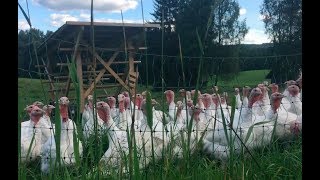
Richard Perkins updates his farm operations: turkeys get 40% of their diet from forage, he's adding a 30x10m polytunnel for up to 1,500 layers, and building two more eggmobiles for around €1,500 each. Marco then demonstrates Cretan instruments including lyra, bouzouki, and baglama.
Questions this video answers
30 by 10 meters
Up to 1,500 layers
End of September to mid-September (phrasing in transcript)
Early October
About 50 hens
Chapters
So I'm back at the busy farm and lots is going on in my brain about thinking about moving into the second half of the season as well as next year. So here's a little update from today. I had an amazing time away and great to connect with old friends. Something that's hard to do in the middle of the season, but it's also great to be back. I love having a small team here. It's how I want to operate in the future. Like less people is better in my mind. We work so much more efficiently and communication is so much easier and clearer. And I'm reaching a point where I'm reinvigorated about optimizing the farm. And I see that the function of this farm has been really getting people started on the right foot, teaching people about how to design and install these kind of systems. But now that's not really the. The case. We've installed everything and now it's about optimizing. And something I see is that, you know, we haven't really even started yet. I'm gonna, as long as I'm here, I'm going to push myself to see how far we can take these things, how far can we push ecosystem processes in a healthy triple bottom line that is good for the soil, good for our consumers, good for. For us and our financial security. And it's a really interesting time. It's totally got me excited again in a very different way. I feel more excited now than I did when we got the farm, which was pretty exciting time. And so, you know, there's a lot of changes happening behind the scenes and my brain is working overdrive to plan all the details and fit them together like a big, giant, complex jigsaw puzzle, which is something I love to do. So birds moving themselves. We like it. So second this morning, I'm back and very nice and easy to move these. It's a bit of a clunky. We wanted to trial this out with the youngest bears because it's the last batch of young bears this year, and I wanted to see how they responded to open space and nets. Another pen has been built and we've got three more to build this week. Monday's slaughter day, so it's a busy day today, but then hopefully we'll get three more of these whipped up and we will put all of the older birds that are up at the back here to see how they do in a bigger group. So it looks very hopeful and it's, you know, it's a pleasure to move them, but we need to see how it works at full scale. Now, at the moment, we're just doing a single net with a bit left over on the side. It's a bit clunky, but when we have four of these pens, one net will stick out just a meter from the side. So concerns about owls and hawks and not so worried about that because, you know, you'd have to be a very bold predator bird to want to get inside such a tight space. But they've done a nice job with this one. It's got the back end of a bicycle, because we need quite a lot of bicycles to make all of these pens, which we can find in the scrap. And we have a bunch of old bikes lying around at the farm that have been gifted to the farm, but they've cut away the sort of back frame. Now, the axle on the back wheel of a bike with gears is too long to work with this model, so they've cut the whole frame off and bolted that on like so, which is quite smart. And so these birds will hopefully. I mean, we'll be able to put eight of these pens. No, 10 of these pens. Yeah. 10 of these pens will go under four of these shelters with a single net between them. So should change a lot of things. So the turkeys are doing good. We took half the turkeys so far and, oh, they're incredibly good. It's always good to brine a turkey before roasting it, just to really keep the meat super succulent and never had turkey this good. The Turkey Mobile has been a great success. We've had no predator problems. These are big birds, they're very strong, but we're going to grow some of these birds on a lot bigger. Most of our customers reflected back they wanted four to six kilo birds because that's what fits in a conventional oven. But we want some larger birds, so we took the bigger half and we'll let these smaller ones grow on a little bit and then we'll keep probably a third of these to grow much bigger too. Turkeys are a great bird because they're taking so much forage, quite aggressively, up to about 40% of their diet from grass. And it's really amazing to watch them. They're really ferocious eaters, really like turkeys. Important to consider keeping turkeys and chickens separate because of things like blackhead. Yeah, that's no problem for us. We've been doing them on the neighbour's field. Thinking about using this field for boilers next year, if we're allowed to. This is our neighbour's field. But there's something neat about having open straight runs. We're really looking to optimize all enterprises next year just to make workflows as efficient as possible as we're aiming to double revenue streams from all enterprises. We're already running a very productive farm per square meter. But I feel like this is like what's really excited me about the business is the ideas I've been putting out on YouTube, like to change the business structure but also to totally optimize it, see how far we can push it because I feel like that's where this farm can lead. The way a bit now is, you know, going on to we're not putting in so many new systems now. It's more optimizing the systems we have. But I think as I was writing on Facebook the other day, the, you know, we really haven't seen the start of it. Models that appeared new a couple of years ago were just already feeling old. We haven't really scratched the surface of how far we can push these regenerative land based enterprises. And that's what really excites me Now. We got buckwheat, Yorkshire puddings, peas, cabbage and what have we got here? Roast potatoes and our pasta, roast turkeys.
And one of our ducks and some chanterelle gravy.
Chanterelle gravy. And what did you do with the turkeys to prepare them?
They were brined for 24 hours and then rested in the fridge to let the brine go throughout the meat for another 24 hours and then they've been roasted on a high heat.
Very nice. Wow, this turkey. You've got to bind turkey because just amazing. Do you like the turkey?
Do we know who the person is.
I mean Allah, who is arranging this whole. So we've got clear now what we're going to do animal wise in the next part of the season. We separated all the females over here. They're in a new paddock and the males are still in this paddock. But I've got a clear idea what I want to do and basically I'm trying to clear out animals for the winter because we've got a lot of replanning to do. It's almost like we're starting the farm again with the change of structure and really want to intensify and optimize all the different enterprises here. So we're, we bought a livestock trailer in the UK and it's about a third of the price as buying a decent livestock trailer here. And so a few of us are going to Drive. After the upcoming farm scale permaculture course in early September, we're going to drive down and pick it up. Even with the fuel costs and the time input, it saves us a lot of money. But basically the sheep are all going to slaughter in end of September, middle of September, and a lot of the pigs are going to go early October. So we're going to sell the cow and calf pairs and the heifers and we're going to maybe keep two sows and the boar, Reuben. And so over the winter we'll just have the laying hens and the few pigs and that feels really good. We've got a lot of work to do over the winter and I have a lot of work outside the farm to take care of. And the main reason for getting rid of the pigs is we want to, we're going to cut this old forest over the wintertime because it would be silly economically not to cut it now. And we want to rapidly turn it back to diverse lumpy woodland. And so we need to wrest this land from the pig's influence and so will always have a low number of pigs from this point for the next few years and really focus on perfecting the other enterprises that we're running at the farm. So we're up in the front of our neighbour's land and we haven't grazed here before, but it gives extra rest for our land. But now it's come to the crunch time, we're thinking to sell the cow and calves. So we have two cows with a calf, a cow with twins and two heifers. So now's the time to offer them up for sale for people that want a local heirloom breed that has very high quality milk and is bred to survive, you know, really harsh mountain conditions out in the winter. But same goes for the sheep. We're going to take the ewes and the lambs and send them all off and have them butchered and packaged and put them into our freezer space for sale. There's a lot of people interested in our sheep and pork and we also want to keep some for next year. So it's nice to get decisive action on this. So all the animals will be gone by the end of the season in October, which leaves us a lot of time to focus on getting the infrastructure together for next year. So we're putting up a massive polytunnel at the in front of our barn in front field, and it's a 30 by 10 meter tunnel, so that's big enough that we could keep up to 1500 layers in there, which is what we plan to have next year. Guys are curious. So hens are doing great now. The tragic accident that happened has lowered our egg numbers, which means we've had to adjust things because we pre sell all of our eggs and we could actually sell double the eggs we have, which is why we're so confident to build two more eggmobiles and upgrade this enterprise. But it's mean we've had to shuffle things around with our customers because it was only 50 hens we lost. But that's quite a significant amount of eggs throughout the season. So it's, you know, it's what it is. I'm going to stay with this same design. It's very nice to see Mikkel's chicken caravan from Australia in Denmark. It looks very efficient and very neat, but I don't see a massive time saving over what we have here. And I quite like the design. It's going to cost me about €1500 to build two more, so. And what we've learned from building this heavy one in the beginning is it's too heavy. This one is about, probably 60% of the weight at most. So I'm happily building two more of these boilers are doing good. We had busy slaughter day today and finished nice and efficiently again, which is great. Team is really optimized and very much interested in this new pen design. Now, people have mentioned about predators. I really don't feel it's a major problem as long as the nets stand up, which they do for the other animals. And the nets will be quite in close to the room, close to the roof of the run once we've got the other few built. So we have a spare one and we need to build three more and my intention is to try and this week get three more built that we can put all of the older birds in there. So we get a bit of a test run, how that works, how the logistics are and maybe these pens and the dolly are things of the past. It's very curious. It's still, you know, I'm very open to things going very wrong. I mean, this is a tried and tested model and it's why we're so interested in sharing it. It's a very good system, but definitely for people aren't so physically strong. It's a struggle sometimes, even with our super lightweight pens. I mean, these are probably lighter weight than anyone's building. The wood is very thin dimension and having the bolts was a, you know, good idea because these pens are very Strong, but still, it's a lot of work when you have. We got 20 on the field this year and if anything, we'll scale up. So it's something I'm willing to try out because, you know, this enterprise will then become less work than layers, which involves egg packing and things, etc. So it's. It's a very tantalizing prospect and I'm happy to share how it goes with you all because I think it could change the face of, you know, how we do pastured boilers efficiently and, you know, it's a pretty efficient thing as it is. It's a very lucrative small farm enterprise. But it's, you know, I'm really in this stage, as I said, of really trying to optimize everything and we need to push past old models whilst respecting old models. You know, there's a reason why people do things a certain way. I totally get that. But, you know, innovation is key and I think we're looking to generate extra revenues without increasing the size of the farm. And I'm confident we can double revenue here and run it with four people working full time. It's part of the process. So a big project coming up is we're going to get a digger in and make a little flat pad up here which will be as long as that barn. It's a big tunnel. It's like the one I put up in Mikael's video. Same tunnel from first tunnels. I've been helping sell dozens of them around Europe. Still haven't twigged on with the commission bit, which I should have done a long time ago, but that's going to be delivered. We were thinking it was being delivered today, but it seems like it's coming tomorrow, the next day, and we will set that up in the coming weeks over up here. And that will be the winter home for all these guys. I'm very happy with these Easy roll up four wheeled water hoses with 100 meters of gas hose on there. You know, they work great. I think what I might do is add another 50 meters of hose onto the layers because next year we'll be taking them right up the hills. And there's a couple of spaces where you'd like an extra 20 meters. Maybe 20 meters is enough. But the boilers will all go on these too, so it will be a major time saving. Currently we have hose pipes that we take to the boilers, but each pen must be individually watered and because of our tree lanes and spacing the birds out so they can manoeuvre through the Tree lanes. It doesn't work to have any automated watering system unless they're in a large batch. But these have been proving really useful for us. So definitely on the agendas, a lot more of these quick connectors placed maybe twice as regularly. Some people have been asking about the willow. The willow is doing great. It's all got grassed over here, but these are all firmly established. One here, one here. But I would say 95% have taken and they will grow slower because of the competition with grass. Here's one that didn't take, but all the others have taken. But the grass will slow their growth down. But it's willow. It's you know, still going to grow and for the lack of inputs needed, I'm happy if it grows a bit slower. I don't need any quicker growth than it's going to give me. These are the inheritance plantings. They call them chestnut and an English oak, another chestnut. This is actually a red oak which is not something you normally find around here. More chestnuts and oats. And these are going to be pruned this winter for straight lateral growth for future home builders. When I'm turned into soil by earthworms, I guess. Someone asked how the pond we dug during the internships doing. I'd say pretty nice. Sealed over mostly. There's a bit of land that was really. We graded that bit off there, that little segment that's not grassing over. It's quite compacted but it's coming and it will come. I like it. Hey. Hey. Back in time. How's the boats coming out? They're huge. Yeah? Yeah.
I think we're gonna average 2.3, 2.4.
Yes, mate. Like it? You girls look very fetching. You look like a Danish baker actually, Astrid. Yeah, yeah. What are you going to make us? Chicken pie. Alrighty. Hey. And so you two taking them tonight to Kilston? Yep. Good job. Very nice. Birds are looking good and we're heat shrinking in spare scalder. So these birds, they're non funny chemical shrink bags. Well, I'm sure they've got some funny stuff in them but some of the cheap Chinese bags are not very good. These bags work out really well. What do we think of these kanga boxes? I mean you, you can get various versions but we quite like them, don't we? They're fantastic.
They've enabled us to keep veg fresh and then we give them a hot soapy rinse. Then we reuse them for chickens. Hot soapy rinse. They've enabled us to bring 60 turkeys to our freezer in Karlstadt.
It's perfect.
We ordered just the right amount. We have the right amount of ice packs that's 15 in a kanga box. And then when we leave we put a thermometer in there and do checks.
On the way to Karlstadt Keep make.
Sure everything is legal. Yeah, and they're perfect.
Nice job on clean there. Looks good. You got a whole box of pickling cucumbers. You like them? Yeah, pretty good. So this is the intern wagon. It's served us for a couple of years as accommodation with bunk beds. We picked it up for €200 so it's done pretty good. But there's a central room in here and then two rooms each side. So we're going to turn one side into smokery and Chillbot Coolbot refrigeration for birds coming out of the slaughtery to then be brined before putting into the smoker. And then the other half is going to be a double sized egg packery which will be perfect because we're planning to double the layers next year and we'll need a lot more space to store eggs. And it's a comfy, you know, decent room with all the things you need inside it. So we just need to get water here. You've got to have running water to an egg packery facility and we'll need it anyway for the smokery facility. So a little bit of infrastructure there but other than that it's ready to go. It's very nice having all buildings painted now looks really good. Just brings a bit of life back to the farm. And so this is the egg packery currently and the egg packery is going to turn into a walking cooler. It has a little back room with a simple division so we'll knock that out. That's a very simple setup for packing eggs but we'll knock this middle wall down and we're gonna move it because on wheels we want it here in the winter so it's out the way. But the washing packing station is getting an overhaul so we'll probably park it there and we only need a normal electrical socket to run it. So that's very nice. In terms of the packing station it's going through an overhaul. I got very inspired by Anderson Mickel and Katrine's wash station and this has been working fine so far. You know the packing is quite easy for us but I'd like to upgrade this because I've not been in the gardens that much because of all the other things going on. But Now I turn my focus on it. I want to get everything running really optimally. So I'm going to build two mesh stands and put a water system in permanently. The best water pressure we got is from this hose here that we often use for the washing up station. So I'll have it that you can just plug it in here and it will give you a sprayer on top of a mesh grid that drains out to the garden chilled dip tank. So this will be full of water for dunking veg and then a drying tray over there. Then packing around the back as well as storage built in. And that's going to be really nice. I'm going to put this like a barn wall with open spaced cladding so that light gets in, but also have some windows in here because in the winter this must serve a function of storing the van and the lawnmower and things like this. So it's important that it's done well. But it's nice to have a bit of time now to be able to get into some of these projects. So gardens doing good. It's about time now for row covers to come back on. We're getting lots of field beans, which are really nice, and tomatoes are all ripening up. There's animals around, there's a lot of frogs about and we put in a lot of wind crops, kales and things. We had a bit of a reshuffle. Matt's been identifying beds that can be replaced. We're still getting abundant peas. I mean, these bushes have been giving and giving and giving, like ridiculously, but. Mmm. I'm really sweet. But still a lot going on and it's still a while to the end of the season. But all the beds that are empty are getting put down to carrots, kales, things that restaurants want throughout the winter. One thing I got to say coming back from my trip is, I mean, the places I went are amazing. But one thing I'm very happy about is how well maintained and weed free our gardens are. You know, they're the best kept gardens I've ever been to and it's such a pleasure to work in. But not only that, it's efficient to work in because you're not picking weeds out of everything. It just works. And we got a lot of tomatoes coming on now. Going to start tomatoes a month earlier. We've had to nip these already because it's just hard to get things to ripen up in the short season here. But some very incredible tasting tomatoes. I'm not allowed to actually eat these Because Matt will be unhappy with me. But I got one. It's great to be getting the field beans now and lots of leeks and onions to put into storage for ladder boxes and for restaurants. Some things have like here's some bolted chard, but we have such an abundance of leafy greens that it really is not affecting things now. So we've been talking about all the things we can do to increase efficiency in the market gardens. And probably the biggest change we'll make next year with the addition of the extra polytunnel space is being able to grow on transplants and putting in really big transplants. And that's something we're excited about. So we'll be putting in lettuces that only need two or three more weeks to grow. And it takes time. But in a short growing season like this, you haven't really got many other options to stack in time. Some beautiful turnips and radish this year and we've been excited to announce a new two day weekend training specifically for market gardening and no Dig market gardening. It'll be appropriate for people that might use light tillage too. It's all going to be about planning soil science, soil amendments, how to really run these things, how to choose the right tools for the job, how to monitor your plans, how to make those plans, how to sell things, market things, etc. So really excited about that. And I'm going to do that in tandem with Matt so that he can share some of the insights he's gained here with this is third season here, so he's got a lot to share too. So it's getting colder here and autumn is definitely coming and I've got no better way to leave you than with my friend Marco playing some of his beautiful music. So thanks for watching our videos. Hope you enjoy the music, hope you enjoy the videos and you can find out more in our book Making Small Farms Work. And come join us for two days if you want to be a market gardener. See you next time. So I was just talking to Marco. We haven't seen each other first five.
No, you haven't been here for five years.
Yes, but he came for the birth of Ragnar. That's true, but I haven't been here for five years and time flies. We're all getting older, I guess. But Marco is one of my favorite musicians in the world and he likes to make instruments and has a rather vast collection of beautiful string instruments, Cretan music and different music spirit. But Marco, do you want to tell us about a Couple of your instruments you've made, because Marco is a very talented man, you see, and his friends are very talented. Georgie made this one, though.
Yeah. One of my best childhood friends gifted me this instrument for my 30th birthday. And it's quite special. It's a Cretan Lyra. It's a bow instrument. And it's really amazing because it's personalized specifically for me. So these are my initials. And it's full of just symbolism and lots of little, very nicely crafted details. You might notice two faces here. That's because I'm a Gemini. And this is a seed that I brought back from Brazil, and I gave it to George, my friend. He integrated that in there as a little decorative touch. And here it's common to mark that because that's the middle of the fretboard. Usually it's just a dot. And what he's done here, he's put a clover because that symbolizes the Irish part of me. I'm half Irish. My mum is from Ireland. And inside, where normally people would put the. The etiquette with the name on them, he's. He's done that on what is a old 100 Luxembourgish Frank note.
So that.
That symbolizes the Luxembourg part of my story. And of course, instruments from Crete. So, yes, I was. I was moved.
Yeah.
So that's Lyra. This is a bouzouki. That's the first instrument I. Or the first instance, serious instrument that I got when I was saving up for years. I was about 13 or 14 at the time. And so that's been with me for over 15 years now and offered a lot of great moments. And that's a more common instrument you might know. That's a mandolin. Very much used in Cretan music as well. This is a baglama. That's one of the ones I've made. And using nice woods here. There's walnut and cherry. And that's the younger brother of this one. The same instrument, but this one was illegal back then. He was associated with some marginal outlaws, and in order to hide it, they just made a smaller version. And they could just stick in their pockets, Very high pitched to it. And my favorite new passion is this lute. This is a Cretan lute. Amazing instrument. Very, very diverse in what it can do. And Richard sent me a challenge now to try and play all of these and integrate them in one tune without losing the beat.
11:30 at night. Are you up for it? I'm gonna give it a go. It's gonna be a one take wonder there's no editing going to be involved yeah and Marco's a talent guy so we see how it goes. Sa.
If you just hear how that sound echoes and how how responsive it is you can really play nice and gently but it also has a capacity like you could play the type of stuff I was playing before and it fills up a room nicely but its actual function in Creek music is accompanying that very often and there you're you're talking about like serious I won't even do it now it's going to blow up the room a lot more. So you can do it's a solo instrument doing all these solos but it's also accompanying instrument and I mean it's just as versatile as a guitar and it's such a beautiful instrument It's a shame that we have this kind of guitar when a culture of the world he says so much other beauty to discover yeah.
It.
More from Richard


A review of short and intensive season on a mixed farm and restaurant/event space in Sweden






Alskade Kyckling Exploring complexities of poultry production in Sweden and what we stand for


