S4 ● E99 Gleaning wild mushrooms and taking it easy
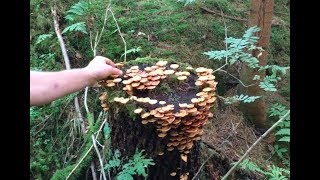
Richard Perkins forages for wild mushrooms around his farm, identifying porcini, chanterelles, and turkey tail while discussing how different fungi feed the soil. He shows off pasture built up to 45 centimeters deep and a neighbor's grazing that extended his land by 2.5 to 3 hectares.
Questions this video answers
August 27, 2017
Approximately 45 cm
About 2.5–3 hectares
It is currently out of stock and they are waiting for more copies to be delivered in the next couple of weeks.
Chapters
Farm scale permaculture course is over and we had a good time. People have left today, so no better way to start the morning than finding edible mushrooms. Oh, pasture raised turkey gravy with mushrooms collected from the forest. Then spice. What's here? This is swede and carrot and Swede. Carrot and sweet from the garnish.
Yeah, Yep.
And we got potato. What's that from?
Raw potatoes with wild mushrooms from surrounding forests.
What mushrooms? We got Latin names.
Belitus edulis. The sep. The penny bun or porcini.
What a feast.
And you also got red currant sauce. Penny bun, Beletus edulis, Porcini. Steinpils in German. One of my favorite mushroom.
Highly deadly.
Yeah. In the Amanita family. I could just. Yeah, yeah. That's definitely not a blusher. That's a. Yeah, that's a panta cat. I should imagine it could even be a washed out amanita mascara.
No, there's a pantakat.
Nice little paletus edulis prime.
We're just outside the market gardens. I mean we don't have to go far.
Yeah, that's another pumper cat. Okay. This coral mushroom beauty, probably Romaria, but it's.
What's this one.
That will be. I should have. Yeah, that looks like a Rusula. Let me have a little look. If it's a rooster, it should have. Yeah, maybe it's just wet. It's quite granular on top. I'm not gonna. Not gonna taste this one because I'm not 100% sure. Oh yeah, yeah, it is. It's granular, but it's not in the nicest state, so I probably won't bother tasting that one. This one's a good example. Cortinarius is the Latin name, but webcap is the common name. A lot of are very unpleasant ones that you don't want to confuse with things like blue foot. And.
What are these little tufty ones?
I don't know if they're. They don't look like the sheath wood tuft. Probably could be a sulphur tuft actually. Yeah, probably a silver tuft.
We just had a little bit of rain.
A nice amount of warmth, all.
The mushrooms popping up. Look at this little beauty. Primo.
Come something else because they don't fit this genus, but yeah, this is like the. The type genus, the type species.
Here's some very curious fellows.
Ah, yeah. And probably in the club fungi group, I should imagine. Yeah, there's lots of pizzazas around, like the ground sort of cut bungee as well. Lactarius deliciosus. They love it in Spain and apparently the Russians love it as well. You should be able to tell that it's a milk cap by this saffron coloured milk oozing out of it. But this one's been so maggot eaten they've. It's not got any milk left. Sheath wood tuft growing on. Is that an old birch? Yeah. Find loads of these on birch. They're really lovely. Fried up crispy but not one to start on for the amateur. Yeah, they look very similar to the Galerinum marginata which will kill you little. Amanita muscaria. Moray Garrick. I'm hoping we would see. That'll be one of the. Looks a bit like a morel. That comes from the same family as the morels, I'm sure.
Edible.
No, no, I mean the morel is barely edible. You got. You have to cook a morel and you have to make sure that it's not grown up in anywhere where there's been lots of lead stuff laid down. There's a couple of mycologists, a couple of collectors that have suffered from lead poisoning from eating lots of morels. That's an unusual looking one. You very rarely get them like that but yeah, definitely a yellow foot. Cantarellis tubiformis. Delicious little one. Only a little mushroom but when you do find it it's normally in big tufts. Toonomyces mutabilis. Really delicious when fried till crispy. Should I chuck those in your bag, kit?
Duck and geese and peacock brigade. This is a flush of shiitake from the logs that we served. But the slugs get in pretty quick so just been taken in. Neighbour grazing. So this is the, the front field of our neighbour here and we're grazing right up to the road. So we're taking all of this field which adds another two and a half, three hectares. I guess it's cute seeing them on the.
Orange. Orange peel fungus. I'm not sure of the Latin name of this.
Incredibly sweet.
Have a look. They seem to really like this sandy disturbed ground.
Beautiful. Looks almost synthetic. This is just a good example of how shallow the soils we're working on are because now the ground's quite different on the farm in different places. But these forests are growing on pure sand. This is a sand pit where people are taking sand as a resource. But you see it's incredibly thin lens on top of these soils. So it's been remarkable to build our pasture soils up to 45cm deep now.
Very hard to See from the top quite often. But then very distinguishable because they've got hollow stems, ridges rather than gills.
Tasty. Tasty. Very nice.
It's definitely a true turkey tail family. Turkey tail family? Almost certainly medicinal.
You reckon most of the cocotail family are medicinal.
I read an article that the Japanese have done a study on about five or six different tramite species and they all had the polysaccharides that are associated with being pretty cancer and everything.
There's four main types of fungi. You have your saprophytes, which eat dead things and where you tend to find the whole organism in one log or whatever. They're the edibles that we cultivate, like oysters, shiitake, lion's mane, etc. But we're out in the woods looking for mycorrhizal fungi. So they're living in association with the tree. So you can't dig up a patch of chanterelle or porcini and move it somewhere else. They're attached to living tree. Then we have our parasitic fungi in farming that we can inhibit by airflow and spacing plants further apart. It's often in greenhouses that we get big fungal problems. Using silica sprays, which you can make with nettle or chamomile, horsetail things high in silica and stop water, stop watering the plants by aerial watering, which spreads spores around. And then we have the endophytic mycelium that runs up between the cells of plants up into the tops of the plants as part of the nutrient cycle. There's really mycorrhizal fungi and saprophytic fungi that we're working with. And it's a fascinating world. There's so much diversity of fungi here in Sweden. These are the winter chanterelle. Very nice.
You got your knife, ain't you?
Yeah. Everything in nature looking after itself, taking care of the hole. These little guys are swapping mineral for sugar.
I think it. I think it's amalaria. Yeah. Honey fungus. What everyone's really scared of being parasitic.
Taking out their trees.
Yeah. But probably doing a lot of good turning the tree back into food, back into soil.
Nice specimens.
Very nice. Still getting the golden chanterelles. The fins eat a lot of it, but no one else really bothers with it. But they've just found that it has. I think they called it. It's not griflin, but it's got something that burst. Boosts neuron growth. Let's eat it then.
So I need some neurons.
Yeah. I think we'll go for these Young white ones, shall we? Hang on.
Forest raised pig together. Mushrooms, slow roasts.
Yeah, I think we're gonna have a very slow roast and then quick roast right at the end to give it a bit more color so you see how he's looking. And then maybe on the.
Like a.
Chinese sucking pig that ends. Maggots in any of these. They're like top, top.
I'm just learning the sauna now. Those of you that have been following us, you'll remember we swapped this wagon for four chickens and we've had a lot of saunas in here this year. It's been an amazing way to get people cleaned and it's been working beautifully. Very cheap, low cost, portable sauna. I I I I. It's hot, isn't it? Ooh, hot. Mr. Sponge, how did it go?
Very good. Got a nice crispy pig.
Piggy, You ready to eat? Like a Viking.
Glass. It's a good noise.
So that's it today, folks. It's not about an update from the farm. It's, you know, we're having a restful day and we've been working very hard. We've been planning out the rest of the season now and it's quite a light and easeful end to the year and really enjoying this time of year. This is the season of the harvest and the abundance. Some people have been inquiring about our book, Making Small Farms Work. It's not for sale right now because we ran out of books and we're waiting for some to be delivered in the next couple of weeks. We'll let you know when they arrive, but you can find them all on our website and follow our page, subscribe, share the videos if you enjoy them. Thanks for your time. See you next time.
It.
More from Richard


A review of short and intensive season on a mixed farm and restaurant/event space in Sweden






Alskade Kyckling Exploring complexities of poultry production in Sweden and what we stand for


