S5 ● E10 €10,000/yr profit from microgreens in super low-cost set-up
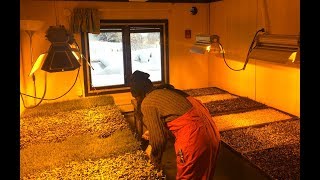
Richard Perkins demonstrates a very low-cost microgreens sideline run from a recycled wagon in a cold rural Swedish climate. He describes the physical setup (a €200 wagon used as a winter grow-space with halide lights), the simple crop mix (radish, sunflower, pea/mustard), routine (two trays of each per week, daily watering, harvest every ~10 days), and economics: tray size 100×40 cm, average winter tray cost ~€6.8, yields ~1.2–1.5 kg per tray, selling price ~€28/kg (280 crowns/kg), light/heating ~€75/month in winter — which scales to roughly €10,000/year from the described weekly seeding cadence. He emphasizes simplicity, monitoring (to avoid mould/seed loss), seasonality (lower electric cost in summer), and that the system is a profitable sideline when market access exists.
Questions this video answers
€200
100 × 40 cm (seedling trays fit 40 × 40 cm also referenced)
Radish, sunflower, and pea (mustard mentioned as another commonly grown alongside these).
Two trays of each per week.
About €75 per month.
Chapters
Those of you that follow our videos regularly throughout last season will know this is our lean to greenhouse, built for €1500 out of recycled Stockholm police station bulletproof glass. And it's where we propagate all the seedlings for the market garden and also do microgreens. Now this is a 1500 Euro structure dug into the ground to help keep some of the temperatures stable in there. And we also can blow heat in from the house. But we're not growing microgreens in here. Throughout the depths of the winter. We grow them in one of the wagons that's lying around the yard. So I just want to show you our very simple setup for growing €10,000 of microgreens a year. Now, I know some of our viewers have much more sophisticated systems than we do. We love doing stuff with scrap, like this old wagon that we use for our eggmobile that we swap for several chickens. And I want to show you where we're growing microgreens now, which is a wagon we bought for €200, which is made out of the same sort of wagon that our slaughtery is made out of, which is also a €200 wagon. That's the kind of way we roll with things. And it's quite cool, even though it's quite energy intensive, growing microbes in such a cold environment here in the winter. I want to show you what we got going on. Now. This is the wagon here which we've used for intern accommodation in the summer, but obviously there's no one there during the winter. So look, the video quality is going to be a bit funny with the frequency of the lights. These are halide lights and they're more towards the red spectrum, which is typically used for promoting flowering. And it's not ideal for microgreens in some way. In another way, it's what we had our hands on. We got these lights, we got like a whole load of these lights for helping take them down in a local spirulina farm, the only spirulina farm in north of Europe. You might remember a video from about a year ago where I went to check that out. And this wagon, As I said, €200. You can see outside it's really cold now, going down to minus 14 this week. Don't know if the camera will switch its focus, but you see there's deep snow here. But the part of the reason we want these lights, typically for micros, it's better to have something shifted towards the blue spectrum. But I like these lights because they kick out a lot of heat, right now it's about 18 degrees in here, and we keep it stable at nighttime. Obviously, the lights are off in the night time with just a simple radiator that comes on on a thermostat basis. Now it fluctuates at this time of year between, you know, 0 degrees and minus 25. Right now it's like minus 8, 9, and it's going to sit between minus 5, minus 15 the next weeks. And we're typically growing just three microgreens. Right here we've got radish, sunflower, peas, and we do two trays of each a week. You might remember in old videos we used to do the micros in here, and we still do at certain times of the year. It's just in the middle of winter now. It's so much more energy efficient to keep the heat at the stable temperature we like in the wagon, and we're not using the wagon for anything else. Whilst we can blow heat in here from the house, from the wood stove on a thermostat basis, it's not insulated in the way that the wagon is, so it's just not efficient. In the early spring and the autumn, it's perfect. And then in the middle of the summer, once all of the plants have come out for the gardens, we can grow micros in there too, although we typically do micros in the tunnels as well. So for five months of the year, we're not using the electric to produce microgreens at all. So our plan looks different for the seasons. Many people have much better setups than we have, but this is a sideline enterprise for us. Because we're so rural, we only have one sort of bigger restaurant that we sell to regularly throughout the winter, in any kind of volume. And for private customers as well, we're selling in small packs that are about €3 each. Now, whilst there's so many different microbes you can grow, we focus on these three because they're very simple and it's easy for us to get the seeds without importing them. A lot of people are growing really fancy microbes, but they often take double the time. And these are all ready in 10 days after germination, which suits us. There's many ways you could go with micros, and as I said, many of the viewers and people you see on YouTube have much better setups. But for us it's such a sideline operation that it's just not worth it for us in this case. If we could sell a lot more micros if we were nearer city, then we'd probably expand this enterprise because it's very profitable per square meter. Just what you see in this space here is generating over €10,000 a year now in the winter, the costs are higher because these lights are quite powerful. There's about €75amonth going into electricity to run these. But bear in mind that's heating throughout the day too. We run a simple fan and that just keeps the air moving in here. But we run this super simple. We don't use any sterilization and we've had mould issues in sunflower at certain times, but we just reduced the seed density there. Mustard and pee, no problem whatsoever. And so I just wanted to show this because I just feel like it's such a simple thing, you know, we could obviously vertically stack these and grow a lot more in the same space. We just don't bother because there's not a market for it here. We're just growing what we comfortably can without sort of stressing about it. And. And it's a nice addition to eggs and meat products that we sell on Rico and to restaurants throughout the winter. But it's simple stuff, you know, I'll just tell you a bit about some of the numbers and you can see how easy it is to get started on your own. So the trays we use are 100 by 40 centimeters. Just pick them up on eBay for like 7, 8 Euros. And I like them because they fit with all of our seeding trays for the vegetables, which are 40 by 40. And you'll remember if you watched our videos, we used racks that we've made for fluorescent tube lighting in our lean to greenhouse. And that's accommodating 120x40cm of trays. So we want everything to tessellate. So we don't need very big structures to heat to be able to grow our seedlings early in the year and to grow microbes year round. They work really well. They're a bit deep. It would be nice if they were a little bit shallower here. You can sort of see the depth there. And these are maybe four days off from being harvested now. Sunflower is doing good and the mustard here is really nice. The chefs really like this one. We'll put in about half a kilo of sunflower, a kilo of peas, and quarter of a kilo of the mustard here. And then we stack those up and put one of the previous weeks trays on top to add some weight. Leave that three or four days for germination. And that compression helps with germination. Then we'll lift them off and just water very carefully. Now, in this kind of environment, you've got to be really careful with the watering. I'm sorry about this flickering light. It's going to be very distracting. But that's the conditions we're in. Very simple setup. You see, the lights are just a plug with a timer, so they're on and off automatically. And we just come in once a day to water, and then we harvest once or twice a week in the summer, when it's busier. Some of the basic numbers here I can show you. It might be hard to make this out, but here I've just got a spreadsheet where I look at the seed cost and the kilos per flat and the compost cost per flat and the electric cost. So in the winter now, it costs about €75amonth to run these lights and the heating in this small space. Now, obviously we could run a lot more seedling trays in here by stacking in space, but we just can't sell it. They were too remote, so we don't bother. But that's okay as long as we keep selling it. Micros are really easy to lose money on if you're not selling them. And so you've got to be really careful that you monitor it and also that you're harvesting at the correct weight in your planning sheets, because it will quickly tally up to very different than you imagine. The average cost of a tray in Wintertime is about 6.8 Euros. That's for organic seed and compost and the electric cost as well in this space. And we're typically getting between 1.2, 1.5 kilos of yield off each tray, slightly different for each variety. And we sell at the average of 280 crowns a kilo, 28 Euros a kilo, which means we typically get a net off each tray of €30. So if you do the maths, for seven months of the year that we're using lights and electricity, it's going to generate about €5,800 just at this scale, with two trays of each per week. And then in the summer months we're doing it outside, so it cuts the electric cost. So the average tray is costing us €6 56,80 in the winter. In the summer that goes down to about three and a half euros. So it's much more profitable, obviously. And so we do that for five months of the year. And so that totals up. If we look at our sheet based on those yields and costs. It comes to 104,000 crowns. That's about €10,000 just for producing this many trays per week. So each week we're seeding this many and we got trays just come on. So every week we have a set day where we're just seeding the next lot and they're cycling through like that. So pretty simple and straightforward. And I hope that's insightful for some of you that, you know, just to really simplify this stuff, because it doesn't need to be super technical. Now, obviously there can be problems. Things like molding is going to be the biggest issue. So ventilation is important. You've got to sort of work that out for the space you're using and work out the seed density that you're working with. For us, it's, you know, pea. And radish is just never any problem with it. It's only sunflower we get molding with. And sunflowers also can be a pain that you get a lot of seeds left on. We'll come up close here and you'll see that it's not too bad. But these all need to be picked off. Black sunflower is better than the white and black stripy ones in that regard. And you can experiment with covering the seed with soil, see how that goes. But the mustard, these are growing super dense and there's no molds in here. That's just beautiful. And pea is also totally reliable and super nutritious and delicious. So there you go, you know, pretty simple enterprise. Yes, you can get a lot more technical with it. And, you know, you can stack this enterprise big time and producing 30 kilos a week, you can make a family income here in Sweden. Now, there, you would need to live near a big city and ship further afield probably. But just goes to show, you know, in a space the size of this single wagon, you could derive a family income if you got the market for it, which we don't. So we keep it at a small scale because we're not trying to push it as a primary enterprise. It's a sideline enterprise and something nice to have in the winter, just to keep regular customer contact, etc. And, you know, €10,000 of profit is quite significant. It's a nice enterprise for the amount of work that's involved. And, you know, you don't need a huge amount of skill to run this enterprise. So we've run this in a wagon that cost €200, 12 trays that cost €8, 9 each. The lighting is free and your running costs are about. Well, they're going to average about €5, you know, if you average out summer and winter in the way we have, plus your running cost of electricity in the winter, which is about €75amonth. So pretty neat, really nice enterprise. And as long as you keep on top of the monitoring to make sure you're not throwing money into seed that then is moulding out or you're not able to sell the quantity you produce, then it's a really good enterprise and a great sideline for a market garden enterprise and something you can do, you know, hyper urban or anywhere really. It's one of the most profitable per square meter enterprises I can think of, along with things like specialist tree nurseries. So that's it today folks. It's just a really quick video just to update a little bit of the activity that's going on. We'll be harvesting microgreens this week and taking them out to restaurants and private customers. But it's pretty quiet time of year for us. We're doing a lot of the admin work and the background stuff that happens behind the scenes to make this all work. But I just wanted to make a quick video just to demonstrate, you know, it can be very simple. You know, there's obviously amazing setups that people have out there. People are doing it as a more full time occupation. But first it's a simple sideline and I just wanted to demonstrate like how simple these things can be, you know, and it's something that can be taken anywhere and can be done on a large scale, a small scale, anything. So I hope some of you will find that inspiring. I'd like to say a big thank you to all the patrons that have stepped up behind the campaign. We've got half of the supporters that we set as our initial goal. It's amazing to see and it really allows me to, you know, put time into this, which I really appreciate and I love to do this stuff and, you know, especially knowing that some people are finding it very beneficial and love to follow what we're up to. You can find out a lot more in our book, Making Small Farms Work and we'll see you in the next video.
More from Richard


A review of short and intensive season on a mixed farm and restaurant/event space in Sweden






Alskade Kyckling Exploring complexities of poultry production in Sweden and what we stand for


