S5 ● E11 Can our winter bedding supply all our Mkt Garden compost needs?
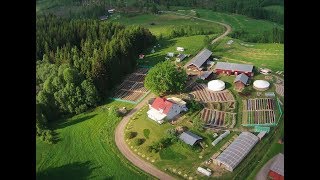
Richard Perkins (YouTube, Feb 1, 2018) outlines how his farm uses deep-litter bedding (peat moss, wood shavings, occasional straw) for 9 cows and ~800 hens, estimates annual bedding/manure volumes and costs, and considers closing nutrient loops by turning spent bedding into compost for a 1500 m² market garden. He gives estimates: <50 m³ compacted dry bedding used per year; cows produce ~30 t manure (≈18–19 m³); hens produce ~12 t (≈6–7 m³); combined output and bedding ≈75 m³; bedding cost ≈€2,300; potential street value of resulting compost ≈€8,000. He discusses peat access, sustainability concerns, need for machinery (compact tractor), ventilation, and farm planning.
Chapters
Today I just wanted to make a quick video looking at the deep litter for our poultry and also for the cows, and thinking about how much volume of material we're putting down throughout the winter, what that costs us and what we can expect that to offer in terms of compost, in terms of returns, which is what we're hopefully going to be using it for. In the past, we've used deep bedding systems using whatever materials we've had at hand. Now we do have our own peat swamp. Those of you that follow our videos will know it's a piece of our property that we didn't realize was coming with the farm. But everyone in the village had a part of a peat swamp. The only issue with accessing that, we've taken some for making compost, but it's very hard to get material out. Now, typically Torf, the peat moss, as it's called here, would be cut in the spring and left on special racks to dry in the actual peat swamp, which we've done here and just to see how that process goes and to use it on small scale garden compost. So it's an amazing substrate for compost, hence you find it as the base of so many composts around the world. But it's, you know, arguably there's different levels of sustainability in terms of how the peat is cut and what type of peat bogs it comes from. Ours are very different. You know, cutting by hand on that scale is very different to the deep mining of it on an agricultural scale. But based on the accessibility of that site, we do buy peat moss in and we would like to develop a way to be able to cut the reserves we have. We're the only people in the village that will actually still be using the peat moss. And our neighbour actually has an interest in cutting the trees down that are taking back over that site. And if we can get vehicle access into there, it will be a lot easier to cut the volumes we need. Based on what we're doing now with the poultry in the greenhouse and the cows, we use less than 50 cubic meters of compacted dry material a year, so that's feasible to cut each spring and we certainly have the resources that could last us for that. And in the past, what we've done is used that for bedding. Now, in the past, we haven't just used peat moss, we've used strawberries, we've used whatever is on hand. But this year, due to the severe problems with the weather, there's been hardly any grain crops. Our local grain farmer, one of the last organic grain farmers locally. He can't actually supply us grain this year, which will have a big impact on our enterprises, which perhaps I'll talk about in another video. But we've been using straw and there's very little straw available this year too. It was a harsh year last year for production. But it's quite interesting to start thinking about the numbers, the volumes and how to integrate these cycles on a farm like ours, where we're also using a huge amount of compost for our garden system. So we have nine cows and calves, by my calculation. In the five months that they have indoor bedding, I think they produce about 30 tons of manure, which I would estimate, you know, in the beginning is about 18, 19 cubic meters, based on the density of the manure. So the bedding we're using is peat moss with a little bit of wood shavings in. And with 800 hens, I would predict they produce about 12 tons of manure in the time they're indoors. They're inside a month longer for six months. And whilst a chicken puts out a tiny amount of manure, there's so many of them, it adds up, I reckon that's about 6 or 7 cubic meters overall. Now, with chicken manure, we're putting down about a cubic meter of compressed bales of this peat mo wood shavings every week. So over their respective times, that's about 26 cubic meters of bedding that go into this greenhouse, about 240 square meters. So by the end of the season, we would expect a nice thick 15 centimeter layer over here in the cows, we're putting down about 20, 22 cubic meters for the cows. Currently, with the amount of cows that we have, anyone that lives in a cold winter environment knows that animal bedding is expensive and it's a big part of the cost. Animals over the winter is winter feeding and winter bedding. We're spending about €2,300, perhaps on winter bedding in this mode. Now, if we buy all of this material that's on the basic price of peat moss with wood shavings in it, like you see here, that would be what it costs. Now, that's quite a significant sum, but when you add it to the volume of the actual manure as well, we end up with about 75 cubic meters of. If we can turn that into good compost, that's got a street value, as it were, of about €8,000 here. Now, that's enough. Bear in mind to put a layer on our market gardens, which is 1500 square meters, about 5 centimeters thick, couple of inches thick. So when you put it into that perspective, you can say that having, you know, this many hens and some larger herbivores, whether they're cows, sheep, etcetera, it's what makes it viable to be able to put that much compost into our market garden environment. Now, we don't need that much. That's the amount of compost that we put on to our market gardens to start them in the very beginning. And you don't need that much to maintain them. I reckon half that much. But that's beautiful because that gives us some excess. And we use this bedding straight on directly as tree mulch in the spring. So come early spring, one of the first jobs we do in the spring is we bring out all the bedding and we mulch all the trees and berry bushes. Now we'll be able to put down about half the bedding that's been generated this winter, and that will be enough to mulch every single tree and bush around the farm, which is the only sort of annual maintenance other than one lot of grass cutting later in the year. And then we will be turning these piles. We'll make windrows and turn them, I think, and that will give us the next year's garden supply. So based on these numbers, we can keep the farm off grid. In terms of compost now, we're not there yet. We do buy compost still. I think this spring we'll be buying a small amount of compost for the market gardens. But based on the amount we put on initially, plus some additionals last year, we're pretty much not going to add compost this year. We'll need to buy it in for seedlings. And there's a few beds that never really got the dose of compost we'd like. But it's a great step for us to move on towards being able to make all of our compost ourselves. And if we can take this next step with accessing the peat swamp, which I'm very happy to do. I know some of our viewers have concerns about using peat because of the. Because they say it's not sustainable. But when you think about it, you know, winter bedding is a serious issue in a long winter climate. And your options are either take your local resource, which is, in our case, we have our own peat swamp that, you know is shallow cut, and it's never going to be. We're not going to use our amount, let alone the rest of the village using theirs. And it's very easy to say, ah, but peat's not good. But then, you know, what's the alternative? So people are using straw? Well, straw is based on bare soil plow agriculture. You know, it swings and roundabouts. We need winter bedding. Yes, we can keep the animals out as long as possible, and that's something we do. And we try and extend the grazing as long as we can throughout the year. But, you know, ultimately we need some kind of winter bedding. And if you put it into a system where it goes back into the gardens and back onto mulching our perennial tree systems, silviculture systems, then I'm totally down with that. But it's really cool to see, like in a year we should have closed the loop with hopefully winter bedding as well as our nutrient for the garden, which is, you know, by far the biggest nutrient demander of our farm enterprises. When we first set up the deep litter system, you'll remember, we dug the polytunnel platform this summer. And then as we brought the chickens in off the field, we put down some of the old sheep bedding, which is straw and sheep manure that been compacted down over the winter, and the chickens spread that out and then we started laying peat moss on top of that. So as you dig down the other day, I made a video where we were looking at the heat generated in that system. And you know, even if it's minus 25 outside, it's 15, 16 degrees in the base of that, which helps create the microclimate for the birds in the tunnel. But that material is breaking down quite readily now that I doubt there'll be much straw present when we dig that out next summer. One of the reasons we've been looking to sell the ATV now is to be able to get a small tractor with a bucket so we can take better care of the animal manures. It's really one important thing for a small farm with animals is to be able to take care of the manures. That's the, you know, the bank account of the farm, essentially. If we can take control of that, then we're really in a good way for looking after. I'm slipping here. The snow's all melting away now. It's actually positive degrees and it's quite lethal on the roads, so it's slippy as we walk around. But taking care of that manure is ultimately what makes a market garden able to thrive. So looking forward to starting things off and just planning because I'm going away until the second week of March to focus on writing. And so I'm having to delay a couple of crops that we're going to be starting after that time. We've put quite a few crops forward this year. We've scheduled quite a few crops to go in earlier and a few to go later based on our experience of the last couple of years. Because winter is changing here. It's not what it used to be, and the old people certainly reflect that back to us. The winters are not as cold as they used to be and the snow is not as deep as it used to be. So we're adapting our veg plan based on what happens here on the ground. I'll talk more about that when I get back from my travels and when we start seeding. One thing I'd say, you know, for sure, like any of these processes, is to really observe what's going on and not follow any strict rule of thumb. I put bedding down whenever we need to, and I don't want the bedding to be wet and I want the animals to be in a good environment without ammonia building up. So, you know, I'll add more material if I need to. I'm trying to just give you an idea of the sort of volumes we're talking about because I know some people are, you know, going to try this out for the first time. Just checking out on there. This is the willow that we're coppicing. Alternate lines you might be able to make out there. So each year now we'll take one alternate row. Amazing growth this has put on. This is, you know, three and a bit years put on as a little cutting as thick as my finger, kind of like that. That's what we put down. It's beautiful in here, but yeah, it's, you know, it's one of those things. Just put down the right amount of material to keep the animals in good condition. And that's the main thing. That's the main reason we're putting the bedding down, to keep the animals comfortable and keep the air good in there too. And I think that one thing to consider, I'm going to put some top vents up in the top of the polytunnel because certainly as the snow has built up in the last couple of weeks, it's blocked the side venting. And so that's something to be aware of is you need ventilation up high as well now. It's melted away now with the warm weather we've been having. But, you know, the ammonia started to build up. My back had been out so we hadn't put any material down for that week. We missed a week in the cycle, so you need to stay on top of it. But we're back on top of things and, yeah, it feels good. Hens are happy. So we wanted to have a tunnel that had these machine doors at either end. That's one of the things that I'd always get for a tunnel like this. You've heard me recommend first tunnels before. I really like their simplicity of design and the rigidness of design. But having these sliding doors is essential. To be able to get like a mini digger or a compact tractor in there to be able to take the bedding out. We've done it by hand before, but, you know, 40, 50 cubic meters of material first thing in the spring, that's a lot of work. And as we get older and backs are sore, it's nice to have a way to get a machine in there and do that. So that's what we're hoping for now is to get rid of the atv, which has served us really well. But we'd like to have a compact tractor now and be able to really focus on making the most of all the animal manures. I think that's, you know, one of the greatest benefits of a mixed farm is the ability to close nutrient cycles. So I think it's time we really take that up a notch and just see how much useful compost we can make out of our animal enterprises. And I aim to keep some good records on that so we can really quantify and value those things in a different way. I think it's a really important thing. Anyway, that's all for today's quick video. Just sharing what's on my mind today. Thanks for everyone who's been supporting us on Patreon, it allows us to make these videos in the first place. You can find out more about Patreon in the links below and you can find out a lot more in our book, Making Small Farms Work. Thanks for watching.
More from Richard


A review of short and intensive season on a mixed farm and restaurant/event space in Sweden






Alskade Kyckling Exploring complexities of poultry production in Sweden and what we stand for


