S5 ● E13 Handling 8000 pastured eggs a week...
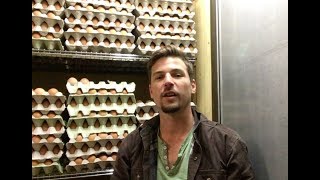
Richard Perkins upgrades his egg packery to handle 8000 eggs weekly as his flock grows from 1200 to 1600 hens. He installs industrial stainless-steel racking, adds a heated water wagon, and cuts a doorway for better workflow through the van. The build stays cheap and regulation-compliant.
Questions this video answers
Between 8 and 16 degrees (Celsius).
1200 hens.
1600 hens.
About 1,140 eggs a day (95% of 1200).
About 30–38 trays a day, or 266 trays a week (speaker's estimate).
Chapters
So I'm in the egg packery and yesterday we delivered normal delivery day. We took over a thousand euros of eggs out of here. So I thought I'd take the opportunity to take the rest of the eggs out of here and give it the radical overhaul I've been talking about recently as we Prepare for having 1200 hens next year. So this is the first time that this wagon's had no eggs in it ever since we built it. Now, you might remember I made a video fairly recently talking about the need to overhaul this place. It's a very small space, but a farm that's selling the amount of eggs we do needs an egg packery. So you might remember you need an egg packery. If you're selling to restaurants or to shops, to private customers, or, you know, direct from the farm to customers, you don't need an egg packery. But to have a certified egg packery where you have an egg stamp with your production number, you must have certified packery in place. I've explained the egg packery in other videos. It's pretty straightforward. We acquired this wagon, we swapped it for a few chickens and it's not a working caravan and we've basically got a full electric rig in there. The only thing you need for a certified packery are things like mouse traps, vented screens. You need to be able to display a temperature monitor. It's got to be kept between 8 and 16 degrees for eggs to be in the correct storage temperature. So we just have a max min thermometer that we monitor. We've got heaters in there already. You have to have hot and cold running water, which we achieved just by connecting a hose pipe from a frost free tap just about 10 meters away to an instant water heater that you can just make out there actually. And that works well for us because we only have one or two frost free taps on the farm right now. And we explained in other videos, you don't want to be putting in frost free infrastructure in the beginning when you don't know where things lie. And you know, this is a temporary movable structure. But it's been working really well for us and actually it's going to be working for us even if we doubled current production up to 1600 layers. But this season we're going to have 1200 layers. So I want to just tell you about my plan for how I'm going to overhaul this. So if you know much about the farm, you'll know we love doing stuff from free or for cheap. And our friends near Stockholm took apart a shop they've been running and they gave us this industrial racking. And these units here, this is what we're going to make the new shelving out of these clip onto these racks here. And these are super strong stainless steel. They're going to be perfect. And the size of each rack is perfect for stacking egg trays. I'm going to show you inside what we plan on doing. Something that's happened just by chance. And I love the way this works when we're doing stuff with recycled or upcycled goods. We can fit six egg trays. We sell nearly all of our eggs in flats of 30 and we can fit six on each tray on each shelf here. And what's more, it fits perfectly in this little side room. Now my racking system is going to fit out to about here on each side of the other side of this wall. And what that allows me to do is get rid of this stuff. So I've got a lot more space in here. And what that will allow me to do is cut a whacking great doorway in here. So I almost have a division. This is the area the eggs come in and they get packed and sorted. And then I have my main storage on the other side of this division with a little doorway. And what that will allow me to do is pack the eggs straight into the van. I can park on the road here, right next to the egg packery. Much more efficient system. It's going to be way better, especially in the wintertime when it's quite slippery outside. And getting eggs to the van is a bit treacherous for a few months of the year. So this is going to be such a better system with a through fro of eggs. And it means even if I'm packing eggs inside and someone else is going off to deliver, they can collect all the eggs without crossing paths, getting in each other's way, all that. So it's a really neat little benefit of this way of setting it up. Okay, so we've cleared out this side. Now we've just got to get the shelving off on the other side of the wall and we can bust a hole through the wall. So first things first, I've got to remove the heater that's on this side and a bit of the wiring rig that's in here because it's going to get in the way when I chop through the wall. Check. There's nothing crossing through where I'm going to cut through the wall. No electric cables or anything. And what that will allow Me to do is just make straight cups up the side, push out that wall division. But first we've got to undo all the shelves on the other side. These are old 18 packs that we don't really use anymore. There's one shop we supply to in 18s, but pretty much streamlined all of our sales to tracer 30s. Way more efficient at the scale we. Okay, so all the woodwork's out of the way. Now. The only thing in our way with chopping a hole through this wall is this heater. So we need to isolate this and this other wire coming across here. Now, that cable goes through the wall down here and that actually goes outside to these lights. And so we don't need them. Luckily, the light switch and the sockets, which will be useful, go up here and they come around the top through there. So we'll leave them. That's really convenient. But see that this is a simple sort of stuff. This little mesh over an opening here meets regulations. It's trying to just show you like you can do this stuff real simple, real cheap. You don't need fancy stuff to pass regulations. It's usually about protocol and some basic principles. So essentially I'm just going to undo the radiator that's on the other side of the wall there. I'm going to leave this radiator and there's another one on the other side there. And that's what we currently use to keep this warm in the wintertime. So everything appears to have gone well. And now just got to see what's underneath here. I can't remember why this step is here, so I'm going to investigate that and hopefully that will allow us to get this cable out. It's disconnected at the other end now, so there's no electrical risk and we just got to see what's going on. Okay. So it seems like there's a splitter there that actually takes the lights to both sides. So I think we do away with this whole piece and get back to floor level. Now, it's a bit in tattered condition in here and it's old fiberboard. It's not letting water in at all anymore. It used to, and we patched it up. So I think this will need a bit of covering up just to make it hygienic for the inspectors. I think what I'll do is scrape away the worst of it and then stick something over or paint it. See how the condition of it is when we get there. First, I want to just get the racking in and get this back together today, because eggs are coming in day after day, so we need to just get it functional. And then I can work on one side and then the other to get it sorted whilst I'm using it for egg packing. But it looks like I can just rip all this electrics out and then we're ready to cut a hole in the wall. Awesome. So now we've got some space and next step is to work on putting the racks in this side. I think I'll just get the racks in here and not put racks on this side yet, just because we don't need that much space right now. I'll work out exactly how many eggs I can fit in here. It's only thin board, but, I mean, there's no structural sort of problem. Nothing's going to be resting on this. I'm just going to leave it for now. And I quite like having an arch there, actually. Just neaten it up, but sweep up, tidy up. And I'll start getting the racks in here. Just got to grind down the metal legs so they fit in the ceiling height we have here. Okay. So it's looking good. We've got the arch in. I've put up racks on both sides, so I've got 1, 2, 3, 4 shelves on each side. And it's going to hold a lot of eggs, but because of the amount of weight pushing this towards it, like, it's got legs on these stands, but they're not very wide compared to the shelf. So I'm going to put two strips of wood, bolting the tops of the two frames together so it just can't lean towards each other. And then we'll see how many eggs we can fit on here. Get on it. So I've bolted the tops together here so that essentially I'm hanging. You can't see that, but I am putting all my weight on this, just on two of the shelves. So I would say that's pretty strong. So we tested the strength and it can hold my weight just on one shelf. So that's perfect. We know it's strong enough. But look here, I put eight egg trays high with enough space above to be comfortable. So a full tray of eggs is about 2 kilos, so that's 16 kilos. So you've got to be able to lift up here. Now, for me, that's no problem at all. Some people that would be tricky. And so they were stacking here. So there's three shelves that can take that many eggs and then a bit of room on the very top. One, maybe you can get three or four trays and six lots of that. So how much space have we got? We've got two sides the same. We're gonna have 1200 hens next season. So when they're in the height of production at full lay, that's gonna be 95%. It's gonna be about 11, 40 eggs a day. That's about 30, 38 trays of eggs a day or 266 a week. That's a lot of eggs. It's €3,000 worth of eggs a week. That's a lot of eggs. You know, it's woof. You got to be able to know that you can sell them because they just keep coming every day. That's the thing with eggs. It's seven days a week. You can generate a lot more income for the amount of hours in compared to something like a market garden or whatever. But it is year round, seven days a week. You don't get a break from it. So that's why I've had to jump in here and do this work today. I'm not going to finish it today, but just to get the basic infrastructure in place because there's a whole bunch more eggs coming in every day. So, you know, I took that opportunity in my schedule and just to get out and do something a bit physical after sitting in the office so much recently. But eggs is like that. It just keeps coming and coming and you've got to be ready for it. So 266 trays a week at a week is about what we need to store because we're always selling each week. Right. We're going on different deliveries in the summer, more often than in the winter. But we need to know we can store a week's worth. So we're always rolling. But just on these shelves you can store 48, 6 times 8 stacks on each shelf. We've got three full shelves on each side. So it's 144 trays on each side. So, you know, and maybe with the tops as well, that's gonna be 162 on each side. So we can store well over 300 trays just in this back room that we've made here. Which means even if we scale up to 1600 birds, I can store a week's worth of eggs just by putting one more rack here. So I think I'm not even gonna bother putting this one up. I'm just gonna leave these two. It makes such a load of difference having this extra space. So I think we'll just work with that. And what a beautiful workflow. You bring the eggs in, we're sitting here to pack and sort the eggs and then they're stored here. And because there's a bit of a separation on the floor, it's nice you can come in with like work shoes on, whereas when you come in for egg duty, you wear a clean overall and clean shoes and keep this space nice and tidy. So I think overall, for a couple of hours work today, it's really nice to have to get all this space a bit more functional and just open up this wasted space essentially. And it's really nice to have done the maths and know that, you know, even if we scale up to 1600 hens, which would make this, you know, a huge enterprise really, it's enough to pay our family wage and some employment to run the enterprise. But we'll probably never scale that much just because we're in a very rural setting here. And that's not to necessary. But look, you know, it's a cool. I just wanted to make this video today just to follow along what I'm doing on a winter's day, but also just to think about how simple some of these things can be. You know, I know what it's like when you're starting out the idea of building a certified slaughtery for boiler enterprises, like how on earth do you do that? Or even just having a certified egg packer. It can feel overwhelming, like, where do you start? The regulations don't make sense. You don't know anyone locally you can talk to or go and see one maybe. But this stuff can be really simple, you know, simple pleasures, you know, I mean, really, it's these little things that make work a pleasure, like little workflows and efficient ways of stacking and storing and dealing with stuff. And it's so simple. But you know, it's often these little things that make joyful moments in a day. And in the work instruction you could ask, why didn't we do this a long time ago? Well, it's just, it's one of a million things we could do, you know, I could write reams of lists of little jobs that could be done. And I think it's true for any scale of production. I've said many times, whether you have an allotment gun, growing vegetables for your family, or you run just a market garden, or you run mixed enterprises, there's always stuff you could do, you know. But I'm glad I took time out today. I've had a good clean down. The egg packery is all nice and spanking clean and I like this new setup. The shelves are obviously strong. I've got some hundreds of kilos on there, so happy days. Thanks for watching. You can find out a lot more in our book Making Small Farms Work. If you haven't read that, you can find links below of how to get a copy of that sent out to you wherever you live in the world. And you can support the channel help us to grow and spread regenerative agriculture to more people around the world. You can support us on Patreon below, which allows us to put more time into making videos for you, which will ramp up as the season gets underway. Thanks as always for watching. We'll see you in the next video.
More from Richard


A review of short and intensive season on a mixed farm and restaurant/event space in Sweden






Alskade Kyckling Exploring complexities of poultry production in Sweden and what we stand for


