S5 ● E16 Milk, Steam & Running out of space
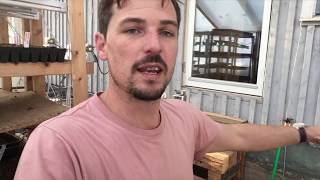
Richard Perkins and Johanna milk their cows, make condensed milk and cheese, visit the local sauna, and redesign their lean-to greenhouse to fit more seed trays. They're running out of space because they're keeping hens longer and growing for an external customer named Rico.
Questions this video answers
1934
€1,500
About 8 m by 3.8 m
40 cm x 40 cm (144s)
Chapters
Sam, Did you eat smoothie? Nang.
Nang? Yeah.
Was it good?
Johanna's busy making cheese. We've been milking and so we've got lots of milk products. Right now we're just separating cream and milk and making condensed milk for making puddings and things. And still eating a lot of stuff from the cellar. If we go down in the cellar, don't come down here very often. We've got cheese and we still got so many of the preserves that we'll be eating through till the middle of summer, probably. And over here I've got the book. Do you remember? If you watch, you'll remember that I inoculated making small farms work with oyster mushrooms. It looks like it's got a bit of contamination. But look, that's oyster mycelium. That's spreading through. So we'll see. Maybe I'll get to eat my own words this year. Did you have a nice sauna Magna? No. No, you didn't. You had a nice bath. You got your loafer. This is our local sauna. We've requested early times. Johanna requested early times because the women's time on a Friday is after the men's and it's too late for mothers. But turns out most young mothers don't know this place exists. It's very hot in here, so I'm getting that. But men's Evening is at 5 o'. Clock. So now we just asked to have family time before and it was very nice. No one else here. There's a nice bath which is a luxury for us because we don't have a bath, do we? Whoa. Slippy.
Let's see. Bath. Let's see what you face. I see.
Let's see. Let's see. Yeah, it's hard to. How you can't see unless I flip it around. Hang on a second. Now you can see. How do you look?
Can you show the dance? Can you show the dance? Look again. Is having a dance nice Dance.
Dance.
Okay. So it says here that the.
Saint.
Rich Bathing House association was started in 1934. They got the funding of 100 crowns.
That's about €10.
2,000 grams. That was under the commune had to guarantee that the bathing house had to be used for at least 10 years.
Who's this dude up here?
There was like a kind of like a council and where the question was raised about building this bathing house, as the call it. And then someone rose up and said that he was against it because for his. From his point of view it was. There was enough of leisure establishments Here in the village.
Can'T be spending €10 on more leisure. The stoic memory of the parish.
5 to 7:30 and.
7:30. 7:30, 10. So this is what Johannes contesting. Because on Fridays anyone with young kids can't really. It's men's time. 7 till 5 till 7:30. So it's prime time and women with small kids just can't make it to the sauna. So we want to change it. It's only €3.
No, about €3 per person, 5 crowns per child.
So it's like 50p, 50 cents for Ragnar and about €3 for an adult. It's super cheap. So we're thinking that with our aims to have a much more relaxed and balanced working weeks this year, maybe we'll end each week early. We've come now at about 2:30, so it might be. We end our Fridays early and come down here and have team group saunas at the end of each week. I think that'll be awesome. So just coming home from sauna, just closing up the nest now and that's it for the day. On the chore side of things, just checking the cows have water and I need to get up and start planning some measurements in the lean to greenhouse. We need a bit of an upgrade for the amount of starts that we have this year. We've got so many more seeds to start that we're running out of space already and we've only just started seeding, so. So I had actually bought staging to go along the sides of the tunnel here. But because our new replacement flock of hens are coming late, we're keeping these birds longer. So like when you're changing flocks over with hens you want to anticipate. Like when we buy our hens at point of lay. So 16 weeks old and it takes up to a month for them to really start their production. And so to avoid a massive spike in sails, what we're doing is keeping these birds longer, which means the tunnel won't be free. So we can't really use this space as early as we wanted to. So we're in a bit of a fix and I've got a little idea how we can increase the amount of space in the lean to greenhouse. And then we might have to use the wagon as well. I'll show you what I'm planning to do up in the lean to having the cows in milk. Obviously, just being Johanna, myself and little Ragnar, it's more milk than we can drink. There's even some milk here. Culturing in the greenhouse. I'm not sure what that's being made into, but yeah. I wanted to tell you about the plans I have in here because it's already nearly full. I calculated I've got enough space now for 30 more trays. That's the small square trays. They're 40 by 40, like these. These are some of the tomatoes seeded, but that will quickly get filled up. So I've got a few ideas. Now. You'll remember, if you've followed us for a while, that we built these racks to be able to tessellate the types of trays we use. We're either using these for leeks and onions. The first onions are popping up here, and we typically broadcast leeks, onions and spring onions just to save space and put 400 onions in a tray and up to a thousand and a few hundred for SP onions that we're going to grow on in tight clumps. And then we have our one four fours. These are 40. So the onion trays are 60 by 40. So two of those fit on a rack. And then all of our main seeding trays are 40 x 40 cm. These are 144s that we use for tomatoes in the very beginning, things like spinach and lettuce. You'll remember, we transplant nearly everything just because of the very short season here. These are the first kohlrabis coming on in 64s. So nearly everything we do is in 64. Then we do microgreens in trays that are one by 40. There's one example here with peas. So that's. It's been really good for us because this space is pretty small, about 8 by 3.8. And it's built out of recycled bulletproof glazing from the Stockholm police station. We dug it down into the ground just to keep it from freezing, which means even though it's super cold outside, we've able to use water here all through the winter, which is nice if we want it. But basically it's, you know, in this environment where it's so cold, it's really important to have the smallest space possible to meet your needs if you're going to heat it. Now we're here, it's now 20 to 5, so the sun's just about to go down. But it's amazing that it's light at this time now. It's amazing when the spring comes back in this way after such a dark winter. But look, we're sitting at 21 and a half degrees and there's no heater on. It's just blowing air from here. So that's from the wood stove that's blowing out into here. And it's a sunny day, obviously. So Even now at 20 to 5 in the evening, when it's very bitter today I think it's minus 9 or 10 outside. It's keeping really good temperature in here and it's a really nice germination space that's using very little energy. The leeks and onions have just been here a few days and they're already off and temperatures are ideal. It's been staying 17, 18, as I said in the previous video, but now we're growing a lot more. So things have changed in a few ways. One, we're growing for Rico, not just for veg boxes. So when we're growing for our vegetable boxes, we need to know we can guarantee vegetables. So we typically start in mid June with the veg boxes and end at the end of October. And that allows for seasonal variations because up here, when, you know, the further north you go, and equally and oppositely, the further south, the more unpredictable the seasons are. So we typically have last frost mid May to end of May, but it can even come into quite, you know, 10th of June, there's been frost here, so it's very hard to tell. It fluctuates. As I said in a few videos, we had the coldest spring on record, we've had the warmest spring on record, the wettest spring on record and the driest summer on record, all in the four years that I've been here. So it's pretty variable. But, yeah, we wanted to keep this space very small. It cost us €1500 to build this whole space, which is pretty remarkable, and it cost us very little to power it and get all our starts going. But because we're growing for Rico now, which we can grow earlier into the year, and we have the caterpillar tunnels that we're hoping to get up just as soon as we can when the ground is thawed, that we can drive rebar in the ground. It means that we've got an advantage now to grow as early as possible. And so we need more space. I've put in maybe, I think we've got 36 beds that are going under caterpillar tunnels, and some of that's going to be direct seeded. But I've put in about 20, 30 trays extra, and then I'm seeding a bunch of stuff earlier. So even just like one week into the seeding plan, we've only got spaces for 30 trays left. And so we have got the wagon we can use if we need to. But I've got some ideas to utilize this space better. The first one is going to be building a new desk here. And what I want to do is I like this setup at the back using these halide lights. But what I want to do is sink all this stuff down to the ground on pallets, for example, and build a frame up above it. So keeping the same distance between how the lights are now and the trays and just dropping this whole thing down, as it were, and building a wooden frame on top of these lights. So I can have a whole other rack. So you see, there's 12 of these trays. That's 24 whole seed trays, if I'm talking 40 by 40 centimeter ones. So that's a nice bump up on its own. And during the summer, just by sunlight, we'll be able to grow on the top rack of that, which is nice. Then I don't know if I'm going to be able to easily show you, But I'm going to climb up on here and turn the camera around. Can you see how the racks here, we've got one facing this way and one against the window. Well, there's only room for those two, even if we had them side by side like we do in this arrangement. But what the benefit of having it like this is we get this big floor space. So I'm thinking to do exactly the same. This bit complicated using a camera like this. I'm thinking of doing exactly the same at this end, which will open up a sort of turning space and working space over there. And I also want to use this wall space below me. This is kind of dead space right now. Now we need to access this door, and we have no steps. We have these big steps down from the house. And so I want to build a bench here that's used for potting in the spring. Now, why don't we have a dedicated potting space? Well, we don't need one because we're typically potting outdoors for most of the year. It's just these first few weeks that are unpredictable. And ideally, we'll be potting in here as short a time as possible. But you just never know. And we can't tell when it's going to be warm enough to start working outdoors. But it's a lot easier to do potting on a table outside where you can throw things around a bit. Here with the gravel floor, we don't really want to Be throwing soil around so much and it's much easier for us to just work outside where it's a lot easier to deal with the logistics. But I would want a table that can be used for potting in the colder times of the year when I'm in here and it's easy to access from the house and you know, I'm pottering around in the winter months and then in the summer I want to be able to grow on there. As I said, we're not using it as a potting space in the summer and so I don't want it to be a permanent feature there. So basically just by building the frame under this lot and maybe putting in a couple of tables, I might put in a table in both the working spaces, maybe a sort of fold up contraption which will allow me to put a few micro green trays on each of them and they will grow fine without extra lights at this time of year onwards if it's weather like we're having now. So it won't take long to do hopefully. And hopefully I can get into that over the weekend and get a bunch more space for trays that we can do all of our starts in here and then we always have the wagon to fall back on if we need it. But I love being able to work in this small space because it uses so little energy to start all of our starts in a place like this. You know, heating a polytunnel or something like that would be crazy for the scale of operation that we have and we just don't need it. It's much more preferable to work in here compared to the wagon because we've got water on tap and it's a lot quicker to do the watering. I get up in here with this device and I can water right under the lights no problem. You just got to be a little bit careful that you don't electrocute yourself with my Thai style wiring. But it'll be nice to get in here and just sort this space out now. Thanks as always for watching our videos and appreciate your shares and likes. You can find out a lot more in our book Making Small Farms Work. We'll see you in the next video.
Paper.
More from Richard


A review of short and intensive season on a mixed farm and restaurant/event space in Sweden






Alskade Kyckling Exploring complexities of poultry production in Sweden and what we stand for


