S5 ● E19 Sleeping in trees and organising visions
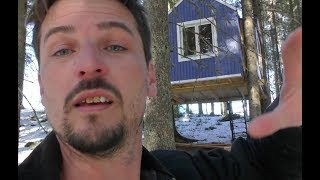
Richard Perkins updates from his treehouse on farm expansion: 1,500 tomato seedlings, plans to scale to 1,200-1,600 hens with new tessellating trays that fit 180 eggs per box, and a late spring with 60cm of snow. He's considering winter teaching tours in the US and Canada, and a longer dream to sail while running the farm in summer.
Questions this video answers
March 29, 2018
Over 1,500 tomato seedlings (five boxes noted)
Tomatillos
About 1,200 hens (considering up to 1,600)
Six trays per box, about 180 eggs per box
Chapters
So it's not even funny anymore. We're totally done with winter and we can't wait for spring. So we're up at the treehouse. I actually camped out here for the very first time the other night. It was amazing. It was freezing cold. But I got inspired by May, who was an intern with us, who we met in Denmark. Of course we did, at our friend Michael's place. And they were free camping then. And it was this time a couple of years ago, so it was, you know, zero degrees and they were all camping out and happy as Larry and I thought they were all crazy. But, yeah, I got into it and I came up here. It was beautiful. I've never ever slept in here since building it. And it was a beautiful clear night. The moon was out and it was freezing cold, but stars were everywhere. And it was so nice to see our land from that perspective because everything's white in the landscape and it was really bright. And I just sat out in the snow. I had a lot of layers on and I sat up just watching. I was hoping to see a wolf or something, but unfortunately they've been shooting the alpha male. And I think some of the important females in the group that live here behind us in this forest, it stretches all the way to Arvika. It's quite a way away. I believe they shot a couple of the main wolves from the pack, which, yeah, it's a big political thing here in Sweden, but I'm not happy about it. I feel like, you know, humans are going to regret that one day. But, yeah, that's another story. But I didn't see any. I did see some deer. And it's always amazing how much life is going on here. Even when, you know, in the middle of winter, when you can't imagine.
I mean, just down here, there's deer.
Droppings and I often see deer up here, but it's amazing. I remember coming up here in the summer just to see the pigs and just seeing. I made a video about it. It was gobsmacking. I put my head torch on and there were thousands of bats and insects. Like it was just alive here. It was amazing. But, yeah, it's really nice to get out and be up here in the night because, yeah, I somehow have never.
Slept out in this beautiful tree house.
We made. Those of you that don't remember, I think we made it in the winter. Nicholas and I made it in a week three years ago now. And it's been stood up here on four little bolts that hold it. And it can Move. I'll show you the mechanism that holds it to the tree. It's very simple, but it does the job. Here you can see these bolts. 30 mil bolts. And then this allows it. This metal piece allows it to slide forwards and backwards, left and right. And that's been keeping it up. It's keeping fine. It means as the trees move, if we look up, you know, as these trees move a couple of meters at the top in the wind, there's tons of pressure down here at the bottom. But as long as they've got enough play, they do the job. But I'm hoping to get in there and finish the wallpapering that I started last summer and stick a wood stove in there so I can keep it warm and have it as an office. I really love the space and to have the lookout on the woods here. Beautiful. So all is going super nice in here. You can see the tomatoes and tomatillos coming up. We're going to do tomatillos as a commercial crop this year. There's plenty of spinach, spring onions, lettuces going on. It's over 1500 tomatoes this year, so it's going to be a big one. We're kind of stretching out too much here as we get the trays on the floor here. I've been heating up the wagon again, which we haven't been using for some weeks, the wagon that we were using for microgreens. But it's been working beautifully up till this point with the halides under here. And yeah, it's going good. We've just taken some microgreens out for delivery today. So we have a little bit more space to use in here. Again, it's a nice sunny day, but it's very cold outside. But you can see it's sitting, it's 22 right now and that's in full grown. Sun in the afternoon. So pretty good. Quite happy with the stability of it. You can see all the seedlings are doing good. Plenty of tomatoes coming along super nice. It's going to be a lot of work stringing up all these tomatoes. These are the seasons tomato strings. So there's five boxes here, 1500. Now these come in a special order, so I'm not going to lift any out. They're designed for the, you know, the huge greenhouse systems in Holland, etc, where you'll take this along on a cart, just pulling one after the other, hooking them on, you know, on kilometers and kilometers of wire. We've got 1500 tomatoes coming on which is going to be epic. Tunnels nowhere near ready for anything like that with all the chickens in there so far. But it's going to be a sight to behold this year with the tomatoes that we've got planned. So I've just closed up nests for the day. Now, it might look all nice and sunny and warm in here, but. And the air temperature definitely raises up during the day. You can see the torv blocks that I'm using. That's the peat moss. They're frozen solid still, so I'm letting the birds do the work of slowly scratching them out. The heat comes in a day and melts the outer layer. They'll scratch it away and then I can spread this nice and easily. And then overnight it's freezing again. So it's tough. It's, you know, it's going to be a really late spring. It's now coming into April and there's still like 60 centimeters of compacted snow outside. And I see it's been minus 12, minus 14 this week. So. Hoping that everything stays in time for the schedule of the market garden because we've got a bit of flexibility with that, with the way we've planned our boxes. But we were hoping to get a good start and get the caterpillar tunnels.
Up nice and early so we can.
Get some early crops that we can sell on. Rico. One thing that we've done is to invest in some better egg collection equipment. And these are beautiful boxes that tessellate, so they stack down inside each other and then they also stack up on top of each other. Normally we're collecting eggs. We have a couple of baskets like this every day from the hens we have now. But as we scale up to 1200 hens this season, it's going to be a thousand eggs, over a thousand eggs every day. And so these are built for six trays. That's about 180 eggs in each. So we're going to need a whole bunch of these every day and it's soon going to build up. But do you remember in a recent video I was making some new racking in the egg packery and it's designed around these containers. So we're going to actually have some of these strapped to an ATV for field collection. And you see how they're made. Like you can easily put your hand down and put the trays in. So we'll be collecting eggs in this way to save any. We don't get so many breakages like this, but you get some, especially if you, you know, hit some bumps or whatever. It's never been a problem, but now we want a solution as we scale up, because we were considering to scale up to 1600 hens and as you start handling that many eggs, you want a really efficient and practical system. And one of the main benefits for us with this system is, is that we will be bringing eggs to the egg packery, packing and stamping them into their paper cartons, which also fit into here. They'll be stored on the racks in these containers. And something that's nice is it's a lot easier to handle. And something that I've been plagued with is a bad back. And carrying eggs like this up slippery paths in the winter is, you know.
It starts to wear on you after a while.
Might sound silly, you know, it's not a major deal, but handling six trays of eggs at a time is much nicer. And what it does is it allows us to put them into the van straight away and transport them safely. And, you know, we can stack three or four of these high and there's no way they're going to break. So they've all come up from Italy. I was a bit disappointed because they asked for three different colours of trays so that we could have one different colour for each egg mobile so we could keep them really separated visually for record keeping. Not a big deal, but I was a bit sad that they didn't send them. Something we've been discussing is how we're going to handle the deep litter from both the chickens, but also the cows from the barn. We're thinking here, just for context, we're walking into our willow windbreak here, but we're thinking to use this area at the top. This is our caravan sauna where we all hang out in the evenings. And the fireplace over here. But this space has always been. We've had nursery stock here and we end up just dumping stuff here. So we're thinking we'll make this a very nice compost area to take 60, 70 cubic meters of deep litter and we'll be mixing it so it's torv or peat moss with chicken manure and it's also peat moss with cow manure. So a nice blend of those together and we'll put them in windrows here and keep them covered for the year and we'll be using them in the following year in the market garden. So we should be able to, from this point on become self sufficient with our own compost. As I've discussed in other videos, just looking down the rows here, hoping to get the cows out to have them bale grazing, we're going to, in effect, put up. It's tricky here. You need an electric drill to put electric fencing in at this time, but we will probably run. Trouble is, it's going to get very wet soon as everything melts. It's a lot of snow. I'm walking on the surface here, but there's actually 60cm of snow underneath me. It's just frozen on the top because we've had these sunny days where it melts on the surface, then freezes again. But I think we're going to run a fence down here as soon as we can and just strip, graze, bale. Graze the cows. This. And it should be getting. I reckon in a couple of weeks all the snow will be going. It's time to get out the egmobiles. You can see in the distance there. It's going to be time to start building on this one. Now, you couldn't even see this one a few days ago, so it's going to be great to get this process going. We're going to document the building of this one. It'll be very much the same as the other egmobiles we've built, so we'll have three of these on the go, which I'm looking forward to this spring. Likewise, the caterpillar tunnels are just still sitting here too. There's not so much to do. I haven't bought the rebar that's going to hold the hoops in the ground, but it's just no way you could bang them in. Right now we've got frozen ground underneath the snow, so we've just got to wait. It's a waiting game this spring. Part of me hoped we would get these up, as you know, in the next week, but I think it's going to be a couple of weeks until we get the frames up and, you know, maybe heat the ground up a bit before we go. Someone was asking whether we use the geotextile to heat the ground up, and the answer is no, not really. I mean, the compost is very dark and would heat up very quickly, you know, in the same way that any dark material would. It's mainly to protect the beds from the elements, but also because we planned our veg garden from the start for our CSA boxes. Some of the beds didn't get planted out till late May or even June, and so it just keeps them covered up from weed seeds drifting in, etc. And just keeps everything under wraps until we want to open it up. And likewise, at the end of the season, you know, we can put it to sleep before it gets weed seeds blowing in or whatever. That's become less relevant now in the way that we're working with Rico as well. Having beds empty in the beginning of the season is something we've worked to change now, because we're selling at Rico more readily now, too, in that we may as well try and get early crops in before our planned box crops, as it were. So that's something we're working with this.
Year, and that's something I was hoping.
To take advantage of with the tunnels. But we'll get a bit of early crop, but not as early as I hoped. I think this year. Something that's crossed my mind recently is whether to sell our key lime plough. I'd originally bought this to go and do. I was working a bit in the Mediterranean and around different parts of Europe at the time I bought it, and I was thinking it would be great to stick it on a trailer and.
Go and help people do implementation jobs.
But in reality, right now I'm far too busy to do that kind of stuff and I don't think we're going to need it again here. We've done all we need to do with it. Our soil's been developing dramatically and I really think part of it's thanks to this and the other part is mainly to do with the animals and the holistic plant grazing that we do here. But I think it could be time to sell this on.
I expect some other people in Europe.
Could benefit from it.
I know there's a plough in France and in England, in Spain, but there's.
Not so many around. And I feel like it's better than.
It sitting here doing nothing. It's better that other people use it.
There aren't so many people in the.
Local region that are taking up regenerative.
Agriculture in this way that I feel.
Like it will get enough use if it stays in my hands. So you could drop me a private.
Message if you're interested. I mean, it's essentially pretty much new. It's great for pasture development and for tree planting.
I've also got a Simon bed former that's great for. It's a vegetable bed former, but great.
For tree planting too. I might consider selling them if someone's interested.
They've always been for lease if anyone.
Local wants to come and borrow them.
That's been on our website for years.
But it might be time to let.
Them go and sell them on now.
We've Had a few requests to come to the US in the winter next year, which is quite interesting for me. I'm often turning down stuff like that because it's just too far away. And it's. It's quite a big effort for me to leave the farm because I have to get someone else here and it has to be someone if, you know, if I'm leaving for a month or something. I have to have someone that really.
Knows the farm well and knows about.
The sales and how to manage everything, basically. So it's not so easy to just.
Walk away in that way.
Something we've been considering is to take a little time out through the winter.
With egg sales and changing the way.
We cycle the hens.
And something that Johanna's been bringing up.
Is that the way that the sales.
Patterns work, it always drops a bit after Christmas, so we're thinking we might, because winter's pretty hard for the hens here and it's. You know, most people are raising in.
Heated barns and I think we've got.
A nice enough system sorted out.
But rather than running them through to.
April like we normally do, and switching them over with the new flock, which is what we've done each year, and.
It'S what we're doing this year, we're.
Thinking we maybe cull the hens in December and then start a new lot again in March, when we're always back at the farm, seeding in the market garden. So we can actually have a couple of months fully off the farm and there'll be not so much going on at all that we don't need such skilled people here to look after the place. And that led me to think, maybe I'll book up a 2019American tour and go and do a few educational things in January and February 2019. It could be really cool. I've always wanted to spend a bit longer in the States and really offer some trainings there, because we have a lot of followers and supporters there.
And I think it could be great.
But it's always, you know, finding the right time. But having a few invites at that time of year now has made me really think, yeah, this could be a good opportunity to do that.
I'm planning.
I'm looking to move the farm towards a place where, like, in the longer term, where I can take time out in the winters to go sailing. As I've said in past videos, I've got this dream in the back of my head to do a circumnavigation and sail and take the kids and you know, really show them some experiences. And I was thinking about it last night. It's a really, you know, here on the farm, you're, you're planting seeds and trees that live for thousands of years. You're rooting yourself in place, you're developing systems that you might not reap the benefits of for years, decades or generations even. And I was thinking, well, what's the opposite of that? And like sailing is kind of the opposite of that. You're totally dependent on this tiny little fragile system and reliant on everyone else for helping meet your needs. And I kind of found that interesting to think about because it's been a childhood dream for me and it's something I want to pursue and it's something that will take many years to plan and to save money for. And so I'm thinking about it, you know, as I wind down from the farm in years to come. And I think I'll always want to spend the summers engaged. And it's the beauty of living in a climate like this is I could actually do that. I could, you know, set it up so that in a few years time I'm mainly focused in the summer here and then take a time out with the kids and take them off and maybe do a circumnavigation bit by bit over three, four, five years or whatever. So that's kind of cool to think about. And I was thinking I could do like an educational tour in that way. Sailing and doing a couple of trainings in places along the coasts of the place I visit. It's all a wild dream. But you know, I love to create these visions and then put them into place. That's what's happened here with this farm and with most things in my life is, you know, I'm not afraid to go for those visions. So trying to work that out, how it fits with family and the rest of life. But yeah, exciting thoughts. But I thought it could be nice to do something for next winter when, you know, I think the winters after that I'm going to start dedicating to this other project. So yeah, interesting thought. Let us know if you're in the States. And we would probably select a few venues that are well chosen for, you know, ease of getting to, for people and do, you know, a range of different trainings according to, you know, maybe we'll put some surveys out, see what sort of things people need ranging from short two day weekend, you know, intensives to longer week or 10 day trainings, who knows? But be in touch if that Excites you if you're in America and. Or Canada even, possibly as well.
It's fun to think of those sales cycles and also just to break outside your own thinking.
You know, it's very easy to get into habits where you do the same thing year after year. And it's great. I love it when Johanna has a totally different idea and it sort of shakes me out of what I'm used.
To and solutions can just appear like that. And I think it's really interesting to play with that. Like we've got a track record of all the sales for the last few years that we can.
You know, it's obvious where the dips.
And busy spells are. And like right now the egg production is dropping still at the end of the winter and we're not getting a new flock and they won't be in full lay until, you know, late May. So it's just prompted this thought that then addresses other life goals as well of taking time out in the winter and having family time in a different way and interesting process. Something we're considering is possibly even to sell the sows and the boar. And I'm really reluctant to do that, but something we need to consider. We're thinking of taking the forest down this winter. We've talked about it last winter, but it was a bit too hectic because they have to rebuild part of the road. But all the old forests at the back of the property, that's all been ready to cut now. And we've put up all this fencing to make all the paddocks, you'll remember from videos. Last year we finally finished all the fencing at the farm, putting up all the paddocks. You can see how deep the snow is here. This is a five wire fence and I'm walking up on top of the snow, which is handy. Like a few days ago I was sinking down up to the middle of my thighs. But yeah, we got to take the forest down to get the economic value out of it. And in order to get the sort of balanced regrowth that we see in the area that was cut before we came. We need the pigs out of the farm for a while to enable that to happen. So it might be best. We're considering to sell the sows and the boar and try and get rid of them in the spring now. And I'll be really gutted. Reuben's been amazing and the sows have too. But we would raise up the last litter until this autumn and then sell them over the winter at Rico's or In quarter, half boxes, whatever. But we really have to leave this whole area of forest. Now. The pigs have been through where the trees are and they'll go through again this summer. But then it's time to really leave it and let the trees come up. What we've seen in the areas over where it was cut a couple of years before we came is that once the trees are up, you know, three, four years, then they're stable enough and the pigs don't really take them out, even if they're in there quite a long time. So we're thinking that's a way forward. And it could be that we raise more like a Yorkshire breed pig if we want to raise, you know, just feeder pigs that we can raise up in six months in some of the paddock because it's only the larger forest paddocks that we don't want to damage by having pigs in there. So we still have some of the land available, but we can't carry the amount of pigs we've been doing and not damage the land. So that's a priority. And then given a couple of years, these lines will have come down as well. And so we'll really be able to turn this area back into. What we're trying to do is turn it back into grazing with trees over the top. And so we can still bring the livestock in there for now, like we'll be able to bring the cows in. And the plans right now are to have more cows. We're going to breed probably Hereford onto the fial cul that we have for beef animals because we still have the neighbors grazing this year and it seems like for years to come. And so it might be that we're scaling down on enterprises and just intensifying the ones we've got and actually value adding things like the smoked chicken that we're doing and maybe cutting birds like turkeys and chickens down a bit so we can sell fillets and half birds, etc. Which seems to work well with the Ricoh setup. It will be really sad to see a lot of this forest going. You can see where we've got the pig fence up. So all around the tree house here we're going to keep this forest. And I really wish, if I had more time, I would like to get into milling some of these logs. And actually Johanna and I have talked about building a home where the old smithy used to be. And originally I thought I would like to rebuild the smithy and, you know, make fine blades and stuff like that. But in reality I don't really have time for that. And what we would benefit from is having another winterproof home with, you know, a small home that someone could live in, someone could come and help out over the winter or you know, if we hire someone over the winter that they can stay there and have running water and, you know, heat, etc. It will be a real shame to change the landscape up here, but I'm also really excited to, you know, see the native regrowth like we see elsewhere and bring back a lot of the oaks and ash and hazel and you know, long term it's going to be a lot nicer. But yeah, it might be that I leave a portion that we don't sell that I use for milling, you know, as a later on project. We'll see. That's it for today. Just getting my excitement back, ready for the season. Nicholas and Carla both arriving on Saturday on the same train. And then I'm leaving on Monday to drive to the UK to pick up things, see my mother. And I'll hopefully be stopping at a couple of interesting places and making some videos of other awesome people that you might remember doing awesome things. So stay tuned for that. Thanks as always for watching our videos. You can find out a lot more in our book Making Small Farms Work. See you in the next video.
More from Richard


A review of short and intensive season on a mixed farm and restaurant/event space in Sweden






Alskade Kyckling Exploring complexities of poultry production in Sweden and what we stand for


