S5 ● E22 Caterpillar tunnels and Egg Mobiles
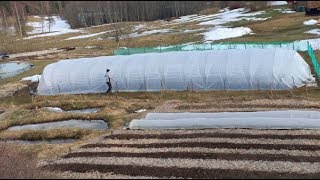
Richard Perkins sets up for the season: installing caterpillar tunnels, building Eggmobile 3 for €1,200, and preparing for 1,200 hens arriving in a week. The farm targets 1,000 eggs a day within six weeks and plans three batches of 900 birds each. Voles are eating about 15% of newly planted trees.
Questions this video answers
About 1,200 hens (turning up in about a week).
Approximately €1,200 to build.
About 1,000 eggs per day within a month and a half.
Three batches of about 900 birds each.
About 75 cubic meters of compost, valued at ~€8,000.
Chapters
So the season has officially begun. The team's arrived. Vegetables are growing nicely and actually today is the first day. We're actually planning out in the eastern west beds, which melt quicker because of their orientation to the sun. But I want to show you around a bit what's happening on the farm as we just ease the team into the rhythm and get to know each other in the first couple of weeks as we start up the season.
So I'm here at the hardware store just cutting rebar for the caterpillar tunnels. We're just going with 12 mil and 85 cm in the ground.
It's a little lightweight. Perhaps this is the length here, but.
I think by the time that's 35, 40 in the ground, that's about as far as we'll want it in the heavy clay here and hoping that's strong enough.
But things are starting to thaw now.
That hopefully we'll get the caterpillar tunnels up in the next three, four days. So Toby arrived.
He's been at Curtis Stone's farm, but also at Roebuck Farm, Jody Roebuck's amazing place in New Zealand. He's doing a lot of bio intensive market gardening and holistic plan grazing with sheep. And thanks very much, Jody, for the T shirt. I love it. Those of you that don't know Jody's.
Work, check it out.
It's a beautiful farm and you can.
Find him on Instagram and Facebook there.
And we're looking forward to meeting him.
When we go to New Zealand one day. Tomatoes growing well, we've got all the tomatoes podded on now we're doing tomatillo. They're in root trainers and we're doing them as a commercial crop. I really like them. They're very abundant. It's an unusual crop here. People maybe not so familiar with it, but lots of things coming along now. Lots of lettuces ready to plant out and we've got microgreens going around. Something we're doing this season is testing out these shoe trays for microgreens. They're smaller than our standard 100 x 40 centimeter trays, but what we like about them is they're very flat. So I think that's going to work with harvesting. We've got a quick gut, the greens.
Harvester that we use for mesclimix.
We've got the attachment for harvesting on a bench to speed that process up. And I think these low trays might work really well.
This is broccoli, which we're not going.
To do as a saleable crop.
I think we're doing it for ourselves.
There's a really fascinating interview on one of Joe Rogan's podcasts with Dr. Rhonda.
Patrick, who studied specifically broccoli sprouts for.
Their amazing ability to regenerate brain synapses and things like that. It's worth checking out.
Very interesting.
But this space has been working great and we've got a lot of stuff hardening off now and starting to plant out. So we'll go and have a look in the gardens.
So Carla's back. Hey, Carla. First planting. So kohlrabi is going in and the.
East and west beds are thawing out quite nicely. They're obviously leaning to the sun.
And we're going to start putting caterpillar tunnels up today. We've got beds showing here on the south. The north beds are still a little bit shaded.
We're going to change our bed plan around a bit so that we can make use of the ground heating up.
In these beds earlier.
So we're switching around the plan a bit and getting vegetables in the ground. We're late, actually, in our seeding plan. Not in our seeding plan, but in transplanting out. There's some direct seeding of peas that.
We'Ve put into trays now just so we can keep on top of things.
And we're switching around beds just to.
Be able to get crops in the ground now so that we keep to our plant.
How are the beds after uncovering from winter?
They're very good. I brought for them. They're really soft and loose, actually. Not weedy.
Look how clean they are. No dig for the wind. We like it.
So Eggmobile 3 is being built.
Here's Luca, who's joining us.
Luka, where is it? You've just been in Central India, Madhya Pradesh. But the farm you were at, Mossy Willow Farm, Australia. Mossy Willow Farm, Australia. It looks beautiful. They've been learning with singing frogs, so they're doing a big no dig operation.
The photos look beautiful.
We're going to hear more about that if you give us a presentation. Yeah, yeah.
Super nice.
And so perfect. We've got some. We've got quite a few market gardeners.
In the team and we've got loads of Germans in the team. We're mostly German, it seems this year.
But Eggmobile 3 is coming along and we've got 1200 hens turning up in about a week. This eggmobile is costing about €1200 to build and it's going to be turning.
Over €40,000 of eggs. This year.
So, as usual, cheap style Ridgedale setup, but this is actually a lighter eggmobile than the previous two. We've just stripped down the amount of wood. We're working with a caravan chassis here, so it's. It's very lightweight. And we're going to modify the first egg mobile that we built to take a bit of weight out of that because we've had problems with that. When the ground is wet, we're going to go up and look in the fields, but it's extremely wet. And where they've been digging the electric line down, we're going to have problems with the eggmobiles. I think.
This is the mesh floor going in. We use 40 by 40 mil. It's 4 mil steel, so it's super strong. And we've built in a little walkway.
Here that you'll be standing on when you're collecting eggs. Every egg mobile we build slightly different.
Because we're just working with whatever trailers we can find. So the guys went to look at another caravan chassis yesterday, but we rejected that one.
And we're basically working with what we've got.
The standard design is the same and.
The reason we've built this wedge shape.
I've explained in other videos, is mainly.
For the high winds we get here.
So we can park it up into the wind.
But also it enables us to get all these roosts in without taking up.
Too much space horizontally because we have narrow spaces to get around quite slopey.
Land and also thin gates. So it just works practically moving it on the road, between paddocks and with the tree lanes that we have set up. So we expect this egg mobile to be done in a couple of days and we'll be bringing the other eggmobiles.
Down just to check, check the wheels, check. Everything's functioning well before the birds go in.
But it's a bit of a scramble this year because it's so wet. You can see the eggmobiles out on pasture there, but they've been digging in the gateway.
We're going to go and have a look.
It's quite mushy and it might present.
Some problems this year.
Something I'm excited about this year is tree planting. We're putting in an orchard, an intensive orchard on 3 meter spacings. And we've also got a bunch more trees and berry bushes to put in the tree lanes. But I'm a little bit concerned. You can see some of these black currants that are doing really well for us. They're Ben Lomond, really big and productive. But they're starting to sprout and we need to get them in the ground as soon as we can. But we have to balance that with letting the land dry up a bit because it's so wet at the moment. We've also got a bunch more plum and a bunch more apple to put in. We've lost some trees to voles. It's been a really good year for voles this year because it's been a deep snow that's they love to crawl around underneath and we're seeing absolutely infestations of voles again. It breaks my heart, but they're in.
The pasture, they're in the tree lanes, they're in the veg gardens.
Now it doesn't appear that they're in the beds at all, but they're in.
The spaces around the gardens and around the polytunnel.
So it's one of the biggest challenges we have here is voles. But I'm excited to get planting and put in another thousand trees and bushes around the farm. Something we're going to be doing with the tree planting is now applying these recycled fiber mulch mats that they use.
In the tree planting industry.
And the reason we're doing that, you.
Might remember from the end of last.
Year we were putting the chickens into.
The actual tree lanes to clear some.
Of the ground there just to save on manual labor. And they've done a good job in there that now I want to cover it with this. And each year we've been using the bedding from the winter, but this year we want to take the bedding from the chickens and the cows, mix it.
Together, make compost that we're going to then become self sufficient in compost for the market gardens which are quite compost intensive.
And the reason that we just don't have the material to put on the.
Tree lanes each year anymore.
And the trees have enough to keep them going. But we've been importing a lot of CO compost to make the no dig beds.
You remember, we put about 400 litres on every 10 meter by 75 centimeter bed and we've got 200 beds plus.
The big tunnels here.
So we want to focus on making about 75 cubic meters of compost this year, which is worth about €8,000.
And then these will help keep the.
Grasses down around the trees and bushes. So caterpillar hoops are all made now and. And we're just moving our bed plan around to accommodate these. The guys have just been shoveling some snow. The tunnels are going over Four beds at a time and they go nicely into the pathway. It's why we wanted to use these standard hoops from first tunnels and get them to develop a kit for people around Europe to be able to buy caterpillar tunnels in Europe. They fit really nicely with this model of 75 centimeter beds. You can see how wet the ground is here as all the snow melts. And what you see is on these beds. These are the old north beds. It's melting quicker at the back. So we've decided to switch the bed plan around and get the caterpillar tunnels up on the backside, which also facilitates watering because we'll be able to hopefully lift up the caterpillar sides and water with the overhead watering system straight into them, which will save a lot of work. And Toby was saying he likes that.
As well because we'll be able to.
Really see what's going on in the.
Gardens a lot better and not shade out any of the beds.
So that's where the 40 meter tunnel is going. Then we're putting up a 30 meter tunnel here. These beds are all going east to west, except these four that go north to south. So we're going to put the tunnel up there and then we have a 20 meter tunnel we'll be putting in the south bed. Right now the cows have just come out and we've got them in the riparium because we don't want them plug in the field at this point time of year. So they're just set up in the ripe air and they're still going to be on hay for the next week. And poor Juliet, she's. She's a bit skinny right now. She's had to have medicine because she got sick.
But all the other cows are doing.
Great and we've decided we're going to breed Hereford bulls with them this year and start doing beef over the next few years. Just on a very small scale because we've decided not to carry a bunch of sheep anymore and just keep the herbivores on a smaller scale and just shave down the operations now like I've said in many videos over the winter. Now we're trying to create a balance and we don't need to do as much as we've been doing. We need to just find a good rhythm and balance. Here I'm up at the gate of top field and you see just how sludgy it is. This is where they dug through to put in the electric cable to this pylon. So they're keeping this pylon up for five years now as a backup system, and then that will go, too. But they've taken away the cable that used to go down and up to the neighbors here. But what's happened is they didn't do a great job filling it all back in. And a week ago, there were holes like two foot deep in this road, and the neighbors were complaining, so they came in and filled it in, but they didn't do a great job. It's still quite swampy in places, and.
It'S not good enough.
They need to come back and sort it out. But something we're really concerned with now is how we're going to run the eggmobiles, because there's basically a channel, and as the snow's been melting, it's been taking that channel and making it worse. So getting across from this part of the field to this part of the field is going to be really difficult. And we've put double wheels on all the eggmobiles. But even then, it's, you know, the ground is super wet at this time of year. What's always happened in the past. You can look back to videos from this time last year. When the hens are delivered, they usually back up the truck into this field.
And we have all the eggmobiles parked here, ready.
We put the birds in and we leave them for 24 hours, and then we'll move them up. We typically always graze from the top of the fields down to the bottom, Just so gravity helps us move the eggmobiles. But we're thinking this year we might put them over in nutfield to start with. We're not totally sure. We've got a week to work it out, and hopefully the ground will dry up quite significantly in that time because it's, you know, as the snow melts, there's a lot of runoff, and then it should be drying up a bit. We got a week of sunny weather, up to 20 degrees this week, which is amazing. It feels really hot after being in -10 a couple of weeks ago. But it's. It's been a long winter, and we're really ready to get going now. It's an amazing team. We've got some much smaller team than we're used to, but super excited about the caliber of people that come here and are excited to participate in regenerative agriculture. I haven't really shown you the vole damage, but all in the vineyard over here, all over the fields here, under the strawberries we planted last year, and all the way through these banks, too. The voles have had an epic winter and are obviously breeding very well. So I'm a little bit saddened by that because it's just, you know, it throws you back a year each time you lose a tree. But I think we've probably lost 15% of our trees from vole activity this winter. I don't know yet. It's hard to tell till the land totally thaws, but that's what we're up against this year. We'll be planting with mesh around the root systems to try and give them protection in that way. And something we'd like to do is just keep building roosts and positions that birds of prey can hunt from. We have a good owl population here that can hopefully take back some of the voles. But, yeah, it's a challenge that's going to be ongoing, it seems like, and that's just the way it is. So we're keeping the old flock of hens for a few more weeks now, and they're fine in the polytunnel, but we'll be slaughtering those in about three weeks to get the crossover with the new flock of hens. And then we're soon going to be ramping up. You know, within a month and a half, we'll be on a thousand eggs a day, which is going to be amazing. It's a lot of demand for our eggs and it's scaled up by one third this year. So, excited to see how that works. It's going to be different to move three eggmobiles. We'll probably move two one day, one the next day. And working on that. It worked well last year to be moving one every alternate day, and next project after that is going to be fixing up a few of the boiler pens. They took a lot of snow over the winter. Some of them are damaged, and we're doing boilers a bit later. So it's a few weeks till the first batch of boilers, and I think we're going to do three lots of about 900 birds. So we're scaling down the boilers this year, but we're going to build a smokery very soon and start smoking birds. So that's going to increase the revenue and it pretty much doubles the price of a bird. And it's nice to, you know, we felt like rather than just double the amount of birds, we could double the.
Income by smoking the birds and have.
An enjoyable activity to do there.
So, looking forward to that.
So this is where we were doing microgreens over the winter, and right now it's full of tomatoes we've got 1500 tomatoes.
In longer term, we're thinking now to invest in some newer LED lights and just really stack the ability to put starts in the lean to greenhouse because it's much easier to keep that warm over the winter and it's right next to the house so it's easy to look after things in there. But that's the limiting factor has been lights. The T8s that we've been using aren't available anymore in the cheap format. So the next best option now is LEDs and they're obviously a lot lower energy consumption, they're just a bit more expensive to invest in. But we can really stack that back wall up.
So that's something we're thinking about probably.
For next winter now because most of the seeding is happening in April and May and then it sort of quietens down. There's still a bunch of successional plantings, but it's. It's nowhere near the same as the.
Start of the year.
But it's going to be an epic amount of tomatoes this year and we'll be putting in the cucumbers, I think on Wednesday.
And we're doing cucamelons this year.
It's a nice, novel crop for us as well.
So excited.
We're doing a bit more variety, growing.
Celery and things that we haven't in.
The past and I'm excited for that.
It's going to be an interesting year.
In the veg gardens with such different management this year where we're all taking a bit of responsibility for the gardens and then sharing out animal duties between us.
So here we've got all the gear for the caterpillar tunnels. These are the clips that go on the rebar that's banged in the ground that hold the hoops up and then crocodile clips hold the strings that hold the plastic on.
But we.
It turns out they didn't send us 20 carabiners, so we've got to go pick some of them up. And then we got web strapping. This is webbing that you use to create a centre bar and then pull it down to the ground at the ends to hold the frame rigid and then the string for holding on the plastic. So it shouldn't take long to get all these up. And it's going to be a really great acid on the farm this year.
To be able to extend the season.
At both ends and get quicker rotations in for some of the salad growing, etc. It's going to be interesting. It changes our plan, but what we've done for the spring is added additional crops. We rearranged. Carla and I rearranged all the beds so that we could put all the latest planted beds in one group that was under a tunnel so that we could put in whole new crops of salad or radish or other quick growing crops that would be done so that we could keep on the rest of our plants. And the reason that's been important for us is that our sales model is.
Changing dramatically in that we're trying to.
Sell more through RICO and less through subscription boxes. So we're just not quite sure how.
That'S going to go yet. So this is part of the plan.
To keep our old plan intact and grow additional crops. And likewise, at the end of the season, it should allow us to do the same. My nemesis.
The voles are everywhere, you see, they've just been rampant along the banks here and all around the polytunnel too. It's.
Yeah, I'm not totally sure how I'm going to deal with that this year.
But they're not actually in the garden beds, but you see, they're rather close for comfort to the tunnel.
So smallest caterpillar tunnel is going up and we're putting posts every meter and a half. So all of the tunnels are the same width. 4.26 meters is the standard size hoop. And that covers four of our beds really nicely and ends up in the pathways on each side.
And we're starting off with the smallest.
Bed and we've got two others to put up on 30 and 40 meter spacings. And so the first step of the.
Process, just putting out a string, putting in the rebar.
We're leaving about 30, 40 centimeters above ground. So the next step is putting on these clips and the carabiners that will hold the string that holds the plastic down.
And this leaves a nice gap for.
The plastic to travel up and down.
The whole idea with these tunnels is they're very quick to install and then.
You can move them obviously very easily.
As you rotate crops. So less than two hours work for a little tunnel like this, maybe a couple of hours for a big tunnel. Super nice. This is what our beds look like in the spring. Ready to go. Okay, so adaptation time. Rosa's putting a support bracket in.
And what we're doing is putting the.
End posts at a slight angle that you see if I come to the side. Because what we're trying to do is.
Keep within the windbreak and the duct fence.
This has been our duck protection strategy.
And so we need an anchor point.
For the plastic to come down to as well as the center line that holds the post to. And so we want to try and keep that inside the fence. So we've just taken it down to be able to work around here. But we're hoping that this is the location it can stay in. And that will give us a nice end that covers the beds mostly. It might cut the very corner off the bed, but that's a happy trade off to be able to keep it within our windbreaks. And if this works, then this will be the strategy we probably use on all of them. So next step, webbing goes on. And this just loops around each of the poles and that will hold the whole frame quite rigid. But we're actually holding this vertical because there's a weight where we've joined these two together. We want this end one to be vertical to keep the structure nice and rigid. Toby's been using these structures in Canada, but in quite sheltered urban environments. This is quite exposed. In fact, our predominant wind is from the southwest looking straight down in the middle of the picture, kind of south southwest. And so this is quite an exposed tunnel, but it has some shelter from the buildings here. But when we have really strong storms here, they come from down in the valley there. So we'll see how this year goes. Part of the plan this year is just reviewing what additional supports might be needed or might be useful for different scenarios. And in the bigger tunnels we've got a cross brace that will go on to the end poles that will make it really strong as well as a solid centre bar which, you know, in America people are then putting up their tunnels year round Here. I think it's totally out of the question with the snow load that we get. Some people have been asking me about whether these would be suitable for keeping poultry in in the winter. And I think I just answered that in that last sentence in that you wouldn't want this up in the winter in Sweden. It's just not going to stand up to the snow. These big tunnels, I cleared these. Well, I cleared this one a few times during the winter. The actual steel is plenty strong enough, but there's a risk of the plastic stretching out when you have extreme snow. And you'll remember from other videos, the other tunnel never needed clearing because it's got livestock in. And in the future we'll be having livestock in both tunnels. But is a very different structure in terms of its structural integrity. Both with the cross beams in the roof and just the steel frame is much Thicker and stronger. So plastic's going over.
We're going to stretch it up, get the strings on.
Strings going on. So we're coiling up a loop, throwing it over, and we'll be going backwards and forwards, zigzagging along the caterpillar.
It's crisscrossed over. So we are unwinding a loop of rope and throwing it over.
And then that clips down into the carabiners here.
And then the process is going to be to tighten the ends and pull.
The plastic long ways.
And then we'll come back and tighten the string and that will really bow down each section.
I think I'll get the drone up.
For the subsequent build. So you can really see that process unfolding. But it's much better to throw a loop of rope over than to throw the whole reel of rope over because you can't really see what you're doing.
That looks good.
No, it is.
We trimmed down the plastic as they've given us. I think it was 9 meters by or 8 meters by 26. So we're having to cut them down. They haven't. These are standard widths that they sell. And that's part of the experimentation we're doing with first tunnels is working out. That's overlapping good, working out what works well. And then the beauty of these tunnels.
Is that you can lick up the.
Plastic and you have little hooks that.
We haven't installed yet that hold the plastic up so you can air it and you can also enter the tunnel.
But this is the small tunnel.
We've got a tunnel twice the size and the tunnel 10 meters, like in between these lengths. But you can see it's going to.
Really change our growing spaces this year.
To be able to have this much indoor space.
Tunnel's just being tightened up now.
We're just looking out the bedroom window. What do you think, Maggie?
Do you like it?
You're going to be able to grow some vegetables this year. Looks good.
That really comes together now.
Perfect.
Well, that's it for today.
We've had a great day getting things moving. The egg mobile is really coming on and getting tunnels up. Feels great to be on the ground again. And that energy is coming back with the light coming back. And that's really how farming is here. The spring and the autumn are quite short periods, really, and it's always amazing to witness how the snow melts and stuff springs back to life and the insects are all out again and really nice. It's really fun. With the new team, there's some great experience amongst the team members and everyone's jibing nicely together, so it feels really good. And I just finished the online course that we've been running for the last three months yesterday, which, which has been really interesting and amazing to witness some of the people just amazing projects in different parts of the world and I've been. I feel really proud of it now.
I've.
I've felt like it's been hard to know how people have been finding it, but the feedback's been. Been really touching and yeah, I'm really happy to be able to support people in that way. It's made me consider whether we'll run another such training over the summer and maybe over the winter if not. And I think we'll just keep adding students to the training and offer for the past students to return through the training as they develop parts of their businesses and farms. They might want to revisit chapters. So the idea is to build up a, you know, a community hub where people can check in and see how each other are progressing and ask questions, etc. But that's been a massive task over the winter and really interesting, but it frees up a lot of time now that I'm going to be putting out videos more regularly. We also started an Instagram account, so we'll be posting photos onto Facebook and Instagram because last year I didn't really post many photos and I think it's nice to have photo records as well as video records.
So.
So you can follow us on Instagram. We're ridgedalefarm, so you can follow us there. It's in the links below. And make sure you read our book.
If you haven't read our book.
We're still posting that out once or twice a week from the farm. It's the only place you can buy our book and it's a technical manual for people that want to do this stuff. And there's a lot of detail, a lot of information packed in there and we've been having amazing reviews from all over the world, people that are really taking the models that we're demonstrating here and still starting up and planning their farms. And I'm getting a lot of feedback that it's changing the way people approach their landscapes, approach their business, approach how they manage things and make decisions. And that's really heartening. I feel so inspired to keep sharing.
In the way that we've been doing.
Thanks so much for watching our videos, as always, and please share and like them if you enjoy them. And yeah, we'll see you in the next video.
Sa.
More from Richard


A review of short and intensive season on a mixed farm and restaurant/event space in Sweden






Alskade Kyckling Exploring complexities of poultry production in Sweden and what we stand for


