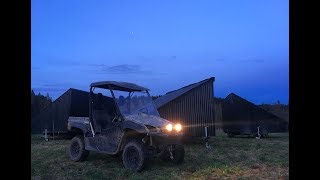
Richard Perkins readies three eggmobiles for 1,200 laying hens arriving the next day, lightening one by trimming its metal chassis and removing two-thirds of the roof and walls. The team plants an orchard with 70 apple trees wrapped in vole mesh, adds berry bushes, and prepares for 900 broiler chicks later in the season.
Questions this video answers
1,200
Lohmann Brown
900
70
Chapters
So we've had a busy weekend actually getting the eggmobiles finished, birds arriving tomorrow and today. We've been out in the rain all day planting trees. I'll just show you a quick view of what's been going on in the last few days at the farm. So of all these poles, we're leaving five and taking away eight of these. And likewise, we will take some of the floor beams out and some of the back beams that are vertical. So we'll have to take the nests away. And it's a whole lot of chopping and ripping stuff up. It's quite easy. It looks more of a job than it is, really, because it's built so simply. But we can really take some weight off this. You can see it's just really overbuilt. I mean, this thing would last forever, but it's just too heavy for the field conditions that we have. We've taken out this metal from the inner frame and all of this wood. So actually It's. We've left £6 in the roof. We've taken out eight. We've left the floor pretty much as it was because we calculated we only would have saved about 4 meters of wood. It wasn't worth the hassle, but it's definitely taken some weight off up in the roof. So it's been a long weekend. Not exactly the weekends off we've been talking about, but we've serviced and cleaned and prepared all three of the eggmobiles having finished eggmob. So we've taken a lot of weight out of Eggmobile 1, the original Eggmobile. We cut off a lot of the metal chassis and we've cleaned it all nicely inside. And we cut off about two thirds of the wood in the roof and walls. And you can really notice the difference in the weight. And it pulls. I mean, the fields are really wet right now, and the entrance to the field is super muddy and soggy, and we had no troubles getting it in. We've got the eggmobiles lined up here, ready for hens coming tomorrow. We have 1200 birds coming tomorrow. Process is same as it's always been. We put the birds in each egg mobile, we give them food and water, and we leave them overnight just to settle down. They've obviously come out of a barn where they've been raised to 16 weeks. Their point of lay birds, we have Lohman Brown. They're a high production layer. There's very little choice here in Sweden, but we don't want white hens with white eggs. We want brown hens it's more, you know, it's preferred. I think something like 80% of egg production in Sweden is white eggs, but people actually prefer brown eggs when they've done surveys. EggMobile 3 is much lighter than the other two and we're really happy with it. Let's have a quick look inside. Same basic design, but we've just used a lot less wood and it's. Yeah, it's a lot lighter. You can see just in the basic. Underneath the. The biggest problem I've said before is Eggmobile 1 had a car trailer, so it's just super heavy and overbuilt and yeah, you know, it was the first one we built and we know enough about the conditions now and how it works with birds in it. Obviously there's, you know, 400 birds at 1.7 kilos. There's quite a lot of weight in birds too, but they're all ready to go. So super looking forward to having the birds arrive tomorrow. And Eggmobile 2 we brought down and just greased everything. We greased the winders that it stands up on on the back and just gave it a clean out as well. And that one's ready to go too. So super exciting times. It's really nice to have the birds come in now as the grass has already started growing. We haven't got a grazing plan yet because the cows are going to be off right now they're in the riparian and they're still on hay because there's not enough grassland to graze. We're actually starting the Eggmobiles up here in Nutfield because we couldn't, you know, we've got a problem with the digging of the land I talked about in other videos in Topfield where they dug the electric line down and we want where they've dug to really dry up a bit before we try and pull an Eggmobile over that. And so we're starting up in the top of Nutfield and we'll be moving to one day, moving one the next day and seeing how that goes for us. It's a new setup obviously, as we scale up the enterprise and it'. Yeah, it's a really exciting one because the impact of layers I've talked about in so many videos. I feel like hens are really an amazing tool for small farms. It's hard to see maybe. I mean, we've literally had a few days of sunny weather and our land is green and grass is growing, whereas if. I don't know if you'll be able to make it out. But Our neighbor's land is several weeks behind that thin strip above my hand there is still brown. Grass hasn't started growing there yet, so we usually get a few weeks head start. And it's, you know, becomes really evident from the aerial photos just where the chickens have been. One thing you always see is this flush of green here where we're walking is where boilers ended up last year. And the last patch that boilers are at the end of the year, it's often brown. It looks almost dead. But as soon as life starts kicking in again and the nutrient cycle gets going, it just goes into life again. And you really see that in the aerials you can see individual boiler pens up and going. Birds are coming in a couple of weeks. That's boilers. We have 900 boiler chicks coming in the first batch. And so we've got boiler pens to fix up. Get on the field, get the brooder ready. It's that time of year when there's so many projects to do and you just got to take it step by step. All the boilers coming in a couple of weeks feels like a very long way away. A massive amount happens already in the week that the team have been here. We've done lots, put the yurt up, put all the caterpillar tunnels up, started planting out. We've covered all of top field with mulch and spot planted any trees that were missing. I can just show you in there. And finished the Eggmobile number three and fixed up all the Eggmobiles one and two, cleaned them out, etc. So a lot happens in a short time. I think you'll just be able to make out behind me here. We've been going through with these ecofiber mulch mats as well as planting some josterberry and blackcurrant in gaps that were there and a few fruit. And it's. Yeah, it's been great to be out in the rain working and just getting some stuff done. And next up is front field. There's a lot more berries to plant in there. Today was pretty straightforward because there aren't so many gaps in this field. But in front field there's whole strips that were never planted out in the beginning. So we're putting in just a berry and blackcurrant. We're putting in Ben Lomond. It's worked really well for us as well as a bunch of gooseberry, hinamaki red and yellow. They've worked really well for us. And we've decided not to go for more diversity but to go with the crops that are working well for us so we get more of the same thing so that we can actually do a useful amount with them. Here, for example, you can see the fiber mats that we've been putting down. It's just cardboard, basically. We found that once it's damp, it sits down really well, and we like that. And we don't know how that will go. We put the chickens through here at the end of last year and they took away some of the mulch and just leveled the ground. And because we're taking all the animal bedding this year and not putting it onto the tree lanes, we're making compost for the market gardens. We wanted to be able to just make sure we're on top of any weeds so we don't have to spend time in the tree lanes throughout the summer when we're busy doing other things. Last tree in. So you can see the vole activity here in the grass in Bucky Field. It's just out of control right now. So we've had to take some stronger evasive measures for the trees we're putting in. We've put in mesh for. There's a base underneath here. And then a roller goes up and sticks up off the ground. And we reckon that's going to be a lot better. 70 trees in this orchard. So all apple here. We have Japanese quince, lemon substitute here. And then this is sea buckthorn that's just budding out here. And then we're putting in apples every three meters. And there's more Japanese quince. Quite excited to see how this works with the vole control because it's a little out of hand here. Some of the sea buckthorn has not done well here. We've had temporary fencing up to have the turkeys. This is a gobbledygo up here over the winter. But the turkeys basically busted into the fencing, spent their whole time inside the fence and trashed a lot of the trees. So we thought we'd use the opportunity to put in a lot of apple and just basically trying to cultivate more of the same crops so that we can actually do something productive with those crops. Growth has started, what with this warm weather we've been having after the snow's melted and the rain. Today is first day we've had rain for a while. One thing on the list to do is make the grazing plan for the year. And I'll talk through that in a video when we get to that. Right now, the cows are in the riparian and they're not going to be on the pasture for a few weeks yet because growth has only just begun and it's early. And we want the ground to really be dry enough to take them and also the grass to kick off enough that we can start grazing. They're going to be on hay still for some weeks and taking a bit of forage they find in the riparian, and we'll probably put them through the forest paddocks a little bit and feed hay up there. But I'll talk through the grazing plan and what we're going to do this year as we get to that. There's a lot to do at this time of year. That's it today, folks. We're going to have sauna and get nice and warm and dry. A bit cold after being in the rain all day soon. This week we're going to be receiving the hens, doing a lot more planting in the gardens, a lot more seeding, moving some of our crops earlier because of the good weather we've been, and then it's going to be tagging pigs, moving pigs to different forest pastures. So we'll see you in the next video.
More from Richard


A review of short and intensive season on a mixed farm and restaurant/event space in Sweden






Alskade Kyckling Exploring complexities of poultry production in Sweden and what we stand for


