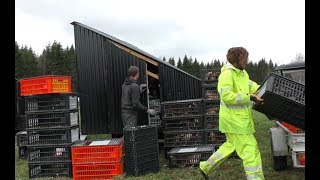
Richard Perkins unloads 1,200 pullets into eggmobiles, mobile coops that cost €1,200 each. The birds will produce 800 to 1,000 eggs daily within 3 to 4 weeks, with feed making up 35 to 40% of costs. Sweden's smallest commercial breeder raises 200,000 hens per year.
Chapters
So chickens are arriving. The truck has just pulled up and we're ready to load chickens. It's, It's obviously quite tight in the eggmobile, since pretty much the hens are only in there sleeping. There's enough roof space for them to meet organic standards. The floor space is not a lot of space. And the birds have come off a barn floor, so they're not used to being up on the perches. I notice a few jump straight up on them and we don't train them to sleep on the perches. They get the hang of that within a few days, up to a week maybe. But the birds are shut in there for a day. And I know some people like to imprint the birds on the new home for up to a week even. But because the space is limited, we want to get them out on pasture as soon as possible. So from tomorrow morning onwards, the birds are able to be outdoors and explore the paddock they have. Each of these has two 50 meter electric poultry nets powered by a mobile solar energizer. And they're moving. We'll move two eggmobiles every day, and then one the next day, two, and then one and two, and then one like this. Sometimes we move them every day if it's super wet on the ground, just to keep the ground in good condition. But typically we're on that alternating schedule and that works really well. So birds coming to us at 60 crowns ex vat, so 75 crowns with moms or VAT here. And so it's about €9,000 in birds that we created for this season. But they're going to be laying around €140,000 worth of eggs. Obviously a big part of that is the feed cost. That's the biggest cost. These eggmobiles. The one we just built was €1,200. So you can see it's a very low start. You add €150 times two for the electric net and about €300 for a good energizer that can power poultry netting, especially in longer grass, something that you really want to avoid. I've heard stories of people having to cut the grass in front of their electric fence. And this is crazy. This is what herbivores are for. The chickens are making better grass for the herbivores. The herbivores are cutting the grass for the poultry netting. It's a beautiful symbiosis. You really don't want to be messing around with cutting grass to put up poultry net. But because poultry netting is such tight squares at the bottom, it is really Easy to short it out. And there's only a couple of energizers on the market that are capable of powering two poultry nets at a time, which is about the right size, I think, for an eggmobile of this size with 400 birds in. But feed cost is obviously a big part. You know, you can set this up for super low budget. You know, one eggmobile you could set up for less than €2,000 and be turning over 45,50,000 Euros in the first year. So it's pretty neat. That's why we like this as an enterprise, particularly for people with small farms and people starting up farming. It's easy to handle. Hens and pastured eggs are the best, so it's a really nice one. But feed cost is going to come out to about 35, 40% of that dependent. That's going to vary massively. Something that we've just been exploring in the online training we've been doing is giving everyone our spreadsheets and plugging in the cost of hens, the cost of organic feed in different parts of the world, and really highlights how that enterprise is working. Obviously, in parts of Europe where you're further south, the winter isn't so harsh. I expect you'd get a higher percentage lay. These birds are not laying yet. They're 16 weeks old tomorrow and they will come in to lay in the next month. You know, in three weeks time we'll be getting maybe 800 eggs a day. Four weeks time, we'll be getting over 1,000 eggs a day. But our production is at 95% way through till November, early December, and then it starts to drop and it decreases. But if you're in a warmer climate further south in Europe, you could expect a slightly higher production during the winter months, I would imagine. So that's all the birds, 1200 chickens. So you get people buying 20 for home. Home chickens and then you get us and then you get 20,000. What's the price if you buy 20,000? Depends on where it is. And around 48, 40. How many hens do you grow every year? 200,000amonth. 200,000. And that's. You're classed as a small breeder? No, I am the smallest. You're the smallest? We are. We are about 5 companies in Sweden and I am the smallest one. And what would the next step up be if you do 200,000? 300,000 and then the other ones have millions. Millions, yeah. The poultry industry is quite wrapped up in Sweden, So I've just been feeding the birds and they're on about 60 grams a day. They're 16 weeks old tomorrow, and they'll be ramping up food up to about 130 grams in six to eight weeks when they're in full production. So it's important to think about how you're planning to increase the feed each day to scale it up to their full feed ration. And at that point, we start introducing some mill grain on top of organic layer pellets just to supplement the feed cost a bit. And they'll be out on pasture and getting a lot of insects and greens from the pasture at that point, too. It's always an interesting thing with comparing feed against the industry. Now, obviously the industry is where we get a lot of data from, because they're the only people really producing lots of data. And obviously the breed of chicken makes a big difference. But what we found is the birds don't take less feed, they actually take more because they're running around all the time. And so it's important to consider that as you're coming to get the feed. I just see Sticken, our neighbor, is coming behind me and he's taking some of the hens for his personal support. So we're gonna go and load them up. Okay, so just got seven birds for our neighbour. He's a really lovely neighbor. He used to be a dairy farmer and lives just around the corner. And he ordered some of the birds off us just to save having a separate delivery. And I've given them food and water. And yeah, I was just saying about the feeds, like, it's important to understand, like, these birds are running around. So if you're raising birds in a barn, then they obviously don't need. And often it's a climate control barn, so they don't need as much food to keep warm. Et here in this climate, in the summer, they're obviously getting a bunch of food in terms of greens and insects, but they're also running around all day, so they do expend more energy. So you need to, like, trial that for your specific circumstance. That's the recommendation I would give to anyone. But the industry is a great place to start from because they obviously have huge amount of data from all over the world and. Yeah, interesting to hear. I don't know if you caught it in the video from the breeder that was delivering the hens, but he is Sweden's smallest breeder, touring 200,000 hens a year. And the next biggest, I think there's one other breeder doing a few hundred thousand and Then the next biggest raising millions. And that's, you know, the industry is owned or run by sort of five companies here in Sweden. But good day. Got the birds in nicely. They're happy and just getting used to their spaces and I'll be moving them in the morning. I've just been putting on the water line that goes around the perimeter of each field so we can have quick release access to water to service the eggmobiles when they're moving on pasture. I just turned it on now to be able to put water in just in ordinary poultry drinkers, but once they're out on pasture, they'll have automatic waterers out in the field wherever they move. So that's it for today, just a quick video just showing the process of how we get the birds on the farm and unload them and ready in the egg mobiles. And I'll be making many updates over the season where you'll get to see how the hens are doing and what the egg production is like and what their impact is on the pasture, which is a big part of why we keep the hens. So thanks as always for watching our videos. Appreciate your likes and shares and comments. You can find out a lot more in our book Making Small Farms Work. It's a manual about how to do all this stuff. Profitable regenerative agriculture on a small scale. Particularly relevant for people in cold temperate climates, but also relevant to people in most climates, maybe the tropics. We're also now on Instagram, so make sure you follow us there. It's in the links below if you want to follow us on Instagram. I'm starting to post photos there from day to day happenings at the farm. Thanks as always. We'll see you in the next video.
More from Richard


A review of short and intensive season on a mixed farm and restaurant/event space in Sweden






Alskade Kyckling Exploring complexities of poultry production in Sweden and what we stand for


