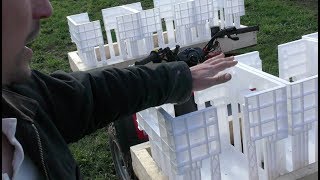
Richard Perkins prepares for pastured poultry season: repairing snow-damaged Salatin pens, testing new roller-style pens with electric fencing, and readying brooders for three batches of roughly 1,000 chicks each. He's also building a smokery, fitting a quad bike with six egg crates to collect 1,150 eggs daily, and planning to ramp feeding from 100g to 130g per bird.
Questions this video answers
Nine pens.
18 meters.
About 1,000 day-old chicks per batch (planning three batches).
About 31–32°C under the lights.
10 square meters per pen; regulation says enough for 250 chicks (he prefers ~200).
Chapters
So busy days at the farm and we're off on our new egg collection mobile to inspect the hens. And a little update today of different things going on at the farm as we get ready to ramp up product. So we've been fixing up the boiler pans. A few of them got snow damage, so we had really heavy snows this year, as you might have seen in older videos. And because we've used such lightweight wood in these, it's caused a bit of trouble. We did have support braces under some of them, but not enough, it appeared. You might remember from a video last year we did a video about making these low cost and super lightweight Celaton style pens. And it's using very thin dimension timber, even, you know, small frames, not so physically able. People can really, you know, two people can pick this up and hold it up and yet it still holds my weight if I stand in the middle of the pen. They're really good, but they're not built to take a meter of snow. Heavy ice and snow on so much roof space during the winter months. We've got nine pens up here in top field. We're going to be starting the birds up here and they still need their feeders and waterers. But it's several weeks till the birds come out and pasture yet. We've just been fixing them up, getting everything out and ready and a couple more pens to fix up. And something interesting this year, what we've done in the past year is because we're working around silver pasture lanes where we have our tree lanes and then in between each tree lane in this field, the tree lanes are at 18 meters. Then we've put in a line of chestnut and walnut with strawberry on the mulch mats you see down here and they're running. So we've got nine meters basically, so enough for three boiler pens to come through. And what's interesting in this setup is last year, if you're acutely observational, we set up the pens in a staggered formation. So we had three here, three there, three down there. So that they were timed for their movements back and forth around the pasture that they would end up at the time they would go for slaughter, they would end up where the next bunch started. Whilst that's graceful in one way for the grazing in another way, it's more beneficial for the grass and the recovery period and how we graze with the eggmobiles from top to bottom of fields for gravity reasons, in one way it's better if all the pens are in one place and it also makes the daily duties of bringing water to the pens and feeding the pens much easier. On the sides of the fields we have our field lines so we have quick release water that we can quickly fill up the buckets that supply the gravity drinkers in the pens. But this does present another logistical problem when you have all the pens in one place is when you get to the end of a tree lane, you need to then move some forward the tree lane to start the new row. So it swings and roundabouts really. But I think I'm up for trying it in this configuration. I think it could be really cool because all the watering is like within, you know, vicinity of each other and all the feeding is going to happen off the small trailer we're going to build for the back of the new quad bike that we use for egg collection. So I'm interested. We'll see how it goes. It's not set in stone that we'll do it like this, but that's what we're thinking so far. And we've set all the pens up ready for that configuration. And I think if you had a big straight field, you would obviously run them as one big batch. But we're working with 9 to 12 meter rows in all of our fields and short runs up to 100, 120 meters at the longest. So it does present some logistical challenges that you might not find in a flat straight field. But then, hey, that's not the most fun way to farm anyway. What one thing to consider that's really important is the way we set these pens up is quite different from the Salatin model. I've explained this in a lot of videos last year and you need to really consider how you run this model in your specific time, place and circumstance based on the climatic factors. You can see we have wind protection on one side and one end and we put the three roof panels on on those adjacent quarters because we have strong winds here and it's wind and wet weather that will kill young birds or certainly decrease their performance significantly. And so what's really important to remember is to move these pens along and in our case, where we're going round a tree lane to move it sideways and backwards so it's still facing the same way to the wind. I've told before on YouTube that one time we had interns that turned the pens around the tree lane, so then it became a wind trap and we lost all the birds that night in a freak storm. And I should have been, you know, hyper aware of that in that situation. But I can't keep track of everything in the height of the production season. It's just interesting. I think these are the lessons learned that are really valuable. And that's something that's a key. You know, it's an observational thing. And you need to really tailor these pens to fit your unique circumstance. So batch one of boilers we're doing in the standard pens that we've been using and batch two, and that comes three weeks later. They'll be out in the roller style pens that we made. So there'll be four pens up on wheels, all close together, fully roofed with angled roofs, and they'll be in electric fencing. We're going to run the second batch. It's the first time we've done that. So I really wanted to continue that model because last year we tested birds from 21 days old, but just I think it was 150 with one pen and a small fence. Then we tested a full batch with birds already five weeks old with four of the pens and a 50 meter and a 25 meter fence. And the reason I want to test it fully is I still think it's a great model because they have one automatic waterer and they have one big batch of feeding. Rather than measuring out feed for each pen, which is the way we've been doing it. Some people do time controlled feeding. We like to do it quite measured and scientifically, but that takes a lot of time to measure out food and to then dispense it around. And so it's a model I'm still curious about. I think with the nets as close up to the sides of the pen as they are, I'm not so worried about predators. And you can watch some old videos from last season about that if you don't know what I'm talking about. Because I think it's a model that could be really useful for many people. Using a bit of electric fencing and using the same style pens but up on bicycle wheels with a sloped roof. And the birds are getting 20% more space. That was one of the main intentions, is save us a bunch of time and give the birds more space because I think that they will enjoy that. So you can stay tuned for that. That'll be coming in the second batch later on in the season. And then due to the amount of pens we have, the third batch will either start with the original Salatin style lightweight pens we use or we'll go back to the roller pen system as well. So I'm excited for that one. This year it's Going to be an interesting process to see if we like that model and want to develop it further. Careful. Let him be. Wow, look how he moves. And he's going back under the grass. It's called a slow worm. Looks like a snake. He's a lizard with no feet. He looks very cozy under the mulch, doesn't he? What a strange creature. Wonder what he thinks of you. So, been busy in brooder and on Sunday I'm off to pick up chicks. Gonna have a thousand day old chicks arriving. So mostly set up in here. I just lime washed the walls and I've set some of the bedding and the lamps on just to warm the room up. It's been about 4 or 5 degrees in the days recently and freezing at nighttime. And we want this up at about 31, 32 under the lights when the day old chicks come. We've been contemplating how we're going to do with the different batches this year. But we're thinking of three batches of around thousand birds and we're going to build a smokery and smoke chickens. I'm going to go off hopefully towards the end of this week, maybe early next week and do a test run of smoking. Smoking chicken is more sensitive than smoking other meats because it's very easy to over salt chicken. So I'm going to be testing a few different salt balances in the brine and a few different smoking times and we're going to. Then I'm going to be doing that at a neighbor's who's an awesome guy who's been smoking meat for 30, 40 years. Going to hopefully make a video at his place because it's awesome. It's really old school in a way but really beautiful. And then we'll be building a smokery at the farm. So instead of doing more birds this year we're going to be smoking birds to increase the revenue to the desired point without actually doing birds. We're actually scaling down boilers this year. But it's looking nice in here. I'm feeling good about it. And got four pens set up. They're all 10 square meters which is enough for 250 chicks by regulation. It's optimal for 200 in my mind. I think when you get 250, when they get bigger towards the three week mark when we put them out. It's a little bit too cramped in there from my experience last year. This year I'm going with three lights over the pen. We've got enough for four on each pen but I want to See if it's enough with three just to save on energy. And also it gets quite sweltering here as the temperature outside increases. It gets a lot of thermal mass is sucked up into the walls here. These are actually, they're made a bit like cordwood. They're just stacks of split spruce logs with a mud based layer in between and then a lime plaster on the top of it. So it does suck up a lot of heat. But I'll update you on Sunday when we get the birds in and how we do with that to get the birds introduced and ready. So this is our new egg collection machine and I picked this Ozark up, it's a Suzuki Ozark and I wanted this specifically for egg collection and taking up broiler food. It's half the weight of the rhino, uses very little fuel. It's an old two wheel drive model but it's totally fine for those procedures that we're going to use it for. And you can see I've set it up for egg collection using our new egg crates. This is six egg crates each holding 180 eggs in their cartons. And that's half the day's collection. We're going to have 1150 eggs a day. And so this is perfect for coming along and picking up half the day's eggs at egg collection time and then half the eggs later on. So you have to time it well and bearing in mind that hens lay eggs at different times throughout the year, but it's an incremental change. So you again it's one of those observational processes but I really like this rigidity of these trays. To be able to pick up that many eggs a day in an easeful way and know they're not going to get damaged on transit. It's really good. I just made a basic frame that's bolted on very simply so it's quick release. You can easily take this off if we want to use the quad for other purposes. And it's attached on at all ends like that. So super nice and super easy and it's going to have less impact on the land. You can see this is we just put drainage in this gateway last year, but it's just been unprecedentedly wet this start of the season and I don't want to mash up the fields too much. We like to keep the fields in good condition. But I'm super excited for this machine this year. I think it's going to save us a bunch of fuel. It's not a huge cost but. But it's also the compaction on the ground and we want the rhino for heavy jobs where we really need that extra power. And this was a very cheap purchase and I think it's going to really pay for itself in time. Save moving from A to B. So the hens are doing fantastically. They've been here four or five days now and they're doing great. They're really exploring their paddocks and enjoying being out in the grass. I just moved these two eggmobiles at the top of the field today and the other ragmobile is down at the bottom of the field. Ragnar, careful touching the fence. That's electric. Do you remember? It's going to be painful if you touch that. He's pretty good. Learning not to touch electric fence. But it's inevitable one day, I think. But the hens are really good. I'm picking up their feed quite rapidly. I think with the cold weather we've been having, they've been needing a little bit more than they might from the barn that they've come from. And so I'm up over 100 grams a day and I'll be ramping that up to about 130 grams in the next couple of weeks. No eggs yet. It's going to be a few weeks till we get into egg production, but amazing that they've settled in and they're going to bed on their own so beautifully. I come up here right now about 8, 30 and put the work lights in just to give them some light that they can see to get back in. And then about 9, 29, 30, they're all in and they're. They've all been going in totally on their own. It's amazing to see and that saves so much work. I think it's a fantastic idea for anyone that's running an egg mobile is definitely use lights to coax them back in in the beginning. It's not something I'd be intending to do for more than a couple of weeks. I think once they're in that habit, it's no trouble. And I say that because we used to put them into the. When they would all go underneath before we used lights and we would manually put them in and it would take about a week until they're trained and they do that on their own. So I don't think I'll be using the lights for long. But the hens are really enjoying themselves. They're looking really healthy and really great. And I'm moving them now every second day. It's quite intense on the pasture, but the pasture is a bit wet now and it's also got some areas that were heavily stamped out during the winter months with the cows. So it's not all from the chickens, what you can see behind me, but the grass is really starting to kick in now that every day it's just growing a lot more. And it's really going to be benefiting from the extra manure coming from these hens. Try and catch one. Hello. So today we got our first load of grain. This is just organic wheat from another grower because we can't get any grain this year from our usual supply. He's run out and had a really bad harvest last year. And this grows really nice guy from Scheele, quite a local place to us and supplies grain to some really, really good bakeries in different parts of Sweden. But really nice guy came today with his young son and filled up with about 8 tons of grain for us. That goes to supplement the layers as well as the broilers and the pigs. And we're considering with him today because he can actually deliver twice as much. And we might build another one of these low cost silos. This is a few thousand crowns or a few hundred euros. It's basically plywood sheets with a bit of thicker free timber that we've picked up as bracing and then held in with ratchet straps. It's pretty much the cheapest way you could build a low cost silo. We have room in here for another one. But he can bring a load that would fill two of these at once and therefore halve the delivery cost. We're thinking about moving this closer to the barn door to facilitate getting the screw more maneuverable to bring the grain in. We're not going to be going through so much grain this year. We don't have many pigs this year. And it's a smaller part of the poultry enterprises because they're all specifically fed to optimize the nutrition and performance of the birds. But nice to have this full again. We've been concerned about where we would get grain from. And there's something rather pleasurable about sinking your hands into a big tub of grain. So more plantings again today and it's more cabbages and leeks and onions and tatsoi. Beautiful beds. I'm really happy with the way that this snow dig has worked for us and just putting in extra compost on the beds that are needed this year. On beds like this, we don't need extra compost and we might use chicken manure for heavy feeders. And if they don't, if there's light feeders then we'll just go with what's already there. Everything going under row cover. As I've explained in previous videos and super happy, we've had some really strong winds recently and the Caterpillar tunnels just totally unmoved. I'm really happy with them, really hoping to hear back from the supplier. I've written to them to create basically like a bill of quantities for all the different size builds ranging from 20 to 50 meters and I really hope those kits will be available soon. I think the basic kit is going to be the hoops with options for ends where you can bring the end down sharply like we have, or a more traditional end where you're just missing that last angle. Bracing ridge pole I think is optional. I think it's good for anything above 40 meters, but I think it's not necessary for 2030 meter tunnels and super happy with the way that's worked out. I really like them. I think it's a great investment for people rather than investing in bigger tunnels unless that's an important part of dual purpose farm infrastructure for you. Okay, that's it for today folks. Just a quick update. Super busy times. It's really nice for me at this time. Normally I've had interns here and I'm really focused on them till when I go to bed at night. But it's amazing for me to be on the farm every day and I'm keeping my head around things and also just being active and being engaged in project work and taking care of chores more full time myself and I'm really enjoying it. So thanks as always for watching our videos. You can find out more if you Our book Making Small Farms Work. If you haven't read that, it's a manual about how to do all this kind of stuff with a bit more technical info and data and yeah, I hope you can read that sometime. A lot of people from around the world have been really finding that useful from the feedback we get. So I look forward to the next video and I'll update you with what's going on the rest of the week. Thanks for watching, see you next time.
More from Richard


A review of short and intensive season on a mixed farm and restaurant/event space in Sweden






Alskade Kyckling Exploring complexities of poultry production in Sweden and what we stand for


