Richard Perkins (video author/uploader) argues that farmers should prioritise growing soil (microbial- and carbon-rich topsoil) over focusing narrowly on plants. He demonstrates two mechanical "kickstart" tools used on his farm — a Yeoman/keyline-type rigid-tine subsoiler (keyline plough shank) and a hand broadfork — explaining how they fracture compacted subsoil (plough pans), allow deeper root penetration and water/air movement, and accelerate soil-building when combined with holistic grazing and continuous rooting. He frames these tools as short-term aids (used a few seasons) while emphasising that living roots, plant exudates (5–50% sugars), microbiology and grazing drive long-term soil formation and carbon sequestration. Practical measurements and outcomes are cited (e.g., plough pan depth, soil gained, tool specs).
Questions this video answers
January 8, 2018.
Between 5% and 50%.
About 30 cm to each side.
About 18–20 cm deep.
Approximately 25 cm additional topsoil.
Chapters
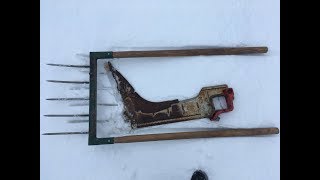
If you read a lot of market gardening books today, you see a lot about growing plants, but very little about growing soil. And soil is the basis of what we need to cultivate. We need to be microbe farmers if we want to make farms that live into the future. So today's video is about a couple of tools that we use to grow soil here on the farm. So this is the shank from our keyline plough. And this is a broad fork that we use in the market garden. And I just want to explain the function and use of these because these are tools that really helped us build soil. And they're tools that need testing in your context, because you might not need them, but they've been very useful for me. So this is part of our yeoman's plough that we imported from Australia specifically for pasture development work and for tree planting, which it's invaluable for. This is a rigid tine, non inversion plow. It's just a subsoiler. It just happens to be the best model of subsoiler out there. And that's due to the very narrow shank width, which has minimal disturbance in the soil. The shape and profile of the foot and the angle that that foot sits, it's just a very good subsoiler. And what you do when you pull this through the ground, you can see how narrow it is there. This foot explodes the soil about 30 cm to each side of it. And so what we do is we drag it through the ground below the root depth of the grasses in our pasture, about 5, 10 cm lower than the rooting depth. And think about it, what's the difference between topsoil, the living, dark organic matter, rich topsoil, and the subsoil? It's just life, air and water. So what this tool does is it smashes up the compacted subsoil. We measure the compaction around the farm with a penetrometer. And we could see that we had a plow pan about 18, 20 cm deep all over the farm. So we smashed that up to allow roots to penetrate through that. And obviously air and water can now percolate into the decompacted subsoil. And wherever plants root, they're releasing sugar, short chain carbohydrates. All plants release between 5 and 50% of their hard earned sugar that they get from photosynthesis and put that carbon in the ground. And wherever there's carbon and sugar going into the ground, you have life happening. So we're building soil from below, and that's what we do on the field scale. You'll remember the video from last season where we did some soil profile pits and we started off with 15, 18 centimeters of soil and a heavy compacted layer called a plough pan where a horse drawn plough had been pulled here for decades. We smashed that up and three seasons of subsoil ploughing and grazing our animals. Holistically planning our grazing holistically. We've now got 25cm additional topsoil. That's radical. You know, if all farms were building topsoil at that rate, we wouldn't have any carbon dioxide issues in the atmosphere. Now, do you need a keyline plough? No, you don't need a key lime plow. Plants will do this anyway and animals grazed properly on grasslands will do that on their own. But this we used as a mechanical kickstart to enable us to break up that compaction. That happened over decades very quickly. So it's a mechanical aid, it's a short term tool. We're using it for two or three years only. And typically you'd use this two or three times and then you wouldn't need to anymore. We've got 45, 50 centimeters of active topsoil. We don't need to be using this at all. What's important with this tool is that it's used alongside grazing. Just using this tool or using a broad fork in the market garden is not enough on its own. We need to get plant roots going in the ground as long as possible throughout the year, releasing sugar into the ground, that's the basis of soil building. So that brings me to the broadfork. The broadfork is a super useful tool and you could think of it as like a handheld keyline plow. Now, does a tool like this belong in a no dig garden? Well, I think so. And I draw a distinction between turning the soil over and breaking up the soil surface and aerating it from below, which is what the keyline plow does. You see in videos where the keyline plough has passed, you can barely tell it's been there. But under the ground the impact is huge. That's why we can use it for tree planting as well. If I pull this down at full depth in the ground, it's the equivalent of digging a hole about 75 cm deep, which is obviously a huge amount of work. Now when you see this one moving through the ground, we're just putting it into the ground at full depth, leaning back on it. We're not turning the soil over, we're just opening up some space in the subsoil for air and moisture to. For air and moisture to pass deeper into the ground to allow plants to root deeper, release their sugars. And then we'll move it every 20cm or so along the bed, moving backwards until we've done the whole bed. Now it's really important to understand that this is a short term tool as well. We're farming essentially old pasture that we've laid material down on the ground straight onto lawn that you see here. That's been lawn for decades and decades now. We could do this without the board fork. I have market gardens in various places just by laying materials straight on the ground. I've done it in the tropics in temperate climates and that works fine. But this, again, it's a mechanical kickstart. It's just speeding up that process. What's important when we're working with natural systems is that we understand the pattern languages because then we can start to increase the speed that things happen naturally. Whether it's regenerating a forest land by bringing all the pieces of succession together at once, or building topsoil in our vegetable productions, or our pastures or our tree plantings. Carbon being sequestered from the atmosphere and being put into the soil. That's the default of regenerative agriculture, at least in my definition. And I think it's critical. If all land managers would focused on building carbon back into their healthy living topsoils, focused on building healthy soils rather than trying to grow plants as it were, then a lot of humanity's problems would be alleviated. Climate change, pests and diseases in our crops, health in the actual food products we create. It all has its basis in the soil. So let's make this a year that we deepen our knowledge on soil and that we focus our farming efforts on soil, not the plants that we're trying to grow. Nature can take care of itself and we humans love to take a lot of credit for things that happen on their own. Like plants thriving and surviving on their own without our need. Thanks so much for watching. You can find out a lot more about keyline design and how to apply that in our book Making Small Farms Work. There's a whole chapter dedicated to how to apply the patterning of this tool. Because not only are we subsoiling and breaking up compaction, we're doing it on a very special topographic process pattern to allow water to be distributed as evenly as possible throughout the landscape. There's only a couple of people in Europe who I think truly understand the function of keyline design, and I made a really good effort in the book to lay that out in a way that people will understand. Clearly. It's a very misunderstood topic. And so it's a multifunctional tool allowing us to really address multiple landscape issues with very minimal power in a very long term context. And these are great tools. I really recommend this if you're starting out with any level of compaction in your ground, but make sure you buy a good quality version. This is from BlackBerry Lane in the UK and it's specifically built for 75 centimeter beds, but you got to buy a good one. This is about €180. It's going to go through a lot of force to move this into the ground. When we first moved here, you could only put this about 2, 2 or 3 inches into the ground. Now it goes right down at full depth with very little effort. And that's the point that you probably don't need to be using it anymore. So it's a short term strategy, a tool that allows us to get to a place we're going in an increased speed and that's awesome. It helps us grow a lot better veg. And you can see the blackness of the soil in the video I showed earlier, how quickly it's incorporating down into the ground through the action of microbiology, earthworms, etc. So tools that help us get to where we want to go, but allowing plants to do the work to allow the microbiology to do the work, that's the secret of healthy soils, healthy plants and good farming. Thanks so much for watching. See you in the next video.