S5 ● E31 Introducing 1000 Day Old Chicks to the brooder
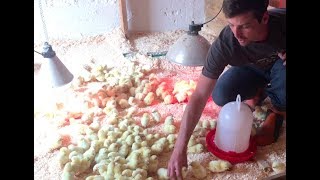
Richard Perkins brings 1,000 day-old broiler chicks from a commercial hatchery into his farm brooder. He shows how to unload them from shipping boxes, set up waterers and feeders, manage heat and lighting, and switch from open-access feed to controlled feeding after four days. This year he's running three batches instead of four to use a new smoke facility.
Questions this video answers
About 1,000 day‑old broiler chicks.
Boxes of 100 and boxes of 50.
About 28 million chicks from this hatchery per year.
About 50 million broiler chickens per year.
Four days (open access feed for four days, then controlled feeding).
Chapters
So I've been up since dawn driving and picking up the first of the year's boiler chicks. So today's video is all about how we introduce a thousand young meat birds, day old chicks into the brooder.
So this is where we interface with the industry. I mean there's two main hatcheries in Sweden producing 30 million odd chickens a year. You can see our boxes at the back. There is a very small amount compared to big orders going out for more conventional in barn product. And we've got boxes in 100 with a box of 50 on the top there. We take a few more than we hope to raise just because with this many young chicks it's natural for some to die in the very early time. Van full of chicks so these day old chicks, they've just hatched, they've never eaten or drunk anything and it's important that they keep warm now it's a warm day and they've got a few hours to sit in the van here. But that's how we've got always done and it's no problem at all. They're packed in there that they keep themselves warm and the brood is ready back at the farm. As soon as we get back to the farm, we'll be putting them out under the lights, introducing them to the waterers because they've never seen a waterer so far.
I was just talking to the guy that was signing the papers with me and he was saying they're doing 28 million chicks out of here each year and they have another hatchery further south. So in total about 50 million broiler chickens that go into the Swedish market. So I don't know know if you'll be able to hear the chirping of the chicks in the back of the van. It's quite loud in here, but maybe the engine will drown it out. There are going to be the first of three, possibly four batches. We're thinking to do less birds this year, so we might just do three batches because of the smoke facility that we're going to build. It's going to be able to drive up the revenue without doing more birds. And it's nice to have different work to do. It's still work to smoke the birds obviously, but it's nice to have a different work to do rather than just keep scaling things up. So that feels good this year. The birds are fine in the back there. It's nice weather outside today and so the van is adequate temperature and because the boxes are quite small, they're all huddled up in there and they're fine for quite a few hours. They're often going in vans and trucks to places all over Sweden. So some of them will have a 10 hour drive ahead of them starting anytime several hours after they've hatched. And in the old days they used to send day old chicks in post, so they're pretty resilient little things. And then once they get to their destination, it's important then to really get them to learn where the water is. We don't use nipple waterers, we're using simple waterers. So it's a lot of inspection and making sure they're kept clean. The cleanness of the fresh water is super important for all poultry. Particularly critical when the birds are so young. And it's more important than food at this stage. Open access food for four days and then we go on to our controlled feeding regime for this group of birds. The next group of birds we're thinking to raise in the Mobile Ridgedale Rollers or whatever they're going to be called. Still haven't decided the name of them. But then they'll be getting batch food and batch automatic water. So hoping to reduce the workload of manually servicing every individual pen. So that'll come in the second batch. So long drive home now. Picking up Johanna. She's been in Stockholm visiting Franz. I'm picking her up on a slight detour and back to the farm to unload the birds.
Last year we had four lamps in the square. It might be we need the extra heat that we need to add another one. One thing we neglected to do was bring the compressed air and blow the dust off here. That's something we want to do regularly between the batches to stop any risk of fire. I think it's going to be fine right now, but we'll do it next time. So the way we get them out the boxes is to throw them with confidence to get the box out and then we do. So that's 100 and then 200 and then there's a box with 50, so we'll put like 12 in each. Just split them up. But it's better for the birds. It seems a bit violent at Rowan, but it's better for them than you picking up each one individually. They're not designed to be picked up or they're eating already, so they're not. Food is not so critical right now. They're going to have open access to food. What's really critical is that this material is easy enough for them to walk around them, but then we introduce them to water. So you pick them up, they're beeping the water and we do that like at least 1 in 20, 1 in 30. But if you do it to like 50 birds, then they know that that is water and they will teach the other ones really quickly. You see this one is drinking on its own. They've got to learn from each other which one's which. So we do like 20 birds over here and then do some over here. And what's critical now is going to be keeping water is clean. So the people on broodery, it's like 6:30, 9 o', clock, 12 o', clock, 3 o', clock, 6 o', clock, 9 o' clock at night again keeping, you know, you need to maintain the water very clean. And it's fun this beginning bit when they're so cute, but they quickly start growing and they're not so pretty in the weeks time they start getting feathers, they start smelling, they start shedding exponentially. And so another job is to keep the bedding clean. And so after like a few days when they start to ship a lot more, after 4 days we go on to restricted feed. So we're measuring the feed very specifically and you have to really observe with these birds because they grow very quickly and their behavior can change very quickly too. So you need to really look like you don't want them jumping in it, but you need to know they can reach it. And then what happens after like four days is that we keep measuring the temperature. And that's something you do every time you come in here. You change the water every time it's dirty. So it's a lot of like observation. And then we start to lift the lights up over the next weeks.
Because.
Basically we want them out in three weeks time on pasta. They'll weigh about 250 grams. They'll be quite ugly because they'll have feathers, but not all their feathers. They'll be very hungry and very aggressive. Like right now they don't care about food. But in a few days time when you come feed them, they all go and they just eat. In eight weeks they'll be four kilos. You can't imagine how quick they grow of. You observe it. It's about 33, 34. It's perfect. It's like we're not let see, they go for the ducks. Like it's. We're not measuring the bedding, we're measuring the backs of the birds. That's the only accurate way we can. So today we want about 33. So it's perfect. The industry would always raise them to four weeks old before they put them out. We want them to go out as early as they can because they forage better. So we start in the last week. We might give them turfs of grass so we can combine that with weeding around the edges of the gardens, like where the grass meets any of the garden beds. We can cut that grass and come put it in here. And it just gives them a chance to get used to, like, standing on grass, which they've obviously never seen before. So birds are settling in. It's largely an observational task now to really check that the water's good and the birds are good and happy. And it's a five times a day minimum thing. Probably six, seven times a day. When they're first in and then up about 10 days old, we go down to four feedings a day. And then when they're out in the field at 21 days, we go down to three watering and feeding sessions per day. So lots of attention in the beginning, lots of learning about the birds for people that are unfamiliar to this and like all things, it's observational based, so you've really got to check in and there's a lot of young birds in here, so you've got to put the time in to really make sure everything's working well. Something I wanted to bring your attention to is the pastured poultry masterclass weekend we're running on the 7th and 8th of July, and participants can arrive at midday the day before on the Friday for a big farm tour. Looking at all the other systems at the farm and understanding a bit more of the context of how we approach farm design and regenerative agriculture. And we're gonna have one day fully on broilers. Start by putting some birds in, hopefully the new smokery, so we can have a feast on the Sunday night. And we'll be looking at all aspects of raising broilers in a brooder, how to build pens, considerations, different designs for different climatic conditions, and get really into the details of how to run that enterprise. We'll be giving participants all the spreadsheets and facts and figures and data sheets of HSCC plans, how to run a slaughtery, etc. And we won't be doing a full slaughter session, but we'll look at how that works and definitely get our hands in there, you know, as a small demo. And then the second day on the Sunday, we'll be looking at the parsute layer operation, how to build eggmobiles, different considerations for that, looking at the numbers, facts and figures again and looking at egg packeries and talking about marketing and sales of all these products, it's a really interesting one for us. We've never done a pastured poultry short intensive course. It's the only short course we're doing this year other than the two day market garden course at the end of the year. And our short course with Curtis Stone, the urban farmer, still got tickets for the one day event in Stockholm. So those of you that want to meet Curtis and I and hear about two very different approaches to small farms. One, ultra urban and aimed at, you know, much wider marketplace, high value vegetables, high intensity, quick rotations in the short climate up in Canada and then us in, you know, a larger farm, but a very small farm in modern terms, but really in a very rural location. And both farms working and able to provide good income from a lifestyle that enriches other people with good quality food. So really excited to have Curtis over and you can come for the one day event in Stockholm. Still got a bunch of seats available for that at the conference center down on the waterfront in Stockholm. So links are below for the events and you can sign up from the pages that you see in the links there. That's it for today, folks. This is a quick video of how we bring the birds and get them settled into the Buddha. There'll be many updates throughout the season as we raise subsequent batches of boilers and have some out in the field and we'll be showing you through that whole process. Thanks as always for watching the videos. You can find out a lot more technical details in our book Making Small Farms Work, which we send out directly from the farm, from me to you and we'll see you in the next video.
More from Richard


A review of short and intensive season on a mixed farm and restaurant/event space in Sweden






Alskade Kyckling Exploring complexities of poultry production in Sweden and what we stand for


