S5 ● E32 A whole farm update as the sun returns
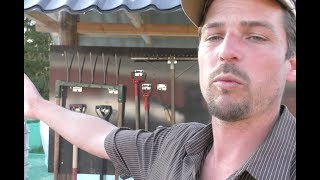
Richard Perkins walks through spring projects on his farm: building a smokery to process 50 birds per level, moving eggmobiles to Nutfield with a new culvert, direct-seeding radishes and carrots with a six-row seeder, pumping 4 cubic meters per hour from a pond for irrigation, and planting around 1,000 tomatoes.
Chapters
So spring has really sprung upon us in the last two or three days. The temperature's gone up and all the trees have gone into leaf, so it's looking beautiful around and life is coming back to the countryside. Quick update today of various things that are going on this week at the farm. Picking up smoked chicken. Beautiful. It smells amazing. So that was 22, 24 hours in this?
Yeah, yeah. 12 o' clock yesterday. I switch after electricity, so chickens look.
Like they came out fantastic. We'll do a taste test later. We're leaving some with urine for his taste testing too, and he's just fetching an old sauna heater, which is what we're going to use in the construction of our smokery, which I hope we get on with quite soon. Now.
Be careful for the thermostat so it not broke.
So this little old sauna heater, it can run 2.2 kilowatts on. On single phase. It can also be run on three phase, but it's got the thermostat and it's got a timer. Timer only goes to nine hours there and we're smoking 22, 24 hours. So someone has to wake up at five in the morning.
We can break it, take it away, take it away. Make a shortcut between so that you don't have the timer.
Perfect. Can you catch one? Go on, catch one. So with this rise in temperature, the grass has really started to grow now and the hens are doing fantastic. We've been really impressed with how well they've taken to the land and going to bed on their own. Perfectly. From day one, it's been fantastic. Still no eggs yet. That comes in time. And it's interesting. Always when you get your first couple of eggs and then you know it's coming because it goes exponentially. Next day you have 86, next day you have 470, and then suddenly you're up to a thousand. Not very long after, but birds are doing fantastic. And so I'm looking forward to clearing the old flock out and clearing out the tunnel now and really getting these birds moving around. We're going. Something we're doing this year is trying to build a culvert to allow us to take the eggmobiles right to the top of Nutfield, which we've never been able to do. I'm not sure if you can make it out on drone footage, but we took broilers down that stretch for the first time last year and it's made a radical impact just having broilers pass over it Once, but there's quite a marsh area down here where they've tried to drain the field before and it didn't really work. And so what we want to do is put a pipe through and put some gravel to make a crossing that's capable of carrying the eggmobiles over it and take the birds right up there, because I think it will do wonders for the ground up there, which is trying to turn back to sort of birchy and sprucey forest again. But we would like to, you know, keep it in good health and really look at building the ground like we have here. It's amazing to see just a couple of days of sun now has really kicked growth in and we'll be moving after this field into top field and going jumping ahead of the first batch of broilers. I think you can see really clearly here this line where the birds have been. It might be easier to show you down here. I'm not sure how that's going to come out on the screen, but I think you'll see very clearly the division there. And it's been quite wet when the birds were here, so they have had a bit of impact. And here you see where they sat overnight. Obviously there's a high intensity of manure here, which will become a very green, thick, abundant patch of grass later on. But still got about a week of moves in here, hopefully before we move down to Nutfield and start the procession there. We're going to get the cows out on to Kent's land, the first of the neighbours paddocks in about four days now and we're going to start really grazing fast around their land and just take the tops off everything so not to stunt the grass and give our grass enough time to really get going to then come back in and graze to clear the land ahead of the poultry. You're upstairs, cool with the swallows. Essie, you've been direct seeding Toby? Yes. So we seeded six row seeder, six.
Row seeder in action. Seeded two beds of radish, two beds of carrots, one bed of turnip, two more beds of carrots over there and two more beds of turnips there too. And then we planted a little bit more radish there too.
Awesome. What do you think of the 6? 4 cedar.
I'm getting along with it, so I'm getting like.
I'm slowly.
Till now I was. I use the Jang a lot, the Jang cedar. And so they see a little bit more calibration.
A little fiddly? No, A little fiddly.
Yeah, so, and it's like you, you can see the, like you have to be more careful when you go over the bed to push it. So the jang is a little bit more forgiving.
Rough and ready.
Yeah, rough and ready. But yeah, so we, I see like getting along with it.
We got some great crops germinating really nicely. There's a few that Apache, some of the radish. Yeah, yeah. But there' some really nice beds. We'll go and take a look.
The mescaline looks really good.
Yeah, things are really coming along. If we look at the landscape here on the drone, you see all the trees are just coming into leaf and it's looking like summer just feels like it's really suddenly come upon us. So we have the insect nets out on some of the Brassica crops. This is scarlet frills. It's germinated very nicely. And this is. We're in here in the caterpillar tunnel. And the caterpillar tunnels, I've heard a little bit of an update waiting to hear on pricing for them, but they're not going to be advertised straight away on first tunnels websites. They're going to basically go through word of mouth, through me telling you about them here on YouTube and they're going to just trial it out for a little while as they build up comprehensive instruction installation manuals which we're going to help them with and then they'll see how that goes and whether they add that to their product list, hopefully this summer. But waiting for pricing before I tell you more about that. So in this tunnel there's a couple of beds of mescaline and some really nice visual reference to the cedars, this rocket and you see the sort of density and spacing that you can get with the six row cedar. Carla's been putting these in. Very happy with them, very happy with the tunnels. Thing that's been going on in the gardens is putting up these tool racks to keep some of the primary tools right out in the garden bed. So we have one here in the north beds, where the majority of our beds are on both sides here. And on here there's the broad fork and the rake, which is 75 centimeter rake, couple of oscillating hose and Korean hose. And then there's going to be a bunch of our hoops. So we use a 4 millimeter wire to hold up fleeces. So we'll have a couple of them spaced on here. And we've got a bed roller for each set of beds too. So that's going to Hang on here too. And then what we're thinking, because we've got all this roof space to hide things under on this side. We're going to put a lot of the fleeces and the rolled up row covers as they come off the beds, just for ease of access and just really quick and efficient use of materials in the guns. But these have been really nice. They've been having a fun time jointing up the wood. These are actually old telegraph poles from the electric lines they took down in the wintertime, remember from old videos. And so we're just reusing them to make some nice structures that also keep a lot of mud and wet out of the workshop. Often we're doing engineering or carpentry projects in there and the garden gang is always bringing in a lot of mud. And I think it's a much nicer solution to have the tools right in the garden where we actually want them for reference. Toolboard 2 is going up in the south beds just outside the small tunnel where we do our cucumbers. And that gives tools access to east and west and south beds down here. It will also have the gear for the greenhouse, like pruning scissors and different harvest gear on there too. Tomatoes are really coming up now still in here under these halide lights. We're taking the old laying flock this week so that we can get that cleared out and beds prepped and wires strained and get these tomatoes in. They're in very small pots and they're starting to get a little bit too. Either we need to put sticks on them or get them in the ground now. So we're hoping in the next week we'll have these out in the tunnel and have them starting to be strung up. It's a bunch of work. A thousand tomatoes in the tunnel this year, but it's going well. It's getting to crunch time now though. So we've been pretty happy with the irrigation at the market gardens. Using the big pond that we created down the bottom for irrigation, pumping up to risers that we were moving around the gardens. But now we have a much better idea of like where is best to position these. They have impact heads on them that can spray with a radius of up to 25 meters, depending obviously how many you have connected at a time. And they spin 360 or you can, you know, limit the angle they turn at to whatever you want. So we purchased a bunch more this year. This time instead of the cross based risers, we went for spiked risers so that you can just stick them in in the pathways, wherever in the configuration you want. And we bought more because we wanted to leave them up permanently in the summer. So you always have four in each set of beds, so you're not moving pipe and things around the garden. Obviously they might need moving. For example, in the new north beds where we are now, you'd need to set these up, four of them in a row, and move them again to hop over a load of beds to water at the back. But that's far less work and far less time consuming than moving things all the way across the ground gardens. Still figuring out how to do best with the caterpillar tunnels, but now we have the pump set up. We've been using the irrigation already because it's gone up to 20 degrees or so the last few four, three, four days. But something that's nice is once the pumps all set up, we have some really nice irrigation wands. And when you put those on the pump, the pump we have down at the pond There is pumping 4 cubic meters an hour. So it's really efficient way to hand water. Things like in the tunnel where we can't get the spray irrigation in at certain times. So spinach is coming on. We've had some harvest off that already. And lettuce is here. We've got some nice growth coming now the temperature's gone up a bit. Something we're adding this year that we just neglected to do in the past couple of years is putting automatic venting at the ends of both tunnels, which is going to be great for maintaining the environment, but also for the livestock. So we're just making some frames and getting them in later in this week. So chicks are all settled in really nicely. They got a bit nervous with my voice there, but temperature is holding really well. Up until this time, no beddings needed to be added, but now's the time where you need to start adding a little bit of bedding daily. And that goes exponentially as the birds grow. And they eat much more and they shit much more, obviously. But it's interesting, last year it was so cold, it was snowing this time last year, and well into the time when we took the birds outside for the first time, it feels like winter stayed a bit longer this year, but now it feels like it's really gone and we're going straight into summer. So it's interesting because we had a gas heater burning in here as well as a fan heater to keep the room up at temperature. But this year it's a lot cooler in the actual Building, but it feels really good. I think the birds are doing really well. Just lost three in the days they've been here, which is totally normal with this many birds. But they look really healthy. They're feeding well, eating, drinking perfectly. And it feels nice. It's not so stifling in here as it was last year, where we had this nervousness to get the temperature up in here. And it was. It was kind of. Yeah, it was a bit stifling in the end. It feels much nicer to have a cooler outside sort of temperature with hot areas that the birds can go in. So I much prefer this year's setup where the lamps are. You know, three lamps is proving adequate for each of the pens here. So on the chicken front, we brought back some smoked chickens from Uran from the video a couple of videos ago. And my feeling was that they were not salty enough and they were not smoky enough. And I think some of the problem could have been the birds were not fully defrosted in the breast meat. And we were doing the test on the fly a bit. So I think that's a big part of the error because obviously if there's any ice in the meat, it can't absorb salt. So I think that was a big part of it because in the legs and wings and in some of the birds, they're fine. So more testing to do. But I spoke with Johan about it and we decided because we've started building our smokery, it's better that we get this built and start experimenting here, because each smokery will be different in its behavior, the way the temperature works, the way the smoke works. So it's better. Now we just finish this and start testing the salts. We know the salt balance is good and we can start to really test the temperature and smoke facility that we have here. So this has just started today. We've got the basin. So now we're standing on the pad outside the slaughtery. So this is the clean room in the slaughtery. So the birds are chilling in the chiller just in there. And so part of the protocol when we were talking with Joran, they wanted to have some hard, cleanable surface that you could walk across to put the birds into the smokery. So you can't just take birds out of a clean refrigerator space and walk across a farmyard and go stick them in a smoker. It was part of the regulation. You had to have a cleanable floor to walk across. So that's fair enough. And that's right outside the slaughtery. So that feels Like a good place for it. We've gone for about 120 by 210 internal. No, sorry, that's incorrect. It's about 1 meter by 210 internal. And we want to know that we can smoke at least 50 birds on one level. Now, you can smoke with things on multiple levels, but you've got to bear in mind the temperature might variate if it's up here at about 2 meters off the ground and then half a meter lower, you might get an 8 to 10 degree temperature difference. And that's a problem because you're trying to bring all the birds to certain inner core temperature to know that they're cooked and safe to go out as a product. And it just brings a bit of logistical nightmare if they're at different levels and you've got to probe each bird to know it's reached temperature. But then the top birds are going to be getting dry. You don't want to be opening the door and moving things around. So we've made it a little bigger than we originally had the plans down on paper, but I think it's a good move. You can see here we've got a doorway 75cm wide here and it's basically going to be a step through and head height door up here is going to plug into the electric on the socket there and it's going to have some permanent poles that you can hang the birds off and then some removable poles in the doorway space to allow easy access. It's going to have another couple of layers of brick and then it's going to be a wood frame on top using free wood that we collected last year. Then it's going to be really well insulated inside the wall with wood cladding on both the inside and the outside. And so it's going to be nice thick timber that we have here to make the cladding. And it's really important it's well insulated because especially if you're going to use this in the wintertime, you need to know that you can reach temperature and maintain it efficiently. So that's going on. Hope to get that built really quickly now, but we're going to spend one day this week taking the old hens flock and we're going to be processing and freezing down those birds. We're thinking we're going to. We might sell some as stewing hens, but we might make stock in a commercial kitchen and have that as a product that we sell throughout the year and through the winter. Also, Felix has been up here Testing the broiler waterers, because the automatic waters have little springs in there and little sieves that keep the water clean that you need to check and maintain. So just testing ahead of time so we don't get any surprises. When the birds come up, can really see what the last few days have done. The gooseberries coming in here and we got the cows taking their last days in the pig paddock. You can just see behind and they'll be making their way over to the neighbor's land through our riparian and off on their march around the land. There's quite a few hectares that they'll be going through really quickly there. But you can really see some really nice pasture is going to be waiting here for the boilers. Now, it's looking great up here and it's going to be probably three, four weeks till the cows come back round. And they won't come in here first, they'll go through Nut Hill first. So it will be quite some weeks till the cows come through here and at that point the grass will be right up over knee high. I'm sure we have the cows up here in the pig paddock and part of the aim here is a to keep them off our pasture till it's time that they can graze it without stunning the grass too much. But it's also to clear some of the lower vegetation to allow more light to the ground for grass to get growing. All this will be grassed over later in the year and it's important to us as we start to transition all of this land back to more diverse agroforestry. So you've probably heard me say many times, we're cutting the big trees later in the season, probably in the wintertime. And so this is. I want this to come back to diverse grazing, but with a lot of trees over the top. And it's just changing really nicely in this part of the land where we've had pigs for more often. There's been pigs in here until recently, so some of it's still quite dug over, but a lot of grass is out here over the back, and the cows and sheep do a really good job of just thinning all the lower leaves. That will allow a bit more light through, which allows more grasses and forbs to get going. And this was like quite acidic spruce floor when we came here. And it's really like all the different pasture, forbs and herbs coming back of their own accord. So the seed bank is always present and ready. It's the little climatic triggers that can help steer things that we're trying to work with. So I'm happy with the progress in there. It's really nice to see. So that's it for today folks, just a quick update. This time of year is when we get into a whole bunch of different projects, so just keeping you up to date with some of that going on and we're getting a mini digger in, doing a bunch of new water lines, putting in winter water, frost free water to a bunch of places and starting to make our compost once the hens have gone and making, you know, probably 70, 80 cubic meters of compost, which I'm excited for as part of our long term, taking the gardens off grid as it were. But busy time of year and so I'm just trying to keep feeding little updates with what's going on as we start boosting up production and getting into the season as it were. Don't forget to click, subscribe and like the channel. If you enjoy the videos, look here you can buy our book Making Small Farms Work. People say it's awesome. People have been changing their farms according to it had a really nice message the other day, like people surprised just how much information's in there. It's a manual for how to do this kind of stuff with lots of technical details and I've tried to make it super informational dense. This is the only place you can buy the book. It's not online through Amazon, any of those things because we don't really believe in that. We're thinking, hey, we'll send the book to you directly from the farmer to you. Hope you enjoy it and that's a great way for you to support us also. So thanks so much for everyone that's been reading that and giving us feedback from all over the world. It's been out to 90 odd countries around the world, which is amazing considering we're in the middle of nowhere in Little Vermland in the middle of Sweden, right in the far north at 59 degrees. So thanks for your support with that. It's amazing and you can find out more about trainings in the links below. There's a few trainings with a few spots left open at the farm. Hope to meet some of you this summer Open Days. Thanks so much for watching. We'll see you in the next video.
More from Richard


A review of short and intensive season on a mixed farm and restaurant/event space in Sweden






Alskade Kyckling Exploring complexities of poultry production in Sweden and what we stand for


