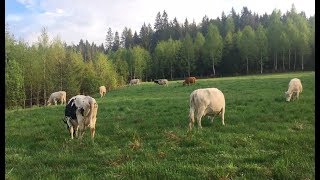
Richard and Johanna butcher their first cow at home, breaking down the carcass into cuts like rump and fillet, packing mince, and saving bones for broth. They also show livestock movements around the farm and progress on a new smokery and culvert.
Questions this video answers
May 12, 2018
Chapters
Today we're picking up one of our cows. So we come to butcher one of our cows. We're just doing the mince and we have some nice cats here. What have we got, Johanna?
Well, here we have what is called in Swedish back beef.
Rig beef.
Yeah. This is called in Swedish rule roll. I think it's something. It sits here somewhere. The outer pie entrecoat. The nice bit is a bit. It's quite high fat so it needs to be eaten a bit more quick than other bits. Filet roast, maybe Roast fillet. Yeah. Francisca. Do you know in English? Yeah, yeah.
Like the rump steak. Quite a lot of meat to keep us going. And we'll have a couple of the bull casks to slaughter later in the year. So the slaughtery that the cows were in is not an official slaughtery. This is meat that's not for sale. It's for us to eat privately and it's for wild game that's common in villages in Sweden for people to take down wild boar and deer and elk and things. And those guys are awesome. They helped us with a big 210 kilo sow a couple of years ago and they're of the old school where they come round with the tractor and help move the animal and just help out and just want a crate of beer for helping. So it's really lovely to have some of those old people in the village. We've packed this mince down into packs of what we anticipate using. So you have to think it through a bit of, you know how you're going to use this. This is enough meat for a family for at least a year. And we also have freezers full of pork and chicken and ducks and other things. So we have plenty of meat. Got some filleting to do. And the guys are working on chopping down bones for making bone broth. We got bones for boiling down, making bone broth. Super nutrient dense broth. Still got some butchering to do. All the mince is in the freezer now. I'll be butchering this down ready for all the different meals that we plan for later in the year. So the cows are out and enjoying the grass. Really nice to see the cows, like zooming around, just taking the tops off everything. They're going to be moving really fast through the property of the neighbour. In about two weeks they're going to be back around here and actually coming into Nutfield again up here. We've started building the culvert now across the ditch there. We need to bring a Lot of gravel up. It's going to be some heavy work, so hopefully not. Not at the weekend, but we'll try and get the eggmobiles up there, I think. And you can see the ground is really recovering where the eggman bills have already been. You can see across on the hill where they were when it was quite wet, but now they're enjoying the grass. The hens are really happy. They're ranging all across their paddocks now and just waiting for eg. So a little update on the smokery. We've still got quite some work to do, but it's come on a lot. I put a day into it yesterday and build up the main building and just show you how it's going to be inside. So it's got a big old insulated door and then a metal plate that sits in front of the door down here and haven't finished inside. I wonder if it'll be light enough, but we're basically clad with wood so far and a lot of insulation behind that give you a sense of the size of the building. But I'm thinking of mounting this. This is old floor we got left from the eggmobiles and I was going to originally have rails across that you hang hooks with the chicken suspended on, but I think I might put this mesh that fits quite perfectly in the roof so that you can really hang hooks anywhere that you like and really position them well. So quite happy with the progress yesterday and nice to have a well insulated door. But then it's got air gaps at the top which is where smoke will come out of. So just getting the slaughtery up and ready for taking the old laying hens, which we'll be doing Monday and Tuesday. Just checking everything works, all the heating's working, all the water systems, check the chiller works. We're going to be scalding for a bit longer. With hens, we usually do about a minute 15 for broilers and they're usually set up at like 62 degrees, something like that. But with laying hens, they're older birds and the feathers are a lot more stuck in there. So we'll be scalding for perhaps half a minute longer and yeah, excited to get this place rolling again for the season. So we're in the brooder lights are off right now because it's just so warm in here. And then at night time, if they need to come back on, they're back on. Birds are growing well, doing fine. Here in the workshop. And last year swallows made nests on this gas hose and we needed the gas hose, so it's a bit unfortunate, but this year, you see, they've conveniently come back and made the nest on this old floor scraper, so we don't need that. So I'm very happy to see the swallows back. It's just a quick update and having a weekend off, I'm going fishing this afternoon. Thanks, as always, for watching our videos and you can find out more in our book, Making Small Farms Work. See you in the next video.