S5 ● E35 Out with Hens, in with Tomato crops...
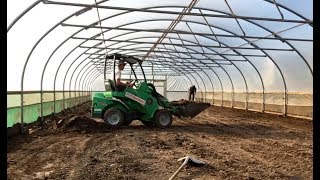
Richard Perkins provides a farm update covering greenhouse preparation for tomatoes, eggmobile movements, broiler husbandry, compost production, and landscape management. He describes preparing eight permanent tomato beds (75 cm wide), cleaning the greenhouse, making compost windrows, and planning to string high-tensile supports for tomato trellising. He reports poultry operations (eggmobile moves taking ~30 minutes for two, 22 minutes solo for one), brooder status (day 11, lights off day/night during a warm spell up to ~24°C), and timing the follow of eggmobiles approximately 96 hours after cattle for optimal maggot peak. The video also covers windbreak/tree planting progress, pasture recovery, pond/irrigation details, and upcoming farm events and courses.
Questions this video answers
75 centimeters
22 minutes
About 30 minutes (half an hour)
Day 11
Up to 24°C
Chapters
So we had a successful couple of days in the slaughtery. It's all packed away and cleaned down, ready for broilers in five or so weeks time. And now we've cleaned out the greenhouse and we're preparing for the tomatoes for the season. Sam. So first time ever that we've got the eggmobiles right up here in the top of Nutfield. And it's a little bit sketchy on my culvert. The way the culvert's built is in a little dip and then a little bridge essentially, and it goes up again. So what tends to happen is the bottom of the slope, the eggmobile's back end is facing upwards due to the connection to the rhino. But then as you go off again uphill, it kinks it back down. So the bottom end tends to kink into the ground a bit, which is not ideal. So I can see the marks and I had Toby watching, so I can see what needs doing to fix there. Talking about time in motion studies. Anyone that follows our channel regularly will know that we're really into like perfecting the movements and efficiency of what we're doing every day, which is, you know, times the limiting factor. And so a lot about farming is remembering the carry stuff from A to B to put things in the right place for the next use, clean things, sort things out, and just use like optimal motions to do any task that you have to repeat. Interestingly, just with the first week with Toby and I working on eggmobiles, even on a day where we're moving both eggmobiles, so one day we're moving one egg mobile, one day we're moving two and just opening and feeding the other one. But even on the busier day with two moves where we're changing the nets and moving the eggmobile, setting it all up again, moving waters, energizers. It's still taking us only half an hour to open one and move two completely. So that's pretty good. I mean, it might get a little faster, but it took me 22 minutes on my own to do one and open the other. So I think to move two in half an hour is fantastic. And you don't need to be any quicker than that. We have time in the morning, so good efforts. And yeah, it's really great working with Toby at the moment on eggs. And he's a smart young kid and he's only 21, but he's got a real appetite for learning and understanding regenerative agriculture and is on a fantastic path. I see he's very likely to go off and start his own project or a collaboration with others. So I'm really enjoying that time sunbathing. So today we're clearing out the big tunnel in preparation for tomatoes and we've hired this little machine. It's not very good. It's not got any traction on the wheels, it's got bold tires. But we're starting to make our compost windrows. It. So we got the greenhouse all clean. Toby's been pressure washing to get rid of some of the dust. Chickens are incredibly dusty. And now we're measuring up for we're thinking eight full size beds, 75 centimeter beds because we will be growing crops on the sides of the tomatoes. We're north to south here which makes that ideal. But also it's such a slow start to the season with tomatoes. It takes them quite a while to get up. So. So we have plenty of time to be growing different herbs, basil and even things like beets and lettuces alongside. So in the polytunnel we're going to be putting down some of the older cow and chicken compost that we use on the no dig beds. And it's because we know it's matured and it's not going to be any risk to to the thousand tomatoes that we've got to put in the chicken bedding we pulled out. Is some of it still fresh? I mean we just took the birds out a couple of days ago so I don't want to risk that. And I'd like to see that mixed with cow bedding and left to mature for a year before we use that. And it's enough for all the greenhouses and the entire market gardens to have all the compost they could need next year. So going to try and look after that well and manage it well and get these tomatoes out soon. Hopefully in the next couple of days. We'll have strung up the high tensile wires that hang the strings and we'll be planting them with the strings straight away because they're getting quite big and leggy in here. We'll do a row of tomatillo too and yeah, just see how that goes. So we're going for eight permanent beds in here that are being broad forked. Toby's on board fork and putting down more compost on top of those beds. We've managed to get quite a decent amount of compost out of here. We didn't want to use this material, it's too fresh that we risk burning our plants. But this is mostly peat moss. It's got a little bit of wood shavings, a lot of chicken manure. The machine we use to clear this is not strong enough to take the cow bedding, which is quite wet and compacted, and it just doesn't have the grip or capacity to lift it. So we're going to wait to pull that stuff out of here and we'll be adding it to these windrows and mixing and turning these a few times this season to make a very large amount of compost that will take the gardens off grid, which we're super excited for. So it's day 11 in the brooder and we've got lights off day and night. Right now it's too warm. We're having this hot spell with up to 24 degrees in the daytime. As you can see, the birds are really growing. It's always funny if you're working with the broilers and coming in here five, six times every day, you don't really notice how quickly they're growing, but they've become ravenous and putting in bedding very regularly now to keep them all clean. They're doing really good. We've had some issue in pen three, which is right at the back here, with a few pecking each other. Now, that happened last year at week three, and we had to get the birds outside when we had up to 250 in each pen. You can see they've got blue spray to cover any red sores, because chickens just instinctively want to peck when they see any blood spots and they'll peck each other to death if you don't do anything about it. Now, I've never seen it in birds this young. I don't think it's from overcrowding because we've had 250 birds in a pen this size and I have seen it before last year, but that was when they were another 10 days older and much bigger and a bit more cramped. I think it's actually to do with sunlight because this pen actually gets the late evening sun and if you observe chicks really closely, they're very much more active with light. This pen currently has sun and there's a distinct difference between the activity. Chickens are very sensitive to light, like all animals, but you see that when you with the layers as well. But you see it particularly if you turn the lights off at night. The birds really calm down a lot and they're really active and sensitive to their daily cycles, like all creatures, but particularly, it seems, we're the birds. So I think the late evening sun has been affecting them. But it seems that covering them up with the blue spray has done the job. They've not been opening up new wounds. And you see it's just a few of them here. Other than that, it's all going really well in here. And really happy with the setup this year. Looking forward to getting these birds out on pasture very soon. So for the first two and a bit weeks, the birds are just on organic starter. We buy organic certified feeds for any animals that we buy feed in for. And we're not certified organic as I've talked about in other videos. But we believe in going beyond organic if we can. But they will start to get a mix of grain as the birds go out on pasture at three weeks typically. And soon we'll start cutting grass turfs and putting them in the pens with the birds so they get used to standing on grass and pecking at it. And we find that they forage better in that rate. Something you start to see with birds at this age is they start to try and catch flies. If there's any flies or mosquitoes in here. I just say that because I saw one just against the wall catching a fly there. But they've become much more inquisitive. I'll just take the thermometer here and show you. This is a laser thermometer we use for measuring the birds on the back of their birds temperature. If I shine this in here, you see the birds are very curious. I think you'll probably make that out on the film. I've been going around inspecting some of the willow cuttings that we put in last year. They're still very small. I'm walking now in the more established windbreak on the south side of the farm where the willows up at about 6, 7 meters. And these are the alder that we put in a couple of years ago as 80 centimeter whips. Some of these are up 3, 4 meters now. And we have spruce every meter on the inside that's growing up pretty well in places you can see down here. So that will grow into a thick bush that gives us winter protection. It's very windy here in the winter too. But it's really nice to see just how quickly this does shoots up. We cut every alternate lane of the willow last year. You can see that's popping back up now. But really enjoying seeing the spring come so fast. And you'll see on the aerial footage it's just gone so green now. And everything is really shot into life. All of the berry bushes and trees are Coming into flower. It's going to be a wonderful year for berries again. Thick with blackcurrant blossoms and pasture is doing really good. We've got some interesting trees that are coming in. This is honeyberry. Delicious edible. And, yeah, it's looking great. I'm really looking forward to the grazing this year with the cows. We've got some really nice pasture that's just. Yeah, it's amazing to see how it's developed over the last few years as we've really planned our grazing and with the benefits of all the poultry, too. So things coming along quite well in the gardens. It's. We've sold some lettuce heads and salad already. Gonna have radish next week, by the looks of things. And things are generally doing okay. Flea beetles have come back and so we've got a bit of damage in some of the Asian greens, which is typical at this time of year, even with insect netting. You see, there's also a bit of slug damage, but nothing severe. It's all quite manageable. But, yeah, it's looking great out here. We've been still playing around with irrigation. There's a lot of irrigation recently because it's just been so hot and dry. But we've got different salad greens coming up now that will be going on to the market soon and meetings with chefs that are taking place to establish what we're putting aside for restaurant customers this year. But it's beginning to look really beautiful. It's not long now until the gardens are fully planted out. There's still a few beds patched here and there that are not planted out yet. But very soon come the cucumber transplants and the tomatoes in the greenhouse, and all the garden beds will be up and running. It's wonderful time of year to really just see how quickly spring has exploded. This year it felt like we'd have a late spring, but it's just really come up. We've got the tool boards all set up now and just setting the other one up. And we've decided to use some of the wire baskets that we got from a shop taken apart in Stockholm. We're going to stick those on the back of here, Use that for our row covers. We haven't got around to that yet. You might remember this little mushroom patch, King Strife area patch, that we put in last year, started to fruit. What we hope to see is some popping up on the other side of the road where we put a lot of the spawn. And this is in alder woodchip, but it's had plenty of water and some spring flowers coming up right now. I haven't seen any mushrooms popping up in here, but I would hope to see some later this year. Here you see some mycelium, so it's active. My sign of mushrooms. But this might become one big King's Griffaria patch under here, under these oak trees. They've just come into life right now. So this is the field the cows have just been through, and you can see they've taken the tops off some of the grass, but it's really growing so fast right now. The recovery times down to, you know, two or three weeks at this point in the year, just with a bit of rain recently and then glorious sunny days up to 24. And so, yeah, cows are happy. This field we call K2 is not as nice as K1, where they've just been through. Had turkeys in here at some point last year in the lower sections of the field. And you do see some improvement from the nitrogen from their manure there, but still some way to go to really repair the land all over. The cows are going through here. They've got a few more days in here and then they're going off all the way up the slope to the neighbour's house. So they're really moving fast. By the time they get round to where the hens have been, you'll see the grass is recovered where the hens were originally when they first arrived. The insects are in full force right now. You see in this cow manure here, the flies and dung beetles are already doing their job. And this is cow manure that was put down this morning. You see the dung beetles in there burying themselves away, and these are the lovely beneficial creatures that are attracted to the smell and then come and bury organic matter in the ground for us. And so we really like to keep that intact. And then when the cows get back to our land, we'll be following about 96 hours behind them with the eggmobiles. That's when the dung beetles have gone, typically 60, 70 hours after the cows have passed. And then at 96 hours is when, through our field surveys, we've seen that the fly larvae, the maggots, are at their peak in production. And so that's the perfect time to bring birds through to follow herbivores, like exactly how it happens in nature. The cows are well fed and happy and we've been enjoying some beautiful beef and happy to see the cows outside again. It's amazing. It's, you know, such a long winter here and I Feel like just with the recent sun and the grass starting to grow and all the trees suddenly coming in, it's. It's really a breathtaking thing to witness the changes. We have very short spring and autumn here and it almost reminds me of the tropics, just the explosive growth you get in the rainy season. You can see the cows are busy with their ears and tails with the insects, but it's nice to be outside and spend long days outdoors and come in only at 10 o' clock at night and feel like you've done a good day's work. That's what summer's about, a lot of work. Long hours and then very low hours in the winter. It's a very seasonal thing. It's nice to be in touch with that seasonality through. Through our work, through meaningful jobs that we do on the ground that connect us to this landscape. We've had the irrigation system set up for a while now and you can see the inflow there with turning over the water. It's quarter of a million litres here that we dug the summer before last. And we turn over the water every 48 hours with the flow coming in. We've got a pipe that goes about 40 meters up the stream. And it's funny, when you're down at the stream, it looks like it's going uphill, but it's going downhill. That's why we need tools like laser levels and things. And you can see the outflow down here. This pond also siphons to the other small pond across the way there. It goes under the road and back up. And that's fine as long as the outflow is lower than the inflow, as it were. Doesn't matter what the pipe does in between so much. But some interesting observation. We have no ducks down here and it means the water is much, much clearer. And we found that we've had the pump on for the market garden for at least three hours without the filter clogging up. We've got quite a nice disc filter that takes out small sediments. But last year, when there was a whole load of ducks on the pond, we would find that it would block up within about hour, which is about 4 cubic meters of water we can get down on the land before it needs rinsing again. And I found using the pressure washer is actually the best way to clean it off because it really takes off micro particles. You can see the inflow coming in here. So down here on the north side of the pond, we've got our alder arl with grapevines growing on them, but we've had a lot of sork damage the voles that have taken out a lot of the grapevines, but some doing okay. This one's just coming into leaf. No bottles of wine yet. I always said once I get a bottle of wine out of here I'm retiring and going sailing. But it'll be some time yet it looks like. But those trees are really putting on some good growth now. Getting this extra light and humidity from the pond. It. Just taking a look at all this beautiful apple blossom. There's music playing in the background, but it's buzzing with insects here. Might be a good year for apples. That's all for today folks. Just a quick update. Busy days as always. We're just getting things rolling. Feels like the sea season is really kicking in now and I hope to see some of you at the open days that are up on the Farm Boutique website. I'm going to post those in the links below. And also the training is coming up. We've got our one day event with Curtis Stone, the urban farmer in Stockholm. And we've still got a few spots on the farm scale permaculture course on our Pastured Poultry Master Class weekend as well as the no Dig Market Gardening Master class us at the end of the year. So I hope to see some of you there. Thanks as always for watching our videos, really appreciate it and look forward to seeing you in the next video.
More from Richard


A review of short and intensive season on a mixed farm and restaurant/event space in Sweden






Alskade Kyckling Exploring complexities of poultry production in Sweden and what we stand for


